
THIS ANNOUNCEMENT CONTAINS INSIDE INFORMATION
Harbour Energy plc
("Harbour" or the "Company" or the "Group")
Full year results for the year to 31 December 2025
5 March 2026
Harbour Energy plc today announces its results for the year ended 31 December 2025.
Linda Z Cook, Chief Executive Officer, commented:
"2025 was a year of significant progress for Harbour. We delivered excellent operational performance while maintaining capital discipline and integrating new assets. This drove record production and higher free cash flow against a backdrop of lower commodity prices. In addition, we improved our cost structure, built momentum at our growth projects in Mexico and Argentina, and announced three significant transactions. Together these actions position Harbour's portfolio to deliver higher margin production over the coming years, leading to material growth in free cash flow.
Today we also announced details of our new distributions policy that links shareholder returns directly to free cash flow. The policy strikes the right balance across the commodity price cycle between our commitment to a strong balance sheet, unlocking the potential of our portfolio and delivering attractive shareholder returns.
2026 is off to a strong start. Production over the first two months of the year averaged 509 thousand barrels per day and we completed the LLOG transaction on 11 February, marking our entry into the US deepwater Gulf. Looking ahead, our focus remains on safety, operational excellence, advancing our growth projects, strengthening the balance sheet and completing the Waldorf and Indonesia transactions."
Excellent operational delivery
§ Record production of 474 kboepd (2024: 258 kboepd), up 84%
§ Unit operating costs reduced by 22% to $12.8/boe (2024: $16.5/boe)
§ Total recordable injury rate (TRIR) of 1.1 per million hours worked (2024: 1.0)
§ New wells and projects online in the UK, Norway, Argentina and Egypt
§ Exploration and appraisal successes in Egypt and Norway
§ 2P reserves and 2C resources of 3.0 bnboe at year end (2024: 3.2 bnboe)
Material strategic progress
§ Appointed operator of the 750 mmboe gross recoverable Zama oil field (Mexico, Harbour 32%) and a new, more capital efficient, phased FPSO-based development plan agreed
§ Construction underway at Southern Energy (Argentina), a 6 mtpa LNG project (Harbour 15%) due to commence operations end 2027
§ Exited Vietnam; announced Indonesia divestments for $215 million with completion expected in Q2 2026
§ Announced $170 million acquisition of Waldorf (UK) with the potential to unlock significant financial synergies including UK tax losses with an expected value of $900 million. Completion expected end Q2 2026
§ Post period end, completed the $3.2 billion LLOG acquisition, securing a fully operated, oil weighted portfolio in the deepwater US Gulf with a long reserve life, a compelling growth outlook and significant running room
Financial highlights[1]
§ Realised post-hedge oil and European gas prices of $69/bbl and $13/mscf (2024: $82/bbl and $11/mscf)
§ Increased revenue and other income of $10.3 billion (2024: $6.2 billion) and adjusted EBITDAX of $7.2 billion (2024: $4.1 billion)
§ Increased free cash flow of $1.1 billion (2024: $0.1 billion)
§ Increased adjusted profit after tax of $0.6 billion (2024: $0.4 billion), equating to adjusted earnings per voting ordinary share of 31 cents (2024: 33 cents)
§ Reported loss after tax of $0.2 billion (2024: $0.1 billion), reflecting a 106% effective tax rate and impacted by a $0.3 billion deferred tax charge associated with changes to the UK fiscal regime and $0.7 billion of pre-tax impairments and exploration write-offs in our North Africa, Mexico and CCS portfolios
§ Investment grade credit ratings of Baa2 (negative outlook), BBB- and BBB- (credit watch negative) by Moody's, Fitch and S&P, respectively
Shareholder distributions
Harbour has adopted an updated distributions policy which links shareholder returns directly to free cash flow and strengthens our capital allocation framework across the commodity price cycle. The new policy includes a base dividend and supports deleveraging alongside disciplined investment in attractive organic growth opportunities in the near term. This will underpin future production and free cash flow growth, driving enhanced shareholder returns over time.
§ Since 2022, Harbour has on average returned c.40% of annual free cash flow to shareholders
§ Under the new policy, Harbour will target returning 45-75% of free cash flow each year, including an initial base dividend of 16.10 cents/voting ordinary share ($300 million[2])
§ While leverage is above 1.0x, Harbour expects to pay out towards the lower end of the range, prioritising debt reduction. As leverage falls below 1.0x, Harbour expects to pay out towards the top end of the range
§ In line with the new policy, Harbour has declared a 2025 final dividend of 8.05 cents/voting ordinary share ($150 million[3]). This brings total distributions for 2025 to $478 million, representing a c.45% free cash flow payout
2026 guidance and outlook
2026 guidance and outlook is updated to include the impact of the LLOG acquisition and assumes completion of the Indonesia and Waldorf (UK) transactions end Q2 2026:
§ For 2026 Harbour now expects:
- Production of 475-500 kboepd. Production to end February averaged 509 kboepd including one month's contribution from LLOG
- Unit operating costs of c.$14.5/boe
- Total capital expenditure of $2.2-2.4 billion, reflecting additional expenditure relating to the LLOG and Waldorf acquisitions
- Free cash flow of c.$0.6 billion[4], assuming $65/bbl Brent and $11/mscf European gas prices. A $5/bbl change in Brent or $1/mscf change in European gas prices for the full year impacts our 2026 free cash flow by c.$170 million or c.$150 million respectively
§ Beyond 2026:
- Production is expected to be maintained in the range of 475-500 kboepd through to 2030, supported by total capex of $2.0-2.3 billion per annum with unit operating costs less than $15/boe
- Annual free cash flow expected to increase to c.$1.0 billion in 2028[5], driven by the LLOG and Waldorf acquisitions
- Further free cash flow margin growth expected around the end of the decade, driven by continued growth from the LLOG portfolio and as Harbour's Mexico projects come onstream
- With anticipated additions to reserves in Argentina, Mexico, Norway and the US Gulf, the 2P reserves replacement ratio for the period year end 2025 to 2028 is projected to be over 100 per cent
- Net debt on completion of LLOG was $7.2 billion with leverage anticipated to be slightly above Harbour's target of <1.0x at year end 2026, reducing to 1.0x in 2028
Enquiries
Harbour Energy plc +44 (0) 203 833 2421
Elizabeth Brooks, SVP Investor Relations
Andy Norman, SVP Communications
Email: CorporateExternalCommunications@harbourenergy.com
Online presentation for analysts and investors
Management will host a live online presentation for analysts and investors at 9.00am (GMT). The link to register, and the presentation, will be available on www.harbourenergy.com. A replay will be available on Harbour's website shortly after the event.
Forward looking statements
This statement contains certain forward-looking statements that are subject to the usual risk factors and uncertainties associated with the oil and gas exploration and production business. Whilst Harbour believes the expectations reflected herein to be reasonable in light of the information available to them at this time, the actual outcome may be materially different owing to factors beyond Harbour's control or within Harbour's control where, for example, Harbour decides on a change of plan or strategy. Accordingly, no reliance may be placed on the figures contained in such forward-looking statements.
The information contained within this announcement is deemed by Harbour to constitute inside information for the purposes of the UK Market Abuse Regulation. By the publication of this announcement via a Regulatory Information Service, this inside information is now considered to be in the public domain. The person responsible for arranging for the release of this announcement on behalf of Harbour is Howard Landes, General Counsel
Summary of 2025 performance
Excellent operational execution
In 2025, we delivered production of 474 kboepd (2024: 258 kboepd), at the top end of guidance and split approximately 40 per cent liquids, 40 per cent European natural gas and 20 per cent other natural gas. The 84 per cent increase versus 2024 reflects a full year's contribution from the Wintershall Dea assets, including 169 kboepd from Norway and 73 kboepd from Argentina, and excellent operational execution.
Production was supported by new wells onstream including in the UK, Norway, Argentina and Egypt, the completion of the Fenix project in Argentina and Maria Phase 2 in Norway, as well as continued high reliability across the portfolio. In addition, we saw outperformance from our operated hubs in the UK.
2026 production is expected to increase to between 475-500 kboepd, reflecting contributions from the LLOG and Waldorf portfolios partially offset by managed decline in the UK and the divestment of producing assets in Indonesia and Vietnam.
Strict cost and capital discipline
In 2025 we reduced our unit operating costs by 22 per cent to $12.8/boe (2024: $16.5/boe). This reflected the addition of the lower cost Wintershall Dea portfolio and the exit from Harbour's higher cost Vietnam business partially offset by a weaker US dollar sterling exchange rate. We also captured early savings as part of the Wintershall Dea integration process and further improved our UK cost base.
2025 capital expenditure including decommissioning spend totalled $2.4 billion (2024: $1.8 billion), with the increase reflecting the addition of the Wintershall Dea assets. The outturn at the lower end of original guidance of $2.4-2.6 billion was driven by high grading and cost efficiency measures across several of our business units including reduced activity in the UK, a pause in drilling in the APE Vaca Muerta gas licence (Argentina), and the reduction of some expenditures in Mexico and across our portfolio of CCS projects.
For 2026, Harbour expects operating costs of c.$14.5/boe and total capital expenditure of $2.2-2.4 billion, reflecting the addition of the LLOG and Waldorf assets.
Safe and responsible operations
2025 saw a slight increase in Harbour's total recordable injury rate to 1.1 per million hours worked (2024: 1.0) as we expanded our operations into new jurisdictions. While there was a reduction in the number of Tier 2 process safety events versus 2024, we recorded one Tier 1 event in Mexico during the year. All safety events continue to be rigorously investigated with learnings shared across the Company to drive improved performance.
In 2025 we delivered a step change in our GHG intensity which reduced to 13 kgCO2e/boe (2024: 18 kgCO2e/boe) on a net equity share basis. This was driven primarily by the addition of the lower GHG intensity Wintershall Dea assets alongside the divestment of our Vietnam business and continued decarbonisation efforts. We remain on track to halve our gross operated emissions by 2030 relative to our 2018 baseline.
Maximising the value of our producing assets
The majority of Harbour's capital programme is focused on infrastructure-led opportunities, profitably converting reserves into production and cash flow. These opportunities are typically low risk, high return investments concentrated around our existing production hubs.
In Norway, we completed our operated Maria Phase 2 project on schedule and within budget, marking the first of six Norway subsea developments due onstream during 2025-2027. Production start-up from our operated Dvalin North field is on track for mid-2026, with installation of the subsea infrastructure completed in 2025 and development drilling underway. Subsea installation campaigns were also completed at Alve North and Idun North, both being developed as multi-well tie-backs to Skarv, and at Irpa, a three-well tie-back to Aasta Hansteen. These projects, as well as infill drilling, are expected to maintain current production levels in Norway.
In the UK, investment in 2025 was targeted at our two largest operated hubs, J-Area and the Greater Britannia Area (GBA). At J-Area, Jocelyn South came onstream just three months after discovery in March, production started up from the RK development well in July and successful well interventions were carried out late in the year. Together with strong subsurface performance from Talbot, these activities contributed to the J-Area achieving production rates not seen for over a decade. The GBA satellite fields Callanish and Brodgar also continued to outperform, with Brodgar production supported by plant optimisation and the successful H5 development well.
In Argentina, at our offshore CMA-1 concession, production was supported by the three-well Fenix project completed in January and a successful Aries platform well workover. Onshore in the Vaca Muerta unconventional shale play, ten 3,000 metre lateral gas wells were drilled with nine new wells completed and connected, supporting production from APE. Drilling resumed in November after a three month pause to align with lower domestic demand requirements.
Elsewhere, development activities across our three production hubs in Germany - Mittelplate, Gas Nord and Emlichheim - continued to provide stable production while in Egypt two Raven West infill wells at West Nile Delta were brought onstream. We also delivered exploration success in Egypt including at West Nile Delta, with the Fayoum-5 and El King gas discoveries, and at Disouq with EZZ-1, which was bought onstream in January 2026, only two months after discovery.
Progressing our highest return, most competitive projects supporting reserves and future cash flow
In Norway, Harbour continued to progress its pipeline of potential developments and infill wells towards final investment decisions (FIDs). These include the Gjøa subsea satellite projects which are targeting a 2026 FID while development concept studies are underway at Adriana/Sabina, Storjo and Cuvette. Additionally, Harbour made a small discovery close to the Skarv infrastructure in 2025. Post period end, a discovery was made at Omega Sør (Harbour 24 per cent) near the Snorre field and Harbour was awarded nine exploration licences in the APA 2025 licensing round, four as operator and all close to existing infrastructure.
In Mexico, we saw good momentum at the 750 mmboe gross Zama oil field (Harbour 32 per cent) with Harbour being appointed operator and a more capital efficient, phased FPSO-based development plan being agreed. FEED is planned for 2026 ahead of FID. We also increased the gross resource estimate of our operated Kan field (70 per cent Harbour) by 50 per cent to 150 mmboe and are maturing development options ahead of FEED. As operator of Zama and Kan, we see the potential for material synergies across the two projects and for leveraging the offshore technical experience acquired through LLOG.
In Indonesia, Harbour retains its interests in the potential multi-TCF Andaman Sea gas discoveries, where we are evaluating potential development options, including an accelerated, phased development starting at Tangkulo.
In Argentina, Harbour and its partners took FID on Southern Energy SA (SESA, Harbour 15 per cent), a phased, two vessel 6 mtpa LNG project. This marks a significant milestone, providing access to global markets for our extensive Argentinian gas resource. 2025 saw all environmental licences, export permits and RIGI incentives secured for both vessels and all major contracts awarded with construction now underway. Production start-up from the first vessel is on track for end 2027, with the second vessel to commence operations end 2028.
Also in Argentina, at the San Roque concession (Harbour 25 per cent), Harbour and its partners are in the process of applying for an unconventional licence. This would allow development of the Vaca Muerta black oil shale to commence, starting with a potential 16 well programme later in 2026. With more than 700 mmboe of 2C resources, mainly in the Vaca Muerta shale play, and the potential to add materially to this, Argentina represents the largest single component of Harbour's 2C resources and a significant reserve replacement opportunity for the Company.
As at year end 2025, Harbour's proven and probable (2P) reserves on a working interest basis stood at 1.12 billion boe (2024: 1.25 billion boe), with additions including at CMA-1 in Argentina and J-Area in the UK partially offsetting the impact of production. In addition, Harbour had 1.84 billion boe of 2C resources (2024: 1.91 billion boe). Additions to our 2C resources resulted from the successful appraisal of Kan in Mexico and discoveries in Egypt offset by transfers to 2P reserves and further high grading of our UK and Mexico portfolios. Combined, our 2P and 2C volumes at year end 2025, represented 18 years reserves and resources life[6].
Harbour's 2P reserves replacement averaged c.250 per cent per annum over the four-year period from year end 2021 to 2025. For 2026, we anticipate at least 150 per cent reserves replacement supported by the expected reserve additions from the LLOG and Waldorf acquisitions.
Building a competitive CCS business
Harbour has a leading CO2 storage position in Europe with 880 million tonnes of net storage resource, offering the potential for a new source of long-term stable cash flow. In 2025, we continued to mature our most advantaged projects.
At our operated Viking project in the UK (Harbour 60 per cent), FEED was completed in March and the development consent order for the onshore pipeline was approved. We also welcomed the government's intention to provide development funding for Viking up to FID. Key milestones to FID include emitter selection and negotiation of the economic licence to be awarded by the government.
In Denmark, the high return Greensand Future project (Harbour 40 per cent) is on track to commence commercial operations by early 2027 with an injection rate of c.400 ktpa. Onshore Denmark, Harbour has a 40 per cent operated interest in the onshore Greenstore project which is progressing through the appraisal phase. Seismic acquisition commenced in December, marking a key step towards advancing the project towards development.
In May, in line with the Havstjerne licence commitment, we delivered a successful CO2 storage appraisal well in the Norwegian North Sea safely and below budget, confirming the existence of a high quality store.
Active portfolio management
We continue to actively manage our portfolio, ensuring our capital and resources are allocated to our most competitive projects and in line with our strategy. In July we exited our Vietnam business and, in December, we announced the sale of the high cost, sub-scale Natuna Sea Block A field along with the Tuna development project in Indonesia for $215 million, improving the overall quality of our portfolio and accelerating value. We also agreed to exit several early-stage projects in Mexico, including Polok and Chinwol, and CCS licences during the year.
In December, we announced the acquisition of Waldorf in the UK for $170 million. Once completed, this acquisition will help to improve the competitiveness and resilience of our UK business amid ongoing fiscal and regulatory challenges by adding c.$900 million in value through UK tax losses. In addition, upon completion c.$350 million of trapped cash is unlocked, more than covering the purchase price. Completion, which is anticipated by mid-year, is subject to final settlement of all creditors' claims against Waldorf. The transaction is currently being implemented via court approved Restructuring Plans.
Also in December, we announced the acquisition of LLOG for $3.2 billion. Through LLOG, Harbour gains a fully operated, oil weighted portfolio and an exceptional team in one of the world's most prolific oil and gas basins. LLOG adds high margin, long-life assets with a compelling growth profile, underpinned by a deep inventory of high return drilling opportunities. The acquisition completed post period end in February 2026.
Collectively, these transactions demonstrate Harbour's disciplined approach to capital allocation, recycling proceeds into cash flow accretive growth opportunities while enhancing the overall quality of our portfolio.
Significant cash flow generation and strong financial position
Harbour generated free cash flow of $1.1 billion in 2025, a significant increase versus 2024 and c.$0.5 billion above the outlook provided at the start of the year after normalising for commodity prices. This was driven by strong operational execution, rigorous capital discipline and the greater scale and resilience of our portfolio.
Net debt (including funds held in escrow and before unamortised fees) reduced to $4.4 billion at year end 2025 (2024: $4.7 billion). This reflects a weaker USD, which increased the value of our euro-denominated debt by c.$0.6 billion, partly offset by $0.4 billion of net hybrid issuances. Post period end, on 11 February, we completed the LLOG acquisition, funded through a combination of $0.5 billion of equity and $2.7 billion of cash, including a $1 billion bridge facility and $1 billion three year term loan. As a result, net debt increased to $7.2 billion. Consistent with our approach on past acquisitions, we will prioritise debt reduction until our leverage returns to target levels.
At year-end 2025, we had a strong hedge position with a mark to market gain of $0.5 billion. For 2026, c.50 per cent of our economic exposure to European gas prices and c.40 per cent of our economic exposure to Brent is currently hedged at $11/mscf and $71/bbl respectively.
Competitive and meaningful shareholder distributions
Following the recent announced transactions, Harbour has updated its distributions policy to a payout ratio approach that links shareholder returns directly to free cash flow and leverage. This change strengthens our capital allocation framework and enhances our resilience to commodity price downturns. It also aligns our policy with our peers.
Since 2022, Harbour has on average returned c.40 per cent of free cash flow to shareholders each year. Under the new policy, we will target returning 45-75 per cent of annual free cash flow, including an initial base dividend of 16.10 cents/voting ordinary share ($300 million[7]) providing a minimum payout to shareholders, with potential for additional returns. When leverage is above Harbour's target of less than 1.0x, Harbour expects shareholder distributions to be towards the low end of the payout range, prioritising debt reduction and balance sheet strength. As leverage falls below 1.0x, Harbour expects to increase the payout towards the top end of the range which, together with growing free cash flow, is expected to support increasing shareholder returns over time.
In line with the new policy, Harbour has declared a final 2025 dividend of 8.05 cents/voting ordinary share. Combined with the 2025 interim dividend and $100 million share buyback announced in August 2025, distributions for 2025 total $478 million, representing a c.45 per cent free cash flow payout.
Our new policy enables us to distribute a base dividend, prioritise near-term deleveraging and invest in highly attractive, high margin growth opportunities. These investments support future production and increasing free cash flow, driving enhanced shareholder returns over the coming years.
2026 Outlook
We had a strong start to the year. Production over the first two months averaged 509 kboepd including a month's contribution from the LLOG portfolio. Production is expected to average 475-500 kboepd during 2026, a level which can be sustained through the end of the decade given our deep inventory of organic investment opportunities. Unit operating costs for 2026 are guided at c.$14.5/boe and total capital expenditure is now expected to be $2.2-2.4 billion, including growth investment in the LLOG assets.
At $65/bbl Brent and $11/mscf European gas prices, 2026 free cash flow is estimated at c.$0.6 billion[8]. Looking ahead we expect free cash to increase to c.$1 billion in 2028, as higher margin new volumes replace higher cost, higher tax UK barrels. We anticipate another significant step up in free cash flow around the end of the decade driven by continued growth from the LLOG portfolio and as our Mexico growth projects come onstream.
Our focus for 2026 is on safety and operational excellence, advancing our growth projects, strengthening the balance sheet and completing the Waldorf and Indonesia transactions as we continue to build a more resilient, cash generative business. We are excited about the opportunities ahead and realising the full potential of our company for our shareholders.
Summary of financial results
|
|
Units |
2025 |
2024 |
|
Production and post-hedging realised prices |
|
|
|
|
Production |
kboepd |
474 |
258 |
|
Crude oil |
$/boe |
69 |
82 |
|
European gas |
$/mscf |
13 |
11 |
|
Other gas |
$/mscf |
4 |
4 |
|
Income statement |
|
|
|
|
Revenue and other income |
$ million |
10,261 |
6,226 |
|
EBITDAX1 |
$ million |
7,118 |
4,027 |
|
Adjusted EBITDAX1 |
$ million |
7,196 |
4,146 |
|
Profit before taxation |
$ million |
2,801 |
1,219 |
|
Loss after taxation |
$ million |
(182) |
(93) |
|
Adjusted profit after taxation1 |
$ million |
603 |
370 |
|
Effective tax rate |
Per cent |
106 |
108 |
|
Adjusted effective tax rate1 |
Per cent |
82 |
79 |
|
Operating costs per barrel1 |
$/boe |
12.8 |
16.5 |
|
Basic loss per ordinary voting share |
cents/share |
(15) |
(10) |
|
Adjusted basic earnings per voting ordinary share1 |
cents/share |
31 |
33 |
|
Other financial key figures |
|
|
|
|
Total capital expenditure1 |
$ million |
2,370 |
1,828 |
|
Operating cash flow |
$ million |
3,386 |
1,615 |
|
Free cash flow1 |
$ million |
1,066 |
(118) |
|
Shareholder returns paid1 |
$ million |
545 |
199 |
|
Net debt1 |
$ million |
4,305 |
4,424 |
|
Leverage ratio1 |
times |
0.6 |
1.1 |
1 Alternative performance measure - see Glossary for the definition. Reconciliations between adjusted performance measures and reported measures are provided within the Glossary.
Income statement
|
|
2025 |
2024 |
|
|
$ million |
$ million |
|
Revenue and other income |
10,261 |
6,226 |
|
Cost of operations |
(5,564) |
(3,613) |
|
EBITDAX1 |
7,118 |
4,027 |
|
Adjusted EBITDAX1 |
7,196 |
4,146 |
|
Operating profit |
3,490 |
1,648 |
|
Profit before tax |
2,801 |
1,219 |
|
Taxation |
(2,983) |
(1,312) |
|
Loss after tax |
(182) |
(93) |
|
Adjusted profit after tax1 |
603 |
370 |
|
|
2025 |
2024 |
|
|
Cents/share |
Cents/share |
|
Basic loss per ordinary voting share |
(15) |
(10) |
|
Adjusted basic earnings per voting ordinary share1 |
31 |
33 |
1 Alternative performance measure - see Glossary for the definition. Reconciliations between adjusted performance measures and reported measures are provided within the Glossary.
Revenue and other income
Total revenue and other income increased to $10,261 million (2024: $6,226 million).
|
|
2025 |
2024 |
|
|
$ million |
$ million |
|
Revenue and other operating income |
10,261 |
6,226 |
|
Crude oil |
3,487 |
2,878 |
|
Gas |
6,033 |
2,936 |
|
Condensate |
511 |
283 |
|
Tariff income and other revenue |
60 |
61 |
|
Other operating income |
170 |
68 |
Revenue earned from hydrocarbon production activities increased to $10,031 million (2024: $6,097 million) after net realised hedging gains of $101 million (2024: $18 million, losses). This increase was mainly driven by higher production volumes and higher post-hedging European natural gas prices, partially offset by lower post-hedging crude oil prices.
Crude oil sales increased to $3,487 million (2024: $2,878 million) after realised hedging gains of $116 million (2024: $32 million). This was driven by higher production volumes partially offset by lower post-hedging crude oil prices of $69/bbl (2024: $82/bbl).
Gas revenue was $6,033 million (2024: $2,936 million), split between European gas revenue of $5,337 million (2024: $2,644 million) including realised hedging losses of $15 million (2024: $50 million) and other gas revenue of $696 million (2024: $292 million). The realised post-hedging price for our European and other gas was $13/mscf (2024: $11/mscf) and $4/mscf (2024: $4/mscf), respectively.
Condensate revenue was $511 million (2024: $283 million) and tariff income and other revenue $60 million (2024: $61 million). Other income amounted to $170 million (2024: $68 million) .
Cost of operations
Cost of operations increased to $5,564 million (2024: $3,613 million) driven primarily by the impact of a full year of the enlarged portfolio. Cost of operations includes operating costs of $2,317 million (2024: $1,612 million) and depreciation, depletion and amortisation expense of $2,907 million (2024: $1,704 million) as discussed below along with over/underlift movements and other items totalling $340 million (2024: $297 million).
|
|
2025 |
2024 |
|
|
$ million |
$ million |
|
Cost of operations |
|
|
|
Field operating costs |
2,317 |
1,612 |
|
Depreciation, depletion and amortisation |
2,907 |
1,704 |
|
Other |
340 |
297 |
|
Operating costs |
5,564 |
3,613 |
|
Total operating costs for operating costs per barrel1 |
2,217 |
1,555 |
|
Operating costs per barrel ($ per barrel)1 |
12.8 |
16.5 |
1 Alternative performance measure - see Glossary for the definition. Reconciliations between adjusted performance measures and reported measures are provided within the Glossary.
Total operating costs increased to $2,217 million (2024: $1,555 million) driven by the impact of a full year of the acquired portfolio. However, on a unit of production basis, costs have materially reduced at $12.8/boe (2024: $16.5/boe), reflecting the lower cost base of the enlarged portfolio.
Depreciation, depletion and amortisation unit expense, which reflects the current period capitalised costs of producing assets divided by produced volumes, decreased to $16.8/boe (2024: $18.5/boe).
General and administrative expenses
General and administrative expenses amounted to $536 million (2024: $352 million). The increase was driven by the enlarged group, including expansion of our corporate centre, and one-off M&A, restructuring and reorganisation-related transaction costs of $78 million (2024: $119 million) associated with various initiatives and M&A activities across the group. 2024 solely related to costs associated with the Wintershall Dea acquisition.
Impairments and exploration costs
The Group has recognised a net pre-tax impairment charge on property, plant and equipment of $365 million (2024: $352 million). Of this, $41 million (2024: $174 million) was in respect of revisions to decommissioning estimates on mainly non-producing assets with no remaining book value. There was was also an impairment of $35 million (2024: $15 million) associated with the disposal of our Vietnam assets. The remainder largely relates to impairments in the Mexico and North Africa driven by reserves reductions and field performance.
During the year, the Group expensed $306 million (2024: $241 million) of exploration and appraisal activities. This covers exploration write-off expense of $200 million (2024: $173 million) including costs associated with projects in Norway ($22 million, 2024: UK $79 million), licence relinquishments in the UK ($40 million) and Mexico ($107 million, 2024: Norway, $64 million), and $84 million (2024: $40 million) costs primarily associated with carbon capture and storage activities.
EBITDAX1
EBITDAX1 was $7,118 million (2024: $4,027 million), with the increase driven by the enlarged group. Adjusted EBITDAX1 was $7,196 million (2024: $4,146 million), an increase of $3,050 million.
Net financing costs
Finance income amounted to $461 million (2024: $173 million). The increase compared to 2024 is primarily due to realised gains on foreign exchange forward contracts of $191 million and changes in the fair value of foreign exchange derivatives of $109 million.
Finance expenses amounted to $1,150 million (2024: $602 million). This included:
|
▪ interest expense incurred of $176 million (2024: $78 million) related to debt facilities and bonds; |
|
▪ bank and financing fees of $123 million (2024: $139 million); |
|
▪ unwinding of the discount on decommissioning provisions of $293 million (2024: $221 million); |
|
▪ lease interest of $40 million (2024: $53 million); and |
|
▪ unrealised foreign exchange losses of $485 million (2024: $118 million, gain) which predominantly arose on the Group's tax liabilities and intercompany balances due to the weakening of the US dollar. |
Earnings and taxation
Loss after tax amounted to $182 million (2024: $93 million loss). This resulted in a loss per ordinary voting share of 15 cents (2024: 10 cents, loss) after taking into account the weighted average number of ordinary voting shares in issue of 1,426 million (2024: 990 million). Adjusted profit after tax was $603 million (2024: $370 million) which resulted in earnings per share of 31 cents (2024: 33 cents).
After taking into consideration $81 million (2024: $15 million) attributable to subordinated notes investors, loss after tax attributable to equity owners of the company amounted to $263 million (2024: $108 million loss attributable to equity owners of the company). Adjusted profit after tax amounted to $603 million (2024: $370 million), an increase of $233 million.
Harbour's tax expense increased to $2,983 million in 2025 (2024: $1,312 million), primarily driven by higher pre-tax profits resulting from the additional earnings contributed by the acquisition and the extension of the UK Energy Profits Levy (EPL). The tax expense comprises a current tax expense of $3,505 million (2024: $1,415 million, expense) and a deferred tax credit of $522 million (2024: $103 million, credit).
The effective tax rate of 106 per cent (2024: 108 per cent) is materially higher than the statutory tax rate of 78 per cent (2024: 78 per cent). This is primarily due to a $311 million deferred tax charge arising from legal enactment of the extension of the EPL in the UK by two years, from 31 March 2028 to 31 March 2030, as well as non-deductible foreign exchange losses and weighting of earnings across the various jurisdictions. The adjusted effective tax rate is 82 per cent (2024: 79 per cent).
Shareholder distributions
A final dividend with respect to 2024 of 13.19 cents per ordinary share was proposed on 6 March 2025 and approved by shareholders at the AGM on 8 May 2025. The dividend was paid on 21 May 2025 to all shareholders on the register as at 11 April 2025, totalling $228 million. An interim dividend was announced on 7 August 2025 at 13.19 cents per share and was paid on 24 September 2025 at a value of $227 million.
The Board is proposing a final dividend with respect to 2025 of 8.05 cents per voting ordinary share to be paid in pound sterling at the spot rate prevailing on the record date. This dividend is subject to shareholder approval at the AGM, to be held on 7 May 2026. If approved, the dividend will be paid on 20 May 2026 to shareholders as of 10 April 2026. The ex-dividend date is 9 April 2026. A dividend reinvestment plan (DRIP) is available to shareholders who would prefer to invest their dividends in the shares of the company. The last date to elect for the DRIP in respect of this dividend is 28 April 2026.
A DRIP is provided by Equiniti Financial Services Limited. The DRIP enables the company's shareholders to elect to have their cash dividend payments used to purchase the company's shares. More information can be found at www.shareview.co.uk/info/drip.
Statement of financial position
|
|
|
2024 |
|
|
2025 |
As restated |
|
|
$ million |
$ million |
|
Assets |
|
|
|
Goodwill |
5,062 |
5,062 |
|
Non-current assets, excluding goodwill and deferred taxes |
19,797 |
21,168 |
|
Deferred tax assets |
121 |
130 |
|
Current assets |
3,723 |
3,640 |
|
Assets held for sale |
390 |
277 |
|
Total assets |
29,093 |
30,277 |
|
Liabilities and equity |
|
|
|
Borrowings net of transaction fees |
5,151 |
5,229 |
|
Provisions |
7,413 |
7,521 |
|
Deferred tax liabilities |
6,491 |
6,177 |
|
Lease liabilities |
634 |
792 |
|
Other financial liabilities |
40 |
877 |
|
Other liabilities |
2,944 |
3,197 |
|
Liabilities directly associated with assets held for sale |
214 |
233 |
|
Total liabilities |
22,887 |
24,026 |
|
Equity |
6,206 |
6,251 |
|
Total liabilities and equity |
29,093 |
30,277 |
|
Net debt |
4,305 |
4,424 |
Assets
The decrease in total assets of $1,184 million to $29,093 million (2024: $30,277 million, as restated) is mainly as a result of a reduction in property, plant and equipment of $1,368 million, driven by impairment charges of $365 million as well as an increase in depreciation $2,773 million (2024: $1,522 million) relative to additions in the period $1,523 million (2024: $1,059 million). Total assets include assets held for sale in respect of the Indonesia disposal of $390 million (2024: Vietnam $277 million).
Liabilities
The decrease in total liabilities of $1,139 million to $22,887 million (2024: $24,026 million) is primarily driven by the reduction in the fair value of the Group's other financial liabilities, reducing to $40 million from $877 million, with the net financial instruments moving to a net asset position. Total liabilities included liabilities directly associated with assets held for sale in respect of the Indonesia disposal of $214 million.
The net deferred tax position on the statement of financial position is a liability of $6,370 million (2024: $6,047 million, as restated). This primarily consists of deferred tax liabilities in respect of the future profits which will flow from our accelerated capital allowances of $9,012 million and fair value losses on derivatives $2,739 million, partially offset by deferred tax assets in respect of future tax relief on decommissioning spend of $331 million and tax losses of $194 million.
Equity and reserves
Total equity decreased by $45 million to $6,206 million (2024: $6,251 million). The decrease was driven by shareholder distributions of $545 million (2024: $199 million), offset by the new issuance of subordinated notes in the period of $970 million less the repayment of $558 million of the existing notes. Movements in equity also included favourable post-tax fair value movements on cash flow hedges of $429 million (2024: unfavourable of $166 million), offset by losses on currency translation of $182 million (2024: $130 million, gains) all recognised in other comprehensive income, in addition to the loss for the year.
Net debt
As at 31 December 2025, net debt was $4,305 million (2024: $4,424 million). This consisted of borrowings amounting to $5,366 million (2024: $5,513 million) less unamortised fees of $215 million (2024: $284 million) less cash balances of $846 million (2024: $805 million). During the year, a new $900 million senior bond maturing in 2035 was placed, and partly used to pay the existing $500 million senior bond. The €1,000 million bond due in 2025 was also paid during the year. In addition, Harbour had surety bonds of $726 million (£538 million) at year end which provide cover for decommissioning securities.
As at 31 December 2025, the Group has the ability to fund its near-term debt maturities out to 2028 and, following the latest acquisitions, its investment grade rating was reaffirmed by Moody's (Baa2) and unchanged by Fitch (BBB-). Available liquidity, comprising the undrawn portion of the RCF facility of $2.3 billion (the $3.0 billion facility had not been drawn down and $0.7 billion letters of credit for decommissioning had been drawn) plus cash balances of $0.8 billion (2024: $0.8 billion), was $3.1 billion (2024: $2.7 billion) at the end of the year.
As at 31 December 2025, the leverage ratio1 was 0.6x (2024: 1.1x) which has decreased primarily as a result of the significant increase in EBITDAX due to a full year of contribution from the acquisition in 2025 versus four months of EBITDAX contribution in 2024. Net debt is marginally lower at $4.3 billion (2024: $4.4 billion).
The balance sheet is in a strong position supported by the RCF facility and investment grade credit ratings.
|
|
2025 |
2024 |
|
|
$ million |
$ million |
|
Leverage ratio1 |
|
|
|
Net debt |
4,305 |
4,424 |
|
EBITDAX |
7,118 |
4,027 |
|
Leverage ratio1 |
0.6 x |
1.1 x |
1 Alternative performance measure - see Glossary for the definition. Reconciliations between adjusted performance measures and reported measures are provided within the Glossary.
Derivative financial instruments
We carry out hedging activity to manage commodity price risk. We have entered into both a series of fixed-price sales agreements and a financial hedging programme for both oil and gas, consisting of swap and option instruments. Hedges realised to date are in respect of both crude oil and natural gas.
The hedging programme as at 31 December 2025 is shown below:
|
Hedge position |
2026 |
2027 |
2028 |
|
Oil |
|
|
|
|
Total oil volume hedged (thousand bbls) |
16,258 |
7,574 |
- |
|
- of which swaps |
14,159 |
1,643 |
- |
|
- of which collars |
2,099 |
5,931 |
- |
|
Weighted average fixed price ($/bbl) |
72.57 |
68.08 |
- |
|
Weighted average collar floor and cap ($/bbl) |
60.00 - 75.24 |
60.00 - 76.99 |
- |
|
Natural gas |
|
|
|
|
Gas volume hedged (thousand boe) |
26,483 |
12,602 |
1,804 |
|
- of which swaps/fixed price forward sales |
19,830 |
5,506 |
510 |
|
- of which zero cost collars |
6,653 |
7,096 |
1,294 |
|
Weighted average fixed price ($/mscf) |
11.67 |
10.92 |
10.87 |
|
Weighted average collar floor and cap ($/mscf) |
9.38 - 17.75 |
8.15 - 14.63 |
7.95 - 16.00 |
As at 31 December 2025, our financial hedging programme on commodity derivative instruments showed a pre-tax positive mark-to-market fair value of $493 million (2024: $475 million, negative). Most of the commodity derivatives were designated as cash flow hedges, therefore, changes in fair value were reported in other comprehensive income.
For foreign exchange derivative instruments, the pre-tax positive mark-to-market fair value was $104 million (2024: $198 million, negative). Of this value, $83 million (2024: $173 million) related to the cross-currency interest rate swaps designated as cash flow hedges relating to the euro bonds of €2.6 billion (2024: €2.4 billion) which were hedged at a forward rate of between 1.1017 and 1.1680 (2024: 1.1015 and 1.1209).The remaining $21 million related to FX forward contracts designated as fair value through income statement.
Statement of cash flows1
|
|
2025 |
2024 |
|
|
$ million |
$ million |
|
Cash flow from operating activities before tax payments |
6,862 |
3,114 |
|
Tax payments |
(3,476) |
(1,499) |
|
Cash flow from operating activities after tax payments |
3,386 |
1,615 |
|
Cash flow from investing activities - capital investment |
(1,912) |
(1,322) |
|
Cash flow from investing activities - other2 |
132 |
89 |
|
Operating cash flow after investing activities |
1,606 |
382 |
|
Cash flow from financing activities3 |
(540) |
(500) |
|
Free cash flow4 |
1,066 |
(118) |
|
Cash and cash equivalents |
846 |
805 |
1 Table excludes financing activities related to debt and subordinated notes principal movements.
2 Excludes net expenditure on business combinations of $34 million (2024: $1,044 million).
3 Interest, lease interest and capital payments only, excludes shareholder distributions.
4 Alternative performance measure - see Glossary for the definition. Reconciliations between adjusted performance measures and reported measures are provided within the Glossary.
Net operating cash flow before tax was $6,862 million (2024: $3,114 million) reflecting twelve months of the enlarged group. The timing and magnitude of tax payments impacted net cash from operating activities after tax which amounted to $3,386 million (2024: $1,615 million). Tax payments during the year were $3,476 million compared to $1,499 million in 2024 due to the enlarged portfolio.
Cash flow working capital movements were positive $60 million (2024: negative $494 million) as a result of the collection of overdue receivables in Egypt and Mexico acquired as part of the Wintershall Dea transaction.
Capital investment was $1,912 million (2024: $1,322 million) which included property, plant and equipment additions of $1,435 million (2024: $884 million), exploration and evaluation additions of $363 million (2024: $359 million) and other intangible additions of $114 million (2024: $79 million). Cash outflow from financing activities totalled $540 million (2024: $500 million) split between interest payments of $246 million (2024: $181 million) and lease payments of $294 million (2024: $319 million).
Free cash flow was $1,066 million inflow (2024: $118 million outflow).
Shareholder distributions totalled $545 million (2024: $199 million) and consist of dividends paid of $455 million (2024: $199 million) and the repurchase of Harbour's own shares of $90 million (2024: $nil).
Cash and cash equivalent balances were $846 million (2024: $805 million) at the end of the year.
Capital investment is defined as additions to property, plant and equipment, fixtures and fittings and intangible exploration and evaluation assets, excluding changes to decommissioning assets.
|
|
2025 |
2024 |
|
|
$ million |
$ million |
|
Additions to oil and gas assets |
(1,511) |
(1,037) |
|
Additions to fixtures and fittings, office equipment and IT software |
(63) |
(73) |
|
Additions to exploration and evaluation assets |
(327) |
(398) |
|
Additions to other intangible assets |
(45) |
(36) |
|
Total capital investment1 |
(1,946) |
(1,544) |
|
Movements in working capital |
(47) |
140 |
|
Capitalised interest |
36 |
18 |
|
Capitalised lease depreciation |
45 |
64 |
|
Cash capital investment per the cash flow statement |
(1,912) |
(1,322) |
1 Alternative performance measure - see Glossary for the definition. Reconciliations between adjusted performance measures and reported measures are provided within the Glossary.
During the period, the Group incurred total capital expenditure of $2,370 million (2024: $1,828 million), split by capital investment $1,946 million (2024: $1,544 million), decommissioning spend $374 million (2024: $284 million), and energy transition expenditure $50 million (2024: $nil) respectively.
The majority of the capital investment was concentrated around our existing production hubs, predominantly in Norway and the UK. Refer to the Operational review for more detail.
Principal risks
The directors have identified a number of changes to the principle risks facing the company following the completion of the Wintershall Dea acquisition. This includes elevated risk levels in relation to the lower commodity price environment, physical asset security, cyber security and a somewhat lower risk in relation to the energy transition. Notably, the principal risk recognised in the 2024 Annual Report as 'Integration of acquired businesses' has been retired following the successful completion of the acquisition.
Events after the reporting period
On 11 February 2026 Harbour announced it had completed the acquisition of LLOG Exploration Company LLC for $3.2 billion, marking the Company's strategic entry into the US Gulf of America. Harbour financed the Acquisition through $2.7 billion of cash and the issuance of 174,855,744 new Harbour voting ordinary shares (the Consideration Shares) to LLOG Holdings LLC (the Seller) with an agreed value of $0.5 billion. The cash was funded by a $1.0 billion bridge facility, a $1.0 billion 3-year term loan and $0.7 billion from existing sources of liquidity.
At the time when the financial statements were authorised for issue, the group had not yet completed the accounting for the acquisition of LLOG Exploration Company LLC. The proximity of the completion of the acquisition to the authorisation of the financial statements has meant the fair values of the assets and liabilities have not been finalised. It is also not yet possible to provide detailed information about each class acquired receivables and any contingent liabilities of the acquired entities.
In 2024, the German non-governmental organisation Deutsche Umwelthilfe (NGO) filed a lawsuit against the German mining authority (LBEG) challenging the operating permit of Harbour Energy Germany GmbH (HEGG) for HEGG's Mittelplate field. HEGG is a joined party in this lawsuit. On 26 February 2026, a court of first instance (Schleswig-Holsteinisches Verwaltungsgericht) decided that the operating permit is to be considered invalid during the duration of the main court proceeding. HEGG filed an appeal on 27 February 2026 with the Appellate Court (Schleswig-Holsteinisches Oberverwaltungsgericht). This Court confirmed the receipt of the appeal and stated in writing that its Senate, which will decide on the appeal, assumes that the operations of the drilling and production island Mittelplate will continue until a decision has been determined. Based on this first response by the Appellate Court, and in close alignment with the mining authority, HEGG is focused on continuing safe operations.
Going concern
The directors considered the going concern assessment period to be up to 31 December 2027. The Group monitors and manages its capital position and its liquidity risk regularly to ensure that it has access to sufficient funds to meet forecast cash requirements. Cash forecasts for management are regularly produced and sensitivities considered based on, but not limited to, the Group's latest life of field production and expenditure forecasts, management's best estimate of future commodity prices based on recent forward curves, adjusted for the Group's hedging programme, and the Group's borrowing facilities.
The Group's ongoing capital requirements are financed by its $3.0 billion revolving credit facility (RCF), bonds $5.3 billion (before unamortised fees), senior term loan $1.0 billion, bridge loan $1.0 billion, subordinated notes of $2.2 billion, and surety bonds of $726 million (£538 million) which provide cover for decommissioning securities. The term and bridge loans were entered into in February 2026 to finance the completion of the LLOG acquisition announced in December 2025.
The RCF is subject to financial covenants that require the ratio of consolidated total net debt, including letters of credit, to last twelve months (LTM) EBITDAX to be less than 3.5x, and LTM EBITDA divided by interest expense to exceed 3.5x. Under the Group's base case, the RCF is forecast to have an undrawn balance of $3.0 billion through 2026 and 2027. When combined with drawn letters of credit and unrestricted cash the headroom is forecasted to be $2.7 billion 2027 which provides a robust liquidity position.
The Group's latest approved business plan underpins the base case going concern assessment and is based upon management's best estimate of forward commodity price curves, production in line with approved asset plans and the ongoing capital requirements of the Group that will be financed by free cash flow, the existing RCF and debt financing arrangements described above.
In addition, Harbour announced the Waldorf transaction in December 2025 which is expected to complete in the second quarter of 2026 which is planned to be financed from existing debt facilities. As part of the going concern assessment, separate base case, sensitivities and reverse stress tests have been run on the enlarged group forecasts, which are supported by Harbour's acquisition due diligence work, and show that the probability of a liquidity deficit or covenant breach is remote.
The base case indicates that the Group is able to operate as a going concern with sufficient headroom and remain in compliance with its loan covenants throughout the assessment period.
In line with the principal risks that have been identified to impact the financial capability of the Group to operate as going concern, a single downside sensitivity scenario has been prepared reflecting a reduction throughout the entire assessment period in:
|
▪ Brent crude, UK natural gas and European TTF gas prices of 20 per cent; and |
|
▪ the Group's unhedged production of 10 per cent. |
Management considers this represents a severe but plausible downside scenario appropriate for assessing going concern and viability.
In this downside scenario when applied to the base case forecast, the Group is forecast to have sufficient liquidity headroom throughout the going concern assessment period and to remain in compliance with its financial covenants.
Reverse stress tests have been prepared reflecting reductions in each of commodity price and production parameters, prior to any mitigation strategies, to determine at what levels each would need to reach such that either the lending covenants are breached or liquidity headroom runs out. The results of these reverse stress tests demonstrated the likelihood that a sustained significant fall in commodity prices or a significant fall in production over the assessment period that would be required to cause a risk of funds shortfall or a covenant breach is remote.
Taking the above analysis into account and considering the findings of the work performed to support the statement on the long-term viability of the company and the Group, the Board was satisfied that, for the going concern assessment period, the Group is able to maintain adequate liquidity and comply with its lending covenants up to 31 December 2027 and has therefore adopted the going concern basis for preparing the financial statements.
By order of the Board,
Alexander Krane
Chief Financial Officer
4 March 2026
Consolidated income statement
For the year ended 31 December 2025
|
|
|
2025 |
2024 |
|
|
Note |
$ million |
$ million |
|
Revenue |
4 |
10,091 |
6,158 |
|
Other operating income |
4 |
170 |
68 |
|
Revenue and operating other income |
|
10,261 |
6,226 |
|
Cost of operations |
5 |
(5,564) |
(3,613) |
|
Impairment of property, plant and equipment |
5,12 |
(365) |
(352) |
|
Impairment of right-of-use assets |
13 |
- |
(20) |
|
Exploration and evaluation expenses and new ventures |
5 |
(106) |
(68) |
|
Exploration costs written-off |
5 |
(200) |
(173) |
|
General and administrative expenses |
5 |
(536) |
(352) |
|
Operating profit |
|
3,490 |
1,648 |
|
Finance income |
7 |
461 |
173 |
|
Finance expenses |
7 |
(1,150) |
(602) |
|
Profit before taxation |
|
2,801 |
1,219 |
|
Income tax expense |
8 |
(2,983) |
(1,312) |
|
Loss for the year after taxation |
|
(182) |
(93) |
|
Loss for the year attributable to: |
|
|
|
|
Equity owners of the company |
|
(263) |
(108) |
|
Subordinated notes investors |
|
81 |
15 |
|
|
|
(182) |
(93) |
|
Loss per share |
Note |
$ cents |
$ cents |
|
Basic |
|
|
|
|
Ordinary shares voting |
9 |
(15) |
(10) |
|
Ordinary shares non-voting |
9 |
(17) |
(11) |
|
Diluted |
|
|
|
|
Ordinary shares voting |
9 |
(16) |
(10) |
|
Ordinary shares non-voting |
9 |
(17) |
(11) |
Consolidated statement of comprehensive income
For the year ended 31 December 2025
|
|
2025 |
2024 |
|
|
$ million |
$ million |
|
Loss for the year |
(182) |
(93) |
|
Other comprehensive income |
|
|
|
Items that will not be subsequently reclassified to income statement: |
|
|
|
Actuarial gains/(losses) |
36 |
(6) |
|
Tax (expense)/credit on actuarial gains/(losses) |
(11) |
4 |
|
Net other comprehensive income/(loss) that will not be subsequently reclassified to income statement |
25 |
(2) |
|
Items that may be subsequently reclassified to income statement: |
|
|
|
Fair value gains/(losses) on cash flow hedges |
1,181 |
(545) |
|
Tax (charge)/credit on cash flow hedges |
(752) |
379 |
|
Exchange differences on translation |
(182) |
130 |
|
Net other comprehensive income/(loss) may be subsequently reclassified to income statement |
247 |
(36) |
|
Other comprehensive income/(loss) for the year, net of tax |
272 |
(38) |
|
Total comprehensive income/(loss) for the year |
90 |
(131) |
|
Total comprehensive income/(loss) attributable to: |
|
|
|
Equity owners of the company |
9 |
(146) |
|
Subordinated notes investors |
81 |
15 |
|
|
90 |
(131) |
Consolidated balance sheet
For the year ended 31 December 2025
|
|
|
|
2024 |
|
|
|
2025 |
As restated |
|
|
Note |
$ million |
$ million |
|
Assets |
|
|
|
|
Non-current assets |
|
|
|
|
Goodwill |
10 |
5,062 |
5,062 |
|
Other intangible assets |
11 |
5,749 |
5,714 |
|
Property, plant and equipment |
12 |
13,210 |
14,578 |
|
Right-of-use assets |
13 |
496 |
656 |
|
Equity accounted investments |
|
7 |
- |
|
Deferred tax assets |
8 |
121 |
130 |
|
Other receivables |
16 |
126 |
176 |
|
Other financial assets |
23 |
209 |
44 |
|
Total non-current assets |
|
24,980 |
26,360 |
|
Current assets |
|
|
|
|
Inventories |
15 |
398 |
368 |
|
Trade and other receivables |
16 |
1,994 |
2,322 |
|
Other financial assets |
23 |
485 |
145 |
|
Cash and cash equivalents |
17 |
846 |
805 |
|
|
|
3,723 |
3,640 |
|
Assets held for sale |
18 |
390 |
277 |
|
Total current assets |
|
4,113 |
3,917 |
|
Total assets |
|
29,093 |
30,277 |
|
Equity and liabilities |
|
|
|
|
Equity |
|
|
|
|
Share capital |
26 |
171 |
171 |
|
Merger reserve |
26 |
3,728 |
3,728 |
|
Other reserves |
|
229 |
(18) |
|
Retained earnings |
|
53 |
807 |
|
Equity attributable to equity holders of the company |
|
4,181 |
4,688 |
|
Equity attributable to subordinated notes investors |
27 |
2,025 |
1,563 |
|
Total equity |
|
6,206 |
6,251 |
|
Non-current liabilities |
|
|
|
|
Borrowings |
22 |
4,915 |
4,215 |
|
Provisions |
21 |
6,967 |
7,024 |
|
Deferred tax |
8 |
6,491 |
6,177 |
|
Trade and other payables |
20 |
68 |
30 |
|
Lease liabilities |
13 |
466 |
551 |
|
Other financial liabilities |
23 |
19 |
415 |
|
Total non-current liabilities |
|
18,926 |
18,412 |
|
Current liabilities |
|
|
|
|
Trade and other payables |
20 |
1,424 |
1,755 |
|
Borrowings |
22 |
236 |
1,014 |
|
Lease liabilities |
13 |
168 |
241 |
|
Provisions |
21 |
446 |
497 |
|
Current tax liabilities |
|
1,452 |
1,412 |
|
Other financial liabilities |
23 |
21 |
462 |
|
|
|
3,747 |
5,381 |
|
Liabilities directly associated with the assets held for sale |
18 |
214 |
233 |
|
Total current liabilities |
|
3,961 |
5,614 |
|
Total liabilities |
|
22,887 |
24,026 |
|
Total equity and liabilities |
|
29,093 |
30,277 |
The following notes form part of these financial statements.
The financial statements were approved by the board of directors and authorised for issue on 4 March 2026 and signed on its behalf by:
Alexander Krane
Chief Financial Officer
Consolidated statement of changes in equity
For the year ended 31 December 2025
|
|
Share capital |
Merger reserve1 |
Other reserves (note 24) |
Retained earnings |
Equity attributable to owners of the company |
Equity attributable to subordinated notes investors |
Total equity |
|
|
$ million |
$ million |
$ million |
$ million |
$ million |
$ million |
$ million |
|
At 1 January 2024 |
171 |
271 |
18 |
1,093 |
1,553 |
- |
1,553 |
|
Loss the year |
- |
- |
- |
(108) |
(108) |
15 |
(93) |
|
Other comprehensive income |
- |
- |
(36) |
(2) |
(38) |
- |
(38) |
|
Total comprehensive income |
- |
- |
(36) |
(110) |
(146) |
15 |
(131) |
|
Issue of new shares |
- |
3,457 |
- |
- |
3,457 |
- |
3,457 |
|
Share-based payments |
- |
- |
- |
48 |
48 |
- |
48 |
|
Purchase of ESOP trust shares |
- |
- |
- |
(25) |
(25) |
- |
(25) |
|
Acquired through business combination |
- |
- |
- |
- |
- |
1,548 |
1,548 |
|
Dividend paid |
- |
- |
- |
(199) |
(199) |
- |
(199) |
|
At 31 December 2024 |
171 |
3,728 |
(18) |
807 |
4,688 |
1,563 |
6,251 |
|
(Loss)/profit for the year |
- |
- |
- |
(263) |
(263) |
81 |
(182) |
|
Other comprehensive income |
- |
- |
247 |
25 |
272 |
- |
272 |
|
Total comprehensive income/(loss) |
- |
- |
247 |
(238) |
9 |
81 |
90 |
|
Share-based payments |
- |
- |
- |
44 |
44 |
- |
44 |
|
Purchase of ESOP trust shares |
- |
- |
- |
(15) |
(15) |
- |
(15) |
|
Purchase and cancellation of own shares |
- |
- |
- |
(90) |
(90) |
- |
(90) |
|
Dividends paid |
- |
- |
- |
(455) |
(455) |
- |
(455) |
|
Distributions to subordinated notes investors |
- |
- |
- |
- |
- |
(58) |
(58) |
|
Issuance of subordinated notes |
- |
- |
- |
- |
- |
970 |
970 |
|
Repayment of subordinated notes |
- |
- |
- |
- |
- |
(558) |
(558) |
|
Fair value adjustment to subordinated notes |
- |
- |
- |
- |
- |
27 |
27 |
|
At 31 December 2025 |
171 |
3,728 |
229 |
53 |
4,181 |
2,025 |
6,206 |
1 The increase in the merger reserve in 2024 represents the difference between the fair value and nominal value of the shares issued as consideration for the acquisition of the Wintershall Dea business.
Consolidated statement of cash flows
For the year ended 31 December 2025
|
|
|
2025 |
2024 |
|
|
Note |
$ million |
$ million |
|
Net cash inflow from operating activities |
30 |
3,386 |
1,615 |
|
Investing activities |
|
|
|
|
Expenditure on exploration and evaluation assets |
|
(363) |
(359) |
|
Expenditure on property, plant and equipment |
12 |
(1,435) |
(884) |
|
Expenditure on non-oil and gas intangible assets |
|
(69) |
(42) |
|
Expenditure on other intangible assets |
|
(45) |
(37) |
|
Acquisition of subsidiaries, net of cash acquired |
14 |
16 |
(1,044) |
|
Acquisition deposit |
16 |
(100) |
- |
|
Disposal deposit |
18 |
50 |
- |
|
Finance income received |
|
106 |
76 |
|
Other receipts |
|
26 |
13 |
|
Net cash outflow from investing activities |
|
(1,814) |
(2,277) |
|
Financing activities |
|
|
|
|
Repurchase of shares |
|
(90) |
- |
|
Proceeds from bond issuance net of transaction costs |
30 |
894 |
1,720 |
|
Proceeds from new borrowings - revolving credit facility |
30 |
440 |
2,225 |
|
Proceeds from subordinated notes net of transaction costs |
27 |
970 |
- |
|
Proceeds from new borrowings - reserves based lending facility |
30 |
- |
178 |
|
Proceeds from bridge facility |
30 |
- |
1,500 |
|
Payments of principal portion of lease liabilities |
|
(257) |
(265) |
|
Interest paid on lease liabilities |
|
(37) |
(54) |
|
Repayment of bonds |
30 |
(1,391) |
- |
|
Repayment of subordinated notes |
27 |
(558) |
- |
|
Repayment of revolving credit facility |
30 |
(690) |
(1,975) |
|
Repayment of reserves based lending facility |
30 |
- |
(178) |
|
Repayment of bridge facility |
30 |
- |
(1,500) |
|
Repayment of financing arrangement |
30 |
- |
(17) |
|
Purchase of ESOP trust shares |
|
(15) |
(25) |
|
Interest paid and bank charges |
|
(246) |
(181) |
|
Distributions paid to subordinated notes investors |
30 |
(58) |
- |
|
Dividends paid to shareholders |
32 |
(455) |
(199) |
|
Net cash (outflow)/inflow from financing activities |
|
(1,493) |
1,229 |
|
Net increase in cash and cash equivalents |
|
79 |
567 |
|
Net foreign exchange difference |
|
(11) |
(37) |
|
Reclassification of cash as asset held for sale |
|
(27) |
(11) |
|
Cash and cash equivalents at 1 January |
|
805 |
286 |
|
Cash and cash equivalents at 31 December |
|
846 |
805 |
Notes to the consolidated financial statements
1 Corporate information
Harbour Energy plc is a limited liability company incorporated in Scotland and listed on the London Stock Exchange. The address of the registered office is 4th Floor, Saltire Court, 20 Castle Terrace, Edinburgh, EH1 2EN, United Kingdom.
The consolidated financial information for the year ended 31 December 2025 and 2024 contained in this document does not constitute statutory accounts of Harbour Energy plc (Harbour or the company), as defined in section 435 of the Companies Act 2006. The financial information for the years ended 31 December 2025 and 2024 have been extracted from the consolidated financial statements of Harbour Energy plc and all its subsidiaries (the Group) which were authorised for issue by the board of directors on 4 March 2026 and will be delivered to the Registrar of Companies in due course. The auditor's report on those financial statements was unqualified and did not contain a statement under section 498 of the Companies Act 2006.
On 3 September 2024, the Group completed the acquisition of substantially all of Wintershall Dea's upstream oil and gas assets, including those in Norway, Germany, Denmark, Argentina, Mexico, Egypt, Libya and Algeria as well as Wintershall Dea's CCS licences in Europe. Under IFRS 3 Business Combinations, the Group is the legal and accounting acquirer as it obtained control over the Wintershall Dea portfolio through the business combination: as it was the entity that issued equity and paid cash to effect the business combination; at completion the existing Harbour Energy plc shareholders held a majority of voting ordinary shares; and from completion, day-to-day management of the enlarged group has been led by existing Harbour Energy plc personnel, with no change to the executive directorship.
The Group designated 1 September 2024 as the acquisition date (beginning of month) rather than the actual acquisition date of 3 September 2024 (during the month) as the events between the designated acquisition date and the actual acquisition date do not result in material changes in the amounts recognised.
The acquired Wintershall Dea portfolio results are fully consolidated in the financial statements from 1 September 2024, and all results prior to this date represent those of the legacy Harbour group only.
The Group's principal activities are the acquisition, exploration, development and production of oil and gas reserves in Norway, the UK, Germany, Mexico, Argentina, North Africa and Southeast Asia.
2 Material accounting policies
Basis of preparation
The consolidated financial statements have been prepared on a going concern basis in accordance with UK-adopted International Accounting Standards (IAS) in conformity with the requirements of the Companies Act 2006. The analysis used by the directors in adopting the going concern basis considers the various plans and commitments of the Group as well as various sensitivity and reverse stress test analyses. The results from the severe but plausible downside sensitivities and reverse stress tests with regard to production and commodity price assumptions, which in management's view reflect two of the principal risks, indicate that material changes within the going concern period that would impact the going concern basis of preparation are remote.
In 2024, the Vietnam Business Unit was classified as an asset held for sale. This sale was completed in July 2025. In 2025, the Indonesia disposal transaction announced in December 2025 was classified as asset held for sale (see note 18).
The presentation currency of the Group financial information is US dollars and all values in the Group financial information are presented in millions ($ million) and all values are rounded to the nearest 1 million, except where otherwise stated.
The financial statements have been prepared on the historical cost basis, except for certain financial assets and liabilities, including derivative financial instruments, which have been measured at fair value.
The accounting policies which follow set out those policies which apply in preparing the financial statements for the year ended 31 December 2025. All accounting policies are consistent with those adopted and disclosed in Harbour's 2024 Annual Report & Accounts.
Basis of consolidation
The consolidated financial statements comprise the financial statements of the company and its subsidiaries as at 31 December 2025. Subsidiaries are those entities over which the Group has control. Control is achieved where the Group has the power over the subsidiary, has rights, or is exposed to variable returns from the subsidiary and has the ability to use its power to affect its returns. All subsidiaries are 100 per cent owned by the Group, except for five entities holding interests in operations in North Africa and CCS projects which are accounted for as joint operations.
Profit or loss and each component of other comprehensive income (OCI) are attributed to the equity holders of the company and to the subordinated notes investors.
If the Group loses control over a subsidiary, it derecognises the related assets (including goodwill), liabilities, non-controlling interest and other components of equity, while any resultant gain or loss is recognised in profit or loss. Any investment retained is recognised at fair value.
The results of subsidiaries acquired or disposed of during the year are included in the income statement from the completion date of acquisition or up to the completion date of disposal, as appropriate. Where necessary, adjustments are made to the financial statements of subsidiaries acquired to bring the accounting policies used into line with those used by other members of the Group.
All intra-group transactions and balances have been eliminated on consolidation.
Prior year adjustment arising from finalising acquisition fair values
On 3 September 2024, the Group closed the transaction to acquire substantially all of Wintershall Dea's upstream assets from BASF and LetterOne, including those in Norway, Germany, Denmark, Argentina, Mexico, Egypt, Libya and Algeria as well as Wintershall Dea's carbon capture and storage (CCS) licences in Europe. A purchase price allocation (PPA) had been performed and provisional fair values of the identifiable assets and liabilities of Wintershall Dea, and resulting goodwill, were disclosed in Harbour's 2024 Annual Report & Accounts. These were finalised during 2025 and resulted in a change in the fair values of the assets and liabilities and associated goodwill, the reasoning for which is described in note 14. Each of the affected financial statement line items have been restated and the impact is summarised in the following table.
Balance sheet at 31 December 2024
|
|
As previously reported |
Adjustments |
As restated |
|
|
$ million |
$ million |
$ million |
|
Non-current assets |
|
|
|
|
Goodwill |
5,147 |
(85) |
5,062 |
|
Property, plant and equipment |
14,543 |
35 |
14,578 |
|
Current assets |
|
|
|
|
Trade and other receivables |
2,316 |
6 |
2,322 |
|
Non-current liabilities |
|
|
|
|
Deferred tax |
6,221 |
(44) |
6,177 |
Significant accounting judgements and estimates
The preparation of the Group's financial statements in conformity with UK-adopted IAS requires management to make judgements, estimates and assumptions at the date of the financial statements. Estimates and assumptions are continuously evaluated and are based on management experience and other factors, including expectations of future events that are believed to be reasonable under the circumstances. Uncertainty about these assumptions and estimates could result in outcomes that require a material adjustment to the carrying amount of the assets or liabilities affected in future periods.
In preparing these financial statements, management has made judgements and estimates that affect the application of accounting policies and the reported amounts of assets and liabilities, income and expenses including those that have the potential to materially impact the balance sheet over the next 12 months. Actual results may differ from these estimates.
The significant judgements made by management in applying the Group's accounting policies, and the key sources of estimation uncertainty, were the same as those described in Harbour's 2024 Annual Report & Accounts, with the removal of the defined benefit obligations on the basis of materiality.
Judgements
Significant accounting judgements considered by the Group are:
|
▪ The carrying value of intangible exploration and evaluation assets, in relation to whether commercial determination of an exploration prospect had been reached. The costs are subject to regular technical, commercial and management review on at least an annual basis to confirm the continued intent to develop, or otherwise extract value from, the discovery. Where this is no longer the case, the costs are immediately expensed. For the carrying value of intangible exploration and evaluation assets see note 11; |
|
▪ The carrying value of property, plant and equipment regarding assessing assets for indicators of impairment (see note 12); |
|
▪ Decommissioning costs in relation to the timing of when decommissioning would occur (see note 21); and |
|
▪ Tax including assessment of risks around tax uncertainties and the recognition of deferred tax assets (see note 8 below). |
Key sources of estimation uncertainty
Details of the Group's critical accounting estimates are set out in these financial statements and are:
|
▪ Purchase price allocation that involved a number of judgemental estimates in determining the fair value of assets and liabilities acquired from Wintershall Dea in September 2024. See note 14 for further information; |
|
▪ The carrying value of property, plant and equipment and goodwill, where the key assumptions relate to oil and gas prices expected to be realised and the estimation of 2P reserves, 2C resources and production profiles. See notes 10 and 12 for further information; |
|
▪ Decommissioning costs where the key assumptions relate to the discount and inflation rates applied, applicable rig rates and expected timing of cessation of production (COP) on each field. See note 21 for further information; |
|
▪ The provision for, or disclosure of, areas of uncertainty for tax purposes where the key assumptions are driven by technical analysis corroborated by external advice; and |
|
▪ Recognition of deferred tax assets and liabilities, where key assumptions relate to oil and gas prices expected to be realised, and production profiles. See note 8 for further information. |
Disclosure regarding the judgements and estimates made in assessing the impact of climate change and the energy transition are described below and references to notes in the financial statements are provided.
The results from downside sensitivities prepared with regard to production and commodity price assumptions, which in management's view reflect the principal risks, indicate that material changes that would impact the carrying amounts of assets and liabilities within the next financial year are unlikely.
Impact of climate change on the financial statements and related disclosures
Judgements and estimates made in assessing the impact of climate change and the energy transition
Harbour monitors global climate change and energy transition developments and plans. Management recognises there is a general high level of uncertainty about the speed and scale of impacts which, together with limited historical information, provides challenges in the preparation of forecasts and plans with a range of possible future scenarios, which may have the potential to materially impact the balance sheet.
The Group's strategic aspiration is to be net zero by 2050 with an interim target of a 50 per cent reduction in gross operated Scope 1 and 2 emissions by 2030 against the 2018 baseline. This will be achieved through several opportunities, including operational efficiency improvements, targeted decarbonisation projects and the eventual cessation of production of mature fields. In addition, the company is investing in the development of CCS projects in the UK and Europe.
All new economic investment decisions include the cost of carbon, and opportunities are assessed on their climate-impact potential and alignment with Harbour Energy's net zero aspiration taking into consideration both GHG volumes and intensity. The acquisition in 2024 has helped to advance our energy transition objective by strategically shifting our portfolio towards natural gas. Over time this move is expected to notably reduce our greenhouse gas intensity on a net equity basis. The corporate modelling that supports the preparation of the financial statements (such as asset and goodwill impairment assessment, going concern and viability, deferred tax asset recoverability) includes project costs related to CCS, certain decarbonisation projects once sanctioned, other activities to reduce gross operated Scope 1 and 2 GHG emissions, the UK and EU Emissions Trading Scheme costs and carbon offset purchases. Emissions reduction incentives are part of staff remuneration through the annual bonus programme.
Climate change and the energy transition have the potential to significantly impact the accounting estimates adopted by management and therefore the valuation of assets and liabilities reported on the balance sheet. On an ongoing basis, management continues to assess the potential impacts on the significant judgements and estimates used in the preparation of the financial statements. Estimates adopted in the financial statements reflect management's best estimate of future market conditions where, in particular, commodity prices can be volatile. Commodity and carbon price curve assumptions are described below noting that there is consideration given to other assumptions, not exhaustively, such as foreign exchange and discount rates. Notwithstanding the challenges around climate change and the energy transition, it is management's view that the financial statements are consistent with the disclosures in the Strategic report, Governance and Additional information section of the Annual Report and Accounts.
This note provides insight into how Harbour has considered the impact on valuations of key line items in the financial statements and how they could change based on the climate change scenarios and sensitivities considered. The scenarios presented show what the possible impact could be on the financial statements considering both high and low commodity and carbon price outlooks plus discount rates range. Importantly, these climate change scenarios do not form the basis of the preparation of the financial statements but rather indicate how the key assumptions that underpin the financial statements would be impacted by the climate change scenarios. They are also designed to challenge management's perspective on the future business environment. It is recognised that the reality of the nature of progress of energy transition will bring greater levels of disruption and volatility than these external scenarios expect and do not represent management's current best estimate.
The financial statements have been prepared using management's current best estimate for the foreseeable future, based on a range of economic forecasts and represented by the Harbour scenario oil price curve. Management regularly reviews these estimates and assumptions to ensure they align with the latest economic conditions and market information.
Property, plant and equipment, and goodwill
Transitioning to lower carbon energy as the energy transition progresses has the potential to significantly impact future commodity and carbon prices which would, in turn, affect the future operating and capital costs, estimates of cessation of production, useful lives, and consequently the recoverable amount of property, plant and equipment and goodwill.
The non-current assets of the Group, particularly goodwill and oil and gas assets within property, plant and equipment, are considered to be the most sensitive to the energy transition.
Depreciation, estimated useful life and risk of stranded assets
The energy transition and the rate of its progression may impact the remaining lifespan of assets. Typically, the Group's oil and gas assets are depreciated using a unit of production method, which is based on the ratio of production in the year to the commercial proven and probable reserves of the field, considering future capital development expenditures.
As at 31 December 2025, the Group's production plans for existing assets indicated that 44 per cent, 17 per cent and nil per cent of the commercial proven and probable reserves would remain by 2030, 2035, and 2050, respectively. Using the unit of production depreciation method, the carrying amounts for the oil and gas assets are depreciated in line with the depletion of reserves. An evaluation of the oil and gas assets as at 31 December 2025 indicated that the oil and gas assets would experience significant additional depreciation by 2030 and complete depreciation by 2050, based on the planned depletion of reserves.
This indicates that a substantial portion of proven and probable reserves are anticipated to be produced by 2035, resulting in lower risk of stranded assets being carried in the consolidated balance sheet. The Group's portfolio management approach aims to mitigate the risk of stranded assets in the event of a faster-than-expected structural decline in demand for oil and gas due to tighter environmental regulations, changes in market demands and global energy demand.
Impairment of property, plant and equipment, and goodwill
The important assumptions for impairment testing of goodwill and oil and gas assets applied to the life of fields production and cost profiles include commodity and carbon prices and discount rates. These key assumptions are carefully assessed by management, both in isolation and in aggregate, to ensure there is a fair and balanced view attained with minimal aggregate bias. These assumptions are inherently uncertain and may ultimately diverge from the actual amounts.
For the current year's impairment testing, the first three years reflect benchmarked consensus and market forward price curves transitioning to a long-term price from 2028. The Harbour scenario utilised real long-term commodity price assumptions from 2028 for Brent crude at $74 per barrel (2024: $78 per barrel), UK NBP gas at 89 pence per therm (2024: 80 pence per therm), and a European gas price at $11.6 per mmbtu.
Carbon costs are expected to evolve over time and are subject to significant uncertainty due to the rate of transition and the maturity of regulatory frameworks. For the carbon price, Harbour management's real forward price curve assumption in 2026 was $78 per tonne (2024: $72 per tonne), projected to increase to $164 per tonne (2024: $182 per tonne) by 2030. Sensitivity analysis was conducted using the IEA Net Zero carbon price curve, with a flat assumed foreign exchange rate of pound sterling to US dollar rate of £1:$1.30.
Sensitivity to changes in commodity price assumptions
Sensitivity analyses on the impairment of oil and gas assets and goodwill have been conducted using different commodity price scenarios to demonstrate the potential impact on their net book carrying values. It should be noted that the financial statements are based on the Harbour scenario. Impairment sensitivities have been developed using average -10 per cent deviation from the Harbour scenario long-term crude and gas prices as well as selected published climate change price curves.
The sensitivity scenarios described below incorporate changes to the commodity price assumptions and assume that all other factors remain unchanged from the Harbour scenario used for the basis of preparation of the financial statements. Importantly, these sensitivities are stated before any management mitigation actions to manage downside risks if the scenarios were to occur.
The Sustainability review within the Annual Report and Accounts discusses both transition and physical risk climate change scenarios. This analysis covers the transition risks and the graphs opposite show the crude oil, UK NBP gas price curves and European TTF gas price for the period to 2050 for the following IEA scenarios: Net Zero Emissions by 2050, Stated Policies and Current Policies
All the scenario price curves are dependent on factors covering supply, demand, economic and geopolitical events and therefore are inherently uncertain and subject to significant volatility and hence unlikely to reflect the future outcome.
|
▪ Harbour scenario: base price curves used for impairment testing |
|
▪ IEA Net Zero Emissions by 2050 (NZE): pathway to limiting global temperature rise to 1.5ºC |
|
▪ IEA Stated Policies Scenario (STEPS): pathway based on existing policy commitments and measures and those currently under development by sector and country |
|
▪ IEA Current Policies Scenario (CPS): pathway based exclusively on existing, enacted energy and climate policies, assuming no new measures or policy intentions are implemented |
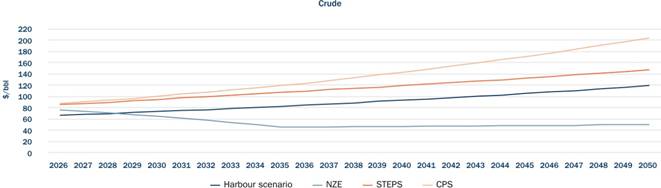
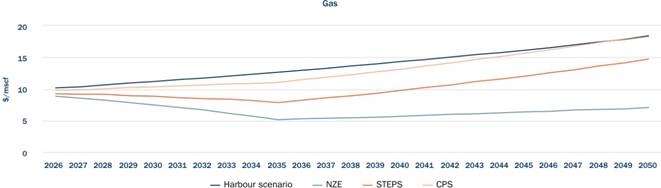
The crude price curves reflect the published IEA price curves for all periods. For UK NBP there are no IEA published price curves therefore management has derived the gas price curves by converting from the published IEA European gas price curve. This was achieved by converting from USD per mmbtu to USD per mscf and applying other known correlation coefficients between the European and UK gas markets. In addition, for the period 2026-2028, the derived gas price curve matches the Harbour scenario price curve to create a scenario that was considered reasonably plausible.
Pre-development assets are recorded in other intangible assets ahead of demonstration of commerciality and recognition of 2P reserves and hence are not included below, however they are subject to the same management rigour with the corporate models. The majority of such assets are in developing countries with a growing future demand for energy which may reduce the climate change impact from these pre-development assets.
The impact of the sensitivities on the carrying value of oil and gas assets and goodwill in the consolidated balance sheet are shown in the table below:
31 December 2025
|
|
|
|
Pre-tax sensitivity (increase)/decrease in carrying value |
|||
|
|
|
|
$ million |
|||
|
|
|
Carrying value |
-10% price to Harbour scenario |
IEA Net Zero Emissions by 2050 (NZE) |
IEA Stated Policies (STEPS) |
IEA Current Policies (CPS) |
|
|
Commodity |
$ million |
||||
|
Goodwill (note 10) |
Crude oil |
5,062 |
171 |
583 |
68 |
53 |
|
Gas |
396 |
1,506 |
882 |
121 |
||
|
Oil and gas assets (note 12) |
Crude oil |
13,114 |
362 |
1,028 |
- |
- |
|
Gas |
116 |
178 |
85 |
50 |
||
31 December 2024
|
|
|
|
Pre-tax sensitivity (increase)/decrease in carrying value |
|||
|
|
|
|
$ million |
|||
|
|
|
Carrying value |
-10% price to Harbour scenario |
IEA Net Zero Emissions by 2050 (NZE) |
IEA Stated Policies (STEPS) |
IEA Announced Pledges (APS) |
|
|
Commodity |
$ million |
||||
|
Goodwill (note 10) |
Crude oil |
5,062 |
45 |
928 |
- |
38 |
|
Gas |
37 |
1,431 |
997 |
1,114 |
||
|
Oil and gas assets (note 12) |
Crude oil |
14,493 |
323 |
2,528 |
- |
415 |
|
Gas |
2 |
131 |
89 |
35 |
||
The -10 per cent price curves used in the Harbour scenarios adjust long-term prices from 2026.
Under the -10 per cent price to Harbour scenario for crude, there is a pre-tax impairment to oil and gas assets of $362 million and on goodwill an impairment of $171 million. For gas, there is a pre-tax impairment of $116 million and on goodwill an impairment of $396 million.
For crude, under the IEA NZE 2050 scenario, there is a pre-tax impairment to oil and gas assets of $1,028 million and on goodwill an impairment of $583 million. For gas, there is a pre-tax impairment to oil and gas assets of $178 million and on goodwill an impairment of $1,506 million.
For crude, under the IEA STEPS, there is a pre-tax impairment to oil and gas assets of $nil and on goodwill an impairment of $68 million. For gas, there is a pre-tax impairment to oil and gas assets of $85 million and on goodwill an impairment of $882 million.
For crude, under the IEA CPS, there is a pre-tax impairment to oil and gas assets of $nil and on goodwill an impairment of $53 million. For gas there is a pre-tax impairment to oil and gas assets of $50 million and on goodwill an impairment of $121 million.
Sensitivity to changes in carbon price assumptions
The sensitivity scenarios described below incorporate changes to the carbon price assumptions and assume that all other factors remain unchanged from the Harbour scenario used for the basis of preparation of the financial statements. This sensitivity is stated before any management mitigation actions to manage downside risks if the scenarios were to occur.
The risk of stranded assets may increase in a higher carbon price scenario. Sensitivity analyses of the carrying value of Harbour's oil and gas assets and goodwill to carbon prices have been conducted based on the IEA NZE 2050 scenario. This aims to demonstrate the resilience of the assets' carrying values to higher long-term carbon prices than those reflected in the consolidated balance sheet.
This analysis covers the transition risks, and the graph below shows the carbon price per tonne for the period to 2050 for the IEA NZE 2050 scenario.
The scenario price curves are dependent on factors covering supply, demand, economic and geopolitical events and therefore are inherently uncertain and subject to significant volatility. As a result, they are unlikely to accurately predict future outcomes.
|
▪ Harbour scenario: base price curves used for impairment testing |
|
▪ IEA Net Zero Emissions by 2050 (NZE): pathway to limiting global temperature rise to 1.5°C |
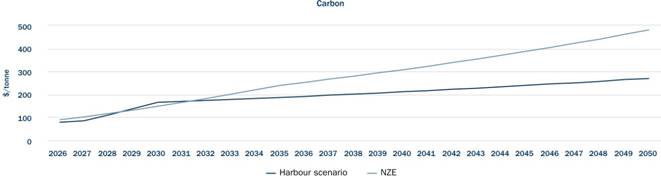
Applying the IEA NZE 2050 carbon price scenario for the entirety of the useful economic life of the assets resulted in a pre-tax impairment of $52 million (2024: $9 million) to oil and gas assets with no impairment to goodwill under this scenario.
Sensitivity to changes in discount rate assumptions
The discount rate applied for impairment testing of the fair value less cost of disposal is based on a nominal post-tax weighted average cost of capital (WACC) after considering both cost of debt and equity. In 2025, the Group's post-tax discount rate ranging from 9.0 per cent to 14.5 per cent (2024: 8.8 per cent to 14.5 per cent) is derived after considering relevant peer group's post-tax WACC and incorporating segment-specific risk.
Considering the discount rates, the Group deems a 1 per cent rise in the discount rate to be a reasonable potentiality for conducting sensitivity analysis, assuming that all other factors utilised in calculating the recoverable value for the carrying amount of goodwill and oil and gas assets remain unaltered.
A 1 per cent increase in the discount rate would result in an additional impairment of $77 million (2024: $113 million) to the oil and gas assets and on goodwill $32 million (2024: $10 million).
Intangible assets - exploration and evaluation assets
The energy transition has the potential to affect the future development or viability of exploration and evaluation prospects. A significant portion of the Group's exploration and evaluation assets relate to prospects that could either be tied back to existing infrastructure or are in developing countries with a growing future demand for energy which may reduce the climate change impact from these pre-development assets and hence require less capital investment as these assets are less exposed to the impacts of the energy transition compared to large frontier developments. At each balance sheet date, all exploration and evaluation prospects are reviewed against the Group's financial framework to ensure that the continuation of activities is planned and expected. There are no significant judgements and/or critical estimation uncertainty related to climate factors.
See Judgements: Exploration and evaluation expenditure for further information.
Deferred tax assets
The potential impact of climate change and energy transition on balance sheet items is uncertain and may lead to significant changes in the estimations of parameters such as the useful life of assets and timing of cessation of production together with their related deferred tax balances.
Deferred tax assets are recognised to the extent that their recovery is considerable probable. In general, it is expected that sufficient forecasted taxable profits will be available for the recovery of deferred tax assets recognised at 31 December 2025 and expected to be recovered within the period of production for each asset and after taking into account deferred tax liabilities.
See note 8 Income tax for information on deferred tax balances.
Onerous contracts
Contracts may become onerous due to potential loss of revenue or heightened costs stemming from changes in climate change and energy transition regulations.
Management does not foresee any of its existing supply contracts becoming onerous based on the current production level and estimated useful lives of its assets.
Decommissioning cost and provisions
The energy transition may accelerate the decommissioning of assets which would result in an increase in the carrying value of associated decommissioning provisions. Whilst the Group currently expects to incur decommissioning costs over the next 40 years, we anticipate the majority of costs will be incurred between the next 10 to 20 years which will reduce the exposure to the impact of the energy transition.
In the current year, the undiscounted provision for decommissioning and restoration was $10.5 billion (2024: $10.5 billion), recognised on a discounted basis in the consolidated balance sheet.
The discount and inflation rates applied have taken into consideration the applicable rig rates and expected timing of cessation of production on each field. Therefore, the timing of decommissioning expenditures has not been materially brought forward and management do not consider that any reasonable change in the timing of decommissioning expenditure will have a material impact on the decommissioning provisions based on the production plans of existing assets.
Decommissioning cost estimates are based on the current regulatory and external environment. These cost estimates and recoverability of associated deferred tax may change in the future, including as a result of the energy transition. On the basis that all other assumptions in the calculation remain the same, a 10 per cent increase in the cost estimates, and a 1 per cent absolute reduction in the applied discount rates used to assess the final decommissioning obligation, would result in increases to the decommissioning provision of approximately $740 million (2024: $852 million) and $312 million (2024: $286 million), respectively. This change would be principally offset by a change to the value of the associated asset unless the asset is fully depreciated, in which case the change in estimate is recognised directly within the income statement.
See Key sources of estimation uncertainty: Decommissioning costs for further information.
Portfolio changes
Harbour expensed $142 million of costs in relation to CO2 emissions during 2025 (2024: $75 million) with the majority in relation to the UK Emissions Trading Scheme quotas net of allocated free quotas. Quotas in relation to future periods are recognised in intangible assets.
Harbour has investments in a number of CCS projects which are regarded as key to assisting in the energy transition. Projects are recognised in intangible assets once the projects are regarded as technically feasible and commercially viable; prior to this, costs are expensed to the income statement. In 2025 Harbour spent $116 million on CCS activities, capitalising $32 million and expensing $84 million.
Global oil and gas demand considerations
The transition to sustainable energy to mitigate climate change carries the potential to adversely impact commodity prices due to a global decrease in the demand for oil and gas, potentially leading to reduced revenue. Furthermore, investment in clean energy via the adoption of clean energy technologies could elevate production costs, thereby diminishing future profit margins.
Based on prevailing policies and regulatory frameworks, it is anticipated that the growth in global oil demand will decrease, but the demand for oil and gas is projected to continue as a crucial component of the energy mix for the foreseeable future. Natural gas is widely known as a key transition fuel. In the 2025 IEA World Energy Outlook report the demand for natural gas has been revised upwards in all scenarios compared to the previous year, reflecting stronger anticipated demand for gas to meet growth in electricity demand.
During the year, the Group produced 474 kboepd (2024: 258 kboepd), accounting for less than 0.4 per cent of global production. Consequently, the Group does not expect the ability to sell the volume of oil equivalent produced to be directly impacted by shifts in global oil and gas demand. Management remains committed to investing in a diversified oil and gas company.
Cost of carbon allowances
Harbour is part of the European and UK Emissions Trading Schemes (EU and UK ETS) and purchases carbon allowances to meet its regulatory obligations under the schemes. Harbour is entitled to receive a share of free allowances according to UK and EU ETS regulations. Allowances owned in excess of liabilities to date that are available to be used in future periods are recorded in other intangible assets and measured at cost. The costs for purchasing allowances are recorded in costs of operations matching emissions for the period. Accruals that are required for allowances to be purchased are measured at market price.
Joint arrangements
A joint arrangement is one in which two or more parties have joint control. Joint control is the contractually agreed sharing of control of an arrangement, which exists only when decisions about the relevant activities require the unanimous consent of the parties sharing control.
Exploration and production operations are usually conducted through joint arrangements with other parties. The Group reviews all joint arrangements and classifies them as either joint operations or joint ventures depending on the rights and obligations of each party to the arrangement and whether the arrangement is structured through a separate vehicle. The Group's interest in joint operations, such as exploration and production arrangements, are accounted for by recognising its:
|
▪ Assets, including its share of any assets held jointly |
|
▪ Liabilities, including its share of any liabilities incurred jointly |
|
▪ Revenue from the sale of its share of the output arising from the joint operation |
|
▪ Share of the revenue from the sale of the output by the joint operation |
|
▪ Expenses, including its share of any expenses incurred jointly |
A joint venture, which normally involves the establishment of a separate legal entity, is a contractual arrangement whereby the parties that have joint control of the arrangement have the rights to the arrangement's net assets. The results, assets and liabilities of a joint venture are incorporated in the consolidated financial statements using the equity method of accounting. Note 34 describes the Group's interests in joint arrangements as at 31 December 2025.
Where the Group transacts with its joint operations, unrealised profits and losses are eliminated to the extent of the Group's interest in the joint operation.
Foreign currency translation
Each entity in the Group determines its own functional currency, being the currency of the primary economic environment in which the entity operates, and items included in the financial statements of each entity are measured using that functional currency.
The consolidated financial statements are presented in US dollars, which is also the parent company's functional currency.
Transactions recorded in foreign currencies are initially recorded in the entity's functional currency by applying an average rate of exchange. Monetary assets and liabilities denominated in foreign currencies are retranslated at the functional currency rate of exchange ruling at the reporting date. All differences are taken to the income statement.
Non-monetary assets and liabilities denominated in foreign currencies are measured at historic cost based on exchange rates at the date of the initial transaction and subsequently not retranslated.
On consolidation, the assets and liabilities of the Group's operations are translated at exchange rates prevailing on the balance sheet date. Income and expense items are translated at the average monthly exchange rates for the year. Equity is held at historic cost and is not retranslated. The resulting exchange differences are recognised as other comprehensive income and are transferred to the Group's currency translation reserve.
When an overseas operation is disposed of, such translation differences relating to it are recognised as income or expense.
Goodwill arising on the acquisition of a foreign operation and any fair value adjustments to the carrying amounts of assets and liabilities arising on the acquisition are treated as assets and liabilities of the foreign operation and translated at the closing rate.
Goodwill
In the event of a business combination or acquisition of an interest in a joint operation in which the activity constitutes a business, as defined in IFRS 3 Business Combinations, the acquisition method of accounting is applied. Goodwill represents the difference between the aggregate of the fair value of purchase consideration transferred at the acquisition date and the fair value of the identifiable assets, liabilities and contingent liabilities acquired, less any non-controlling interest. If however, the fair value of the purchase consideration transferred is lower than the fair value of the identifiable assets and liabilities acquired, less non-controlling interest, the difference is recognised in the income statement as negative goodwill. The Group's goodwill is related to the requirement to recognise deferred tax for the difference between the assigned fair values and the related tax base (technical goodwill). The fair value of the Group's licences are based on post-tax cash flows or benchmarked multiples. In accordance with IAS 12 paragraphs 15 and 24, a provision is made for deferred tax corresponding to the difference between the acquisition cost and the transferred tax depreciation basis. The offsetting entry to this deferred tax is goodwill. Hence, goodwill arises as a technical effect of deferred tax. Goodwill is initially measured at cost. Following initial recognition, goodwill is measured at cost less any accumulated impairment. Goodwill acquired in a business combination is, from the acquisition date, allocated to each of the Group's operating segments. This is subsequently tested for impairment at the Group's operating segment level based on the aggregation of any headroom arising from asset impairment tests. Goodwill is treated as an asset of the relevant entity to which it relates, and accordingly non-US dollar goodwill is translated into US dollars at the closing rate of exchange at each reporting date.
Goodwill, as disclosed in note 10, is not amortised but is reviewed for impairment at least annually by assessing the recoverable amount of the operating segments to which the goodwill relates. Where the carrying amount of the operating segment and related goodwill is higher than the recoverable amount of the operating segment, an impairment loss is recognised in the income statement. The recoverable amounts of the operating segments have been determined on a fair value less costs to sell basis. Impairments are expected to arise as the deferred tax that gave rise to the goodwill initially naturally unwinds in the normal course of business. Impairment losses relating to goodwill cannot be reversed in future periods.
Pre-licence costs
Pre-licence costs are expensed in the period in which they are incurred.
Licence and property acquisition costs
Licence and property acquisition costs paid in connection with a right to explore in an existing exploration area are capitalised as exploration and evaluation costs within intangible assets.
Licence and property acquisition costs are reviewed at each reporting date to confirm that there is no indication that the carrying amount exceeds the recoverable amount. If no future activity is planned or the related licence has been relinquished or has expired, the carrying value of the property acquisition costs is written off through the income statement. Upon recognition of proved reserves and internal approval for development, the relevant expenditure is transferred to oil and gas properties within development and production assets.
Exploration and evaluation costs
Once the legal right to explore has been acquired, costs directly associated with the exploration are capitalised as exploration and evaluation (E&E) intangible non-current assets until the exploration is complete and the results have been evaluated. If no potential commercial resources are discovered, the exploration asset is written off.
All such capitalised costs are subject to technical, commercial and management review, as well as review for indicators of impairment at least annually. This is to confirm the continued intent to develop or otherwise extract value from the discovery. When this is no longer the case, the costs are written off through the income statement.
When proved reserves of oil or natural gas are identified and development is sanctioned by management, the relevant capitalised expenditure is first assessed for impairment and, if required, any impairment loss is recognised, then the remaining balance is transferred to oil and gas properties within development and production assets. No amortisation is charged during the exploration and evaluation phase.
Farm-outs - in the exploration and evaluation phase
The Group does not record any expenditure made by the farmee on its account. It also does not recognise any gain or loss on its exploration and evaluation farm-out arrangements but re-designates any costs previously capitalised in relation to the whole interest as relating to the partial interest retained. Any cash consideration received directly from the farmee is credited against costs previously capitalised in relation to the whole interest with any excess accounted for by the farmor as a gain on disposal.
Property, plant and equipment - oil and gas assets
Oil and gas development and production assets are accumulated generally on a field-by-field or cash-generating unit basis where infrastructure is shared. This represents expenditure on the construction, installation or completion of infrastructure facilities such as platforms, pipelines and the drilling of development wells, including E&E expenditures incurred in finding commercial reserves transferred from intangible E&E assets, as outlined in the intangible asset policy above, which is capitalised as oil and gas properties within development and production assets.
The initial cost of an asset comprises its purchase price or construction cost, any costs directly attributable to bringing the asset into operation, the initial estimate of the decommissioning obligation and, for qualifying assets, where relevant, borrowing costs. The purchase price or construction cost is the aggregate amount paid and the fair value of any other consideration given to acquire the asset.
An item of development and production expenditure and any significant part initially recognised is derecognised upon disposal or when no future economic benefits are expected. Any gain or loss arising on derecognition of the asset (calculated as the difference between the net disposal proceeds and the carrying amount of the asset) is included in the income statement.
Expenditure on major maintenance includes refits, inspections or repairs comprising the cost of replacement assets or parts of assets, inspection costs and overhaul costs. Where an asset, or part of an asset, that was separately depreciated and is now written off is replaced and it is probable that future economic benefits associated with the item will flow to the Group, the expenditure is capitalised. All other day-to-day repairs and maintenance costs are expensed as incurred.
Depreciation, depletion and amortisation (DD&A) of oil and gas assets
All costs relating to a development are accumulated and not depreciated until the commencement of production. Depreciation is provided generally on a field-by-field or cash-generating unit basis where infrastructure is shared, using the unit of production method by reference to the ratio of production in the year and the related commercial proven and probable reserves of the field, considering future development expenditures necessary to bring those reserves into production.
When there is a change in the estimated total recoverable proven and probable reserves of a field, that change is accounted for in the depreciation charge over the revised remaining proven and probable reserves.
Acquisitions, asset purchases and disposals
Acquisitions of oil and gas properties are accounted for using the acquisition method when the assets acquired and liabilities assumed constitute a business.
Transactions involving the purchase of an individual field interest, or a group of field interests, which do not constitute a business, are treated as asset purchases irrespective of whether the specific transactions involve the transfer of the field interests directly or the transfer of an incorporated entity. Accordingly, no goodwill and no deferred tax gross up arises, and the consideration is allocated to the assets and liabilities purchased on an appropriate basis.
Proceeds on disposal are applied to the carrying amount of the specific intangible asset or oil and gas property disposed of and any surplus is recorded as a gain on disposal in the income statement.
Decommissioning
A provision for decommissioning is recognised in full when the related facilities are installed. The amount recognised is the present value of the estimated future expenditure. A corresponding amount equivalent to the provision is also recognised as part of the cost of the related oil and gas property. This is subsequently depreciated as part of the capital costs of the production facilities. Any change in the present value of the estimated expenditure is dealt with from the start of the financial year as an adjustment to the opening provision and the oil and gas property. The unwinding of the discount is included as a finance cost.
Non-oil and gas assets
Property, plant and equipment - fixtures and fittings and office equipment
Fixtures and fittings and office equipment are stated at cost less accumulated depreciation and impairment. Depreciation is provided for on a straight-line basis at rates sufficient to write off the cost of the assets less any residual value over their estimated useful economic lives. The depreciation periods for the principal categories of assets are as follows:
|
▪ Buildings 6 to 50 years |
|
▪ Fixtures and fittings 10 to 23 years |
|
▪ Office furniture and equipment 1 to 13 years |
Intangible assets
Intangible assets principally comprise IT software/licences and carbon allowances. IT software/licences are carried at cost less any accumulated amortisation. These assets are amortised on a straight-line basis over their useful economic lives of between three and ten years. Carbon allowances are carried at cost and subject to impairment testing.
Impairment of non-current assets (excluding goodwill)
In accordance with IAS 36 Impairment of Assets, impairment tests are carried out on items of property, plant and equipment and intangible assets where there is an indicator of impairment, or an indicator identified that a prior year impairment may have reversed or decreased. Such indications may be based on events or changes in the market environment, or on internal sources of information.
Impairment and reversal indicators
Property, plant and equipment and intangible assets with finite useful lives are only tested for impairment when there is an indication that they may be impaired. This is generally the result of significant changes to the environment in which the assets are operated or when asset performance is significantly lower than expected.
The main impairment indicators used by the Group are described below:
|
▪ External sources of information: |
|
− Significant changes in the economic, technological, political or market environment in which the entity operates or to which an asset is dedicated |
|
− Fall in demand |
|
− Changes in commodity prices and exchange rates |
|
▪ Internal sources of information: |
|
− Evidence of obsolescence or physical damage |
|
− Significantly lower than expected production or cost performance |
|
− Reduction in reserves and resources, including as a result of unsuccessful results of drilling operations |
|
− Pending expiry of licence or other rights |
|
− In respect of capitalised exploration and evaluation costs, lack of planned future activity on the prospect or licence |
|
− For reversals, plausible downside sensitivity scenarios are run to test the robustness of the asset carrying values typically against changes in production and commodity prices |
Measurement of recoverable amount
The cash-generating unit (CGU) applied for impairment test purposes is generally the field, except that a number of field interests may be grouped as a single CGU where the cash inflows of each field are interdependent. The carrying value of each CGU is compared against the expected recoverable amount of the asset, which is primarily determined based on the fair value less cost of disposal (FVLCD) method, where the fair value is determined from the estimated present value of the future net cash flows expected to be derived from production of commercial reserves. Standard valuation techniques are used based on the discount rates that reflect the specific characteristics of the operating entities concerned; discount rates are determined on a post-tax basis and applied to post-tax cash flows.
Any impairment loss is recorded in the income statement under 'Impairment of property, plant and equipment'. Impairment losses recorded in relation to property, plant and equipment may be subsequently reversed if the recoverable amount of the assets subsequently increases above carrying value. The increased carrying amount of an item of property, plant or equipment attributable to a reversal of an impairment loss may not exceed the carrying amount that would have been determined (net of depreciation/amortisation) had no impairment loss been recognised in prior periods.
Non-current assets held for sale
The Group classifies non-current assets and disposal groups as assets held for sale if their carrying amounts will be recovered principally through a sale transaction rather than through continuing use. Non-current assets and disposal groups classified as held for sale are measured at the lower of their carrying amount and fair value less costs to sell. Costs to sell are the incremental costs directly attributable to the disposal group, excluding finance costs and income tax expense. The criteria for held for sale classification is regarded as met only when the sale is highly probable, and the asset or disposal group is available for immediate sale in its present condition. Management must be committed to the plan to sell the asset and the sale expected to be completed within one year from the date of the classification. Actions required to complete the sale should indicate that it is unlikely that significant changes to the sale will be made or that the decision to sell will be withdrawn. Property, plant and equipment and intangible assets are not depreciated or amortised once classified as assets held for sale. Assets and liabilities classified as held for sale are presented separately as current line items in the balance sheet.
Financial assets
The Group uses two criteria to determine the classification of financial assets: the Group's business model and contractual cash flow characteristics of the financial assets. Where appropriate the Group identifies three categories of financial assets: amortised cost, fair value through profit or loss (FVTPL), and fair value through other comprehensive income (FVOCI).
Financial assets held at amortised cost
Financial assets held at amortised cost are initially measured at fair value plus transaction costs and subsequently measured using the effective interest rate (EIR) method and are subject to impairment. The EIR amortisation is presented within finance income in the income statement.
Cash and cash equivalents
Cash and cash equivalents comprise cash at bank and other short-term highly liquid investments that are held for the purpose of meeting short-term cash commitments, readily convertible to a known amount of cash and are subject to an insignificant risk of changes in value.
Impairment of financial assets
The Group recognises an allowance for expected credit losses (ECLs) for all debt instruments not held at FVTPL. ECLs are based on the difference between the contractual cash flows due in accordance with the contract and all the cash flows that the Group expects to receive, discounted at an approximation of the original effective interest rate.
ECLs are recognised in two stages:
|
▪ 12-month ECL: for credit exposures for which there has not been a significant increase in credit risk since initial recognition, ECLs are provided for credit losses that result from default events (payment, prospective or covenant) that are possible within the next 12 months |
|
▪ Lifetime ECL: for those credit exposures for which there has been a significant increase in credit risk since initial recognition, a loss allowance is required for credit losses expected over the remaining life of the exposure, irrespective of the timing of the default |
For trade receivables and contract assets, the Group applies a simplified approach in calculating ECLs as allowed under IFRS 9 Financial Instruments. Therefore, the Group does not track changes in credit risk, but instead recognises a loss allowance based on lifetime ECLs at each reporting date. The Group has established a provision matrix that is based on its historical credit loss experience, adjusted for forward-looking factors specific to the debtors and the economic environment.
Credit impaired financial assets
At each reporting date, the Group assesses whether financial assets carried at amortised cost and debt financial assets carried at FVOCI are credit impaired. A financial asset is 'credit impaired' when one or more events that have a detrimental impact on the estimated future cash flows of the financial asset have occurred.
Evidence that a financial asset is credit impaired includes the following observable data:
|
▪ Significant financial difficulty of the borrower or issuer |
|
▪ A breach of contract such as default or past due event |
|
▪ The restructuring of a loan or advance by the Group on terms that the Group would otherwise not consider |
|
▪ Becoming probable that the borrower will enter bankruptcy or other financial reorganisation |
|
▪ The disappearance of an active market for a security because of financial difficulties |
Financial liabilities
Financial liabilities are classified, at initial recognition, as financial liabilities at fair value through profit or loss, loans and borrowings, payables, or as derivatives designated as hedging instruments in an effective hedge, as appropriate. All financial liabilities are recognised initially at fair value and, in the case of loans, borrowings and payables, net of directly attributable transaction costs which are capitalised and amortised over the term of the borrowings. Where borrowings have been fully repaid but the borrowing facility remains, directly attributable transaction costs that remain unamortised are presented within current and/or non-current assets.
Borrowings and loans
Interest-bearing bank loans and overdrafts are recorded at the proceeds received, net of direct issue costs. Finance charges, including premiums payable on settlement or redemption and direct issue costs, are accounted for on an accruals basis in the income statement using the effective interest method and are added to the carrying amount of the instrument to the extent that they are not settled in the year in which they arise.
Subordinated notes
The Group holds subordinated resettable fixed rate notes (subordinated notes). Based on their characteristics (mainly no mandatory repayment and no obligation to pay a coupon except under certain circumstances specified in the documentation of the subordinated notes) and in compliance with IAS 32 Financial Instruments: Presentation, the subordinated notes are wholly classified as equity. On completing the Wintershall Dea acquisition in 2024, the issued subordinated notes were recognised at fair value, based on market rates as of the acquisition date. Accrued interest payable to the subordinated notes investors increases equity, whereas the distribution of interest payments reduces equity.
Derecognition
A financial liability is derecognised when the obligation under the liability is discharged, cancelled or expires. When an existing financial liability is replaced by another from the same lender on substantially different terms, or the terms of an existing liability are substantially modified, such an exchange or modification is treated as the derecognition of the original liability and the recognition of a new liability. The difference in the respective carrying amounts is recognised in the income statement.
Derivative financial instruments and hedge accounting
The Group uses derivative financial instruments such as forward currency contracts, interest rate swaps, commodity option contracts and commodity swap arrangements, to hedge its foreign currency risks, interest rate risks and commodity price risks, respectively. Derivative financial instruments are initially recognised and subsequently remeasured at fair value.
A derivative with a positive fair value is recognised as a financial asset whereas a derivative with a negative fair value is recognised as a financial liability. Derivatives are not offset in the financial statements unless the Group has both a legally enforceable right and intention to offset. A derivative is presented as a non-current asset or a non-current liability if the remaining maturity of the instrument is more than 12 months and it is not due to be realised or settled within 12 months. Other derivatives maturing in less than 12 months and expected to be realised or settled in less than 12 months are presented as current assets or current liabilities.
For the purpose of hedge accounting, hedges are classified as:
|
▪ Fair value hedges when hedging exposure to changes in the fair value of a recognised asset or liability |
|
▪ Cash flow hedges when hedging exposure to variability in cash flows that is attributable to either a particular risk associated with a recognised asset or liability or a highly probable forecast transaction. |
Hedge relationships are formally designated and documented at inception, together with the risk management objective and strategy for undertaking the hedge. The documentation includes identification of the hedging instrument, the hedged item or transaction, the nature of the risk being hedged, the existence at inception of an economic relationship and subsequent measurement of the hedging instrument's effectiveness in offsetting the exposure to changes in the hedged item's fair value or cash flows attributable to the hedged risk, the hedge ratio and sources of hedge ineffectiveness. Hedges meeting the criteria for hedge accounting are accounted for as follows:
Fair value hedges
The change in fair value of a hedging derivative is recognised in the income statement. The change in the fair value of the hedged item attributable to the risk being hedged is recorded as part of the carrying value of the hedged item and is also recognised in the income statement, where it offsets. The Group applies fair value hedge accounting when hedging interest rate risk on fixed rate finance debt.
Fair value hedge accounting is discontinued only when the hedging relationship or a part thereof ceases to meet the qualifying criteria. This includes when the risk management objective changes or when the hedging instrument is terminated or exercised. The accumulated adjustment to the carrying amount of a hedged item at such time is then amortised prospectively to the income statement as finance interest expense over the hedged item's remaining period to maturity.
Cash flow hedges
The effective portion of the gains and losses arising from the remeasurement of derivative financial instruments designated as cash flow hedges are deferred within other comprehensive income and subsequently transferred to the income statement in the period the hedged transaction is recognised in the income statement. When a hedging instrument is sold or expires, any cumulative gain or loss previously recognised in other comprehensive income remains deferred until the hedged item affects profit or loss or is no longer expected to occur. Any gain or loss relating to the ineffective portion of a cash flow hedge is immediately recognised in the income statement. Hedge ineffectiveness could arise if volumes of the hedging instruments are greater than the hedged item of production, or where the creditworthiness of the counterparty is significant and may dominate the transaction and lead to losses.
Cash flow hedge accounting is discontinued only when the hedging relationship or a part thereof ceases to meet the qualifying criteria. This includes when the designated hedged forecast transaction or part thereof is no longer considered to be highly probable to occur, or when the hedging instrument is sold, terminated or exercised without replacement or rollover. When cash flow hedge accounting is discontinued amounts previously recognised within other comprehensive income remain in equity until the forecast transaction occurs and are reclassified to profit or loss. If the forecast transaction is no longer expected to occur, amounts previously recognised within other comprehensive income will be immediately reclassified to profit or loss.
Fair values
Fair value is defined as the price that would be received to sell an asset or paid to transfer a liability in an orderly transaction between market participants at the measurement date. It is determined by reference to quoted market prices adjusted for estimated transaction costs that would be incurred in an actual transaction, or by the use of established estimation techniques such as option pricing models and estimated discounted values of cash flows.
For financial instruments not traded in an active market, the fair value is determined using appropriate valuation techniques.
Under IFRS 9 Financial Instruments, embedded derivatives are not separated from a host financial asset, and are classified based on their contractual terms and the Group's business model.
Equity
Share capital
Share capital includes the total net proceeds, both nominal and share premium, on the issue of ordinary (voting and non-voting) and preference shares of the company.
Merger reserve
On 31 March 2021, Harbour Energy plc (formerly Premier Oil plc) acquired Chrysaor Holdings Limited as part of a reverse acquisition. Under the terms of the merger, Premier legally acquired Chrysaor through the issuance of consideration shares whilst Chrysaor was the acquirer for accounting purposes, primarily as a result of its ability to appoint the Board of the enlarged group. The merger reserve primarily represented Premier's opening balance on the legal reserve plus the fair value of the assets and liabilities acquired by Chrysaor. This was subsequently reduced following a capital restructuring in 2022.
On 3 September 2024, the company's acquisition of the Wintershall Dea assets met the conditions to recognise the difference between the fair value and nominal value of the shares issued as consideration as merger reserve.
Capital redemption reserve
The capital redemption reserve represents the nominal value of shares transferred following the company's purchase of them.
Cash flow hedge reserve
The cash flow hedge and cost of hedging reserves represent gains and losses on derivatives classified as effective cash flow hedges. Upon the designation of option instruments as hedging instruments, the intrinsic and time value components are separated, with only the intrinsic component being designated as the hedging instrument and the time value component is deferred in other comprehensive income as a 'cost of hedging'.
Currency translation reserve
This reserve comprises exchange differences arising on consolidation of the Group's operations with a functional currency other than the US dollar.
Share-based payments
The Group's main share incentive plans allow employees to acquire shares in the parent company, subject to certain criteria, and are classified as equity-settled in accordance with IFRS 2 Share-Based Payments.. The fair value of the equity-settled awards has been determined at the date of grant of the award allowing for the effect of any market-based conditions. The fair value determined at the grant date of the equity-settled share-based payments is expensed on a straight-line basis over the vesting period with a corresponding increase directly in equity, based on the Group's estimate of shares that will eventually vest and adjusted for the effect of non-market-based vesting conditions.
Employee benefit trust
Shares held in the Employee Share Ownership Plan (ESOP) to meet the future requirements of the employee share-based payment plans are not included in assets but are reflected at cost as a deduction from retained earnings. No gain or loss is recognised in the income statement on the purchase, issue or cancellation of equity shares.
Recharge arrangements
The Group operates an intercompany recharge mechanism whereby subsidiaries reimburse the parent company for share-based payments granted under IFRS 2. These recharges are directly linked to the share-based payment transactions. Subsidiaries adjust the initial capital contribution when reimbursing the parent company, while the parent company adjusts its investment in the subsidiaries, resulting in nil net impact on the parent company's carrying value of investments. All reciprocal entries are eliminated on consolidation.
Inventories
Consumables and subsea supplies are stated at the lower of cost and net realisable value. The cost of materials is the purchase cost, determined on weighted average cost basis. Hydrocarbons, including underlift and overlift positions, are measured at net realisable value using an observable year-end oil or gas market price, and are included in other debtors or creditors, respectively.
Leases
Leases are recognised as a right-of-use asset and a corresponding liability at the date at which the leased asset is available for use by the Group.
Right-of-use assets are measured at cost, less any accumulated depreciation and impairment losses, and adjusted for any remeasurement of lease liabilities. The cost of right-of-use assets includes the amount of lease liabilities recognised, initial direct costs incurred, and lease payments made at or before the commencement date less any lease incentives received. Right-of-use assets are depreciated on a straight-line basis over the shorter of the lease term and the estimated useful lives of the assets which are no more than ten years.
The Group recognises right-of-use assets and lease liabilities on a gross basis and the recovery of lease costs from joint operations' partners is recorded as other income.
Liabilities arising from a lease are initially measured on a present value basis reflecting the net present value of the fixed lease payments and amounts expected to be payable by the Group assuming leases run to full term. The Group has applied judgement to determine the lease term for some lease contracts in which it is a lessee that include renewal options. The assessment of whether the Group is reasonably certain to exercise such options impacts the lease term, which significantly impacts the amount of lease liabilities and right-of-use assets recognised.
The lease payments are discounted at the lease commencement date using the Group's incremental borrowing rates of between 0.9 per cent and 28.5 per cent, being the rate that the Group would have to pay to borrow the funds necessary to obtain an asset of similar value in a similar economic environment with similar terms and conditions.
To determine the incremental borrowing rate, the Group where possible:
|
▪ Uses recent third-party financing received by the individual lessee as a starting point, adjusted to reflect changes in financing conditions since third-party financing was received |
|
▪ Makes adjustments specific to the lease, for example term, country, currency and security |
The Group is exposed to potential future increases in variable lease payments based on an index or rate, which are not included in the lease liability until they take effect. When adjustments to lease payments based on an index or rate take effect, the lease liability is reassessed and adjusted against the right-of-use asset.
Lease payments are allocated between principal and finance cost. The finance cost is charged to the income statement over the lease period so as to produce a constant periodic rate of interest on the remaining balance of the liability for each period.
Payments associated with short-term leases and leases of low value assets are recognised on a straight-line basis as an expense in the income statement. Short-term leases are leases with a lease term of 12 months or less.
For lease arrangements where all partners of a joint operation are considered to share the primary responsibility for lease payments under a lease contract, the Group recognises its share of the respective right-of-use asset and lease liability. This situation is most common where the parties of a joint operation co-sign the lease contract.
The Group recognises a gross lease liability for leases entered into on behalf of a joint operation where it has primary responsibility for making the lease payments. In such instances, if the arrangement between the Group and the joint operation represents a finance sublease, the Group recognises a net investment in sublease for amounts recoverable from non-operators whilst derecognising the respective portion of the gross right-of-use asset. The gross lease liability is retained on the balance sheet.
The net investment in sublease is classified as either trade and other receivables or long-term receivables on the balance sheet according to whether or not the amounts will be recovered within 12 months of the balance sheet date. Finance income is recognised in respect of net investment in subleases.
Provisions for liabilities
A provision is recognised when the Group has a legal or constructive obligation as a result of a past event, it is probable that an outflow of resources embodying economic benefits will be required to settle the obligation and a reliable estimate can be made of the amount of the obligation.
The expense relating to any provision is presented in the income statement net of any reimbursement. If the effect of the time value of money is material, provisions are discounted using a current pre-tax rate that reflects, where appropriate, the risk specific to the liability. Where discounting is used, the increase in the provision due to the passage of time is recognised as part of finance costs in the income statement.
The estimated cost of dismantling and restoring the production and related facilities at the end of the economic life of each field is recognised in full when the related facilities are installed. The amount provided is the present value of the estimated future restoration cost. A non-current asset is also recognised. Any changes to estimated costs or discount rates are dealt with prospectively.
The Group recognises a provision for the estimated CO2 emissions costs when actual emissions exceed the emission rights granted and still held. When actual emissions exceed the amount of emission rights granted, a provision is recognised for the exceeding emission rights based on the purchase price of allowances concluded in forward contracts or market quotations at the reporting date.
Group retirement benefits
The Group's various pension plans consist of both defined benefit and defined contribution plans. Payments to defined contribution retirement benefit plans are charged as an expense as they fall due. Payments made to state-managed retirement benefit schemes are dealt with as payments to defined contribution plans where the Group's obligations under the schemes are equivalent to those arising in a defined contribution retirement benefit plan.
The Group operates a defined benefit pension scheme, which requires contributions to be made to a separately administered fund. The cost of providing benefits is determined using the projected unit credit method, with actuarial valuations being carried out at each balance sheet date. Actuarial gains and losses are recognised immediately in the statement of comprehensive income.
The retirement benefit obligation recognised in the balance sheet represents the present value of the defined benefit obligation as reduced by the fair value of plan assets. Any asset resulting from this calculation is limited to the present value of available refunds and reductions in future contributions to the plan.
The Group participates in a legally independent multi-employer plan which is financed by employer and employee contributions as well as the return on plan assets. Since sufficient information is not available for this multi-employer plan, the Group accounts for the plan as if it was a defined contribution plan.
In the case of contribution-based defined benefit pension plans, the Group makes contribution payments to special-purpose funds as well as to life insurances. These contribution payments are recorded as expenses. Furthermore, for some of the Group's contribution-based defined benefit pension plans, benefit obligations are recognised at the fair value of these funds, so far as the assets exceed the guaranteed minimum benefit amount.
If the assets do not exceed the guaranteed minimum benefit amount, benefit obligations for these contribution-based benefit plans are recognised in the guaranteed minimum benefit amount.
The defined benefit plans are administered by a separate fund that is legally separated from the Group. The trustees of the pension fund are required by law to act in the interest of the fund and of all relevant stakeholders in the plans.
Trade payables
Initial recognition of trade payables is at fair value. Subsequently they are stated at amortised cost.
Taxes
Current tax
Current tax assets and liabilities for the current and prior periods are measured at the amount expected to be recovered from or paid to the taxation authorities. The tax rates and laws used to compute the amount are those that are enacted or substantively enacted at the reporting date in the countries where the Group operates and generates taxable income.
Current income tax related to items recognised directly in other comprehensive income or equity is recognised in other comprehensive income or directly in equity, not in the income statement.
Management periodically evaluates positions taken in the tax returns with respect to situations in which tax regulations are subject to interpretation and establishes provisions where appropriate.
Deferred tax
Deferred taxation is recognised in respect of all temporary differences arising between the tax bases of the assets and liabilities and their carrying amounts in the financial statements with the following exceptions:
|
▪ When the deferred tax liability arises from the initial recognition of goodwill or an asset or liability in a transaction that is not a business combination and, at the time of the transaction, affects neither the accounting profit nor taxable profit or loss and does not give rise to equal taxable and deductible temporary differences |
|
▪ In respect of taxable temporary differences associated with investments in subsidiaries, associates and interests in joint arrangements, when the timing of the reversal of the temporary differences can be controlled and it is probable that the temporary difference will not reverse in the foreseeable future |
Deferred tax assets are recognised for all deductible temporary differences, the carry forward of unused tax credits and any unused tax losses. Deferred income tax assets are recognised only to the extent that it is probable that the taxable profit will be available against which the deductible temporary difference, carried forward tax credits or tax losses can be utilised.
Deferred income tax assets and liabilities are measured on an undiscounted basis at the tax rates that are expected to apply when the related asset is realised or liability is settled, based on tax rates and laws enacted or substantively enacted at the reporting date. The carrying amount of the deferred income tax asset is reviewed at each balance sheet date and reduced to the extent that it is no longer probable that sufficient taxable profits will be available to allow all or part of the asset to be recovered. The Group reassesses any unrecognised deferred tax assets each year taking into account changes in oil and gas prices, the Group's proven and probable reserves and resources profile and forecast capital and operating expenditures.
Deferred income tax assets and liabilities are offset only if a legally enforceable right exists to offset current assets against current tax liabilities, the deferred income tax relates to the same tax authority and that same tax authority permits the Group to make a single net payment.
Deferred tax is charged or credited in the income statement, except when it relates to items charged or credited in other comprehensive income, in which case the deferred tax is also dealt with in other comprehensive income.
Where deferred tax assets are recognised for temporary differences arising between the tax base of the Group's share incentive plans and their carrying value, to the extent that the future tax deduction exceeds the related cumulative IFRS 2 expense, the excess movement on the associated deferred tax balance is dealt with directly in equity. To the extent that the future tax deduction is less than or equal to the cumulative IFRS 2 expense, the movement on the associated deferred tax balance is charged or credited in the income statement.
Revenue from contracts with customers
Revenue from contracts with customers is recognised when the Group satisfies a performance obligation by transferring a good or service to a customer. A good or service is transferred when the customer obtains control of that good or service. Revenue associated with the sale of crude oil, natural gas and natural gas liquids (NGLs) is measured based on the consideration specified in contracts with customers with reference to quoted market prices in active markets, adjusted according to specific terms and conditions as applicable according to the sales contracts. The transfer of control of oil, natural gas, natural gas liquids and other items sold by the Group occurs when title passes at the point the customer takes physical delivery. The Group principally satisfies its performance obligations at a point in time and the amounts of revenue recognised relating to performance obligations satisfied over time are not significant.
The Group engages in sleeve and optimisation gas trading activities as part of its broader commodity risk management and commercial strategy. Contracts are evaluated based on their intent and usage. Where contracts are entered into and held for the purpose of generating profit from short-term market movements or dealer margins, they are classified as held for trading and recognised as derivatives. Gains and losses from these derivative contracts related to revenue and costs associated with other contracts that are classified as held primarily for the purpose of being traded are reported on a net basis as other operating income in the consolidated income statement.
Over/underlift
Differences between the production sold and the Group's share of production result in an overlift or an underlift. Underlift positions are measured at net realisable value using an observable year-end oil or gas market price. Overlift positions are measured using the sales price that generated the overlift. Underlift and overlift positions are included in receivables or payables respectively. Movements during the accounting period are recognised within cost of sales.
Interest income
Interest income is recognised on an accruals basis, by reference to the principal outstanding and at the effective interest rate applicable.
Borrowing costs
Borrowing costs directly attributable to the acquisition, construction or production of an asset that necessarily takes a substantial period of time to get ready for its intended use or sale (a qualifying asset) are capitalised as part of the cost of the respective assets. Where the funds used to finance a project form part of general borrowings, the amount capitalised is calculated using a weighted average of rates applicable to relevant general borrowings of the Group during the period. All other borrowing costs are recognised in the income statement in the period in which they are incurred.
New accounting standards and interpretations
Management anticipates that all relevant pronouncements will be adopted for the first period beginning on or after the effective date of the pronouncement. New standards, amendments and interpretations not adopted in the current year have not been disclosed as they are not expected to have a material impact on the consolidated financial statements.
Amendments issued and effective in the current year
The Group applied for the first-time certain standards and amendments, which are effective for annual periods beginning on or after 1 January 2025 (unless otherwise stated).
Lack of exchangeability - Amendments to IAS 21
For annual reporting periods beginning on or after 1 January 2025, Lack of Exchangeability - Amendments to IAS 21 The Effects of Changes in Foreign Exchange Rates specifies how an entity should assess whether a currency is exchangeable and how it should determine a spot exchange rate when exchangeability is lacking. The amendments also require disclosure of information that enables users of its financial statements to understand how the currency not being exchangeable into the other currency affects, or is expected to affect, the entity's financial performance, financial position and cash flows.
The amendments had no impact on the consolidated financial statements.
Standards issued but not yet effective
The Group has not early adopted any other standard, interpretation or amendment that has been issued but is not yet effective.
IFRS 18 Presentation and Disclosure in Financial Statements
In April 2024, the IASB issued IFRS 18, which replaces IAS 1 Presentation of Financial Statements. IFRS 18 introduces new requirements for presentation within the statement of profit or loss, including specified totals and subtotals. Furthermore, entities are required to classify all income and expenses within the statement of profit or loss into one of five categories: operating, investing, financing, income taxes and discontinued operations, whereof the first three are new.
The standard requires disclosure of newly defined management-defined performance measures, subtotals of income and expenses, and it also includes new requirements for aggregation and disaggregation of financial information based on the identified 'roles' of the primary financial statements and the associated notes.
In addition, narrow-scope amendments have been made to IAS 7 Statement of Cash Flows, which include changing the starting point for determining cash flows from operations under the indirect method, from 'profit or loss' to 'operating profit or loss' and removing the optionality around classification of cash flows from dividends and interest. In addition, there are consequential amendments to several other standards.
IFRS 18, and the amendments to the other standards, are effective for reporting periods beginning on or after 1 January 2027, but earlier application is permitted and must be disclosed. IFRS 18 will apply retrospectively.
The Group is currently working to identify all impacts the amendments will have on the primary financial statements and notes to the financial statements. The initial expected material impacts on Group's financial statements are as follows:
|
▪ Foreign exchange difference will be classified in the category where the related income and expense form the item giving rising to the foreign exchange difference. |
|
▪ New disclosure will be added: (a) management-defined performance measures; and (b) a reconciliation for each line item in the statement of profit or loss between the restated amounts presented applying IFRS 18 and the amounts previously presented applying IAS 1. |
Additional standards issued but not yet effective
Other standards and amendments that are not yet effective and have not been adopted early by the Group include:
|
▪ Amendments to the Classification and Measurement of Financial Instruments (Amendments to IFRS 9 and 7). The Amendments are effective for annual periods starting on or after 1 January 2026; |
|
▪ Contracts Referencing Nature-dependent Electricity (Amendments to IFRS 9 and IFRS 7). The amendments will take effect for annual reporting periods starting on or after 1 January 2026; |
|
▪ Annual Improvements to IFRS Accounting Standards-Volume 11. The amendments will be effective for reporting periods beginning on or after 1 January 2026; and |
|
▪ IFRS 19 Subsidiaries without Public Accountability: Disclosures. IFRS 19 will become effective for reporting periods beginning on or after |
These standards and amendments are not expected to have a significant impact on the financial statements in the period of initial application and therefore no disclosures have been made.
3 Segment information
The chief operating decision maker, who is responsible for allocating resources and assessing performance of the Group's business segments, has been identified as the Chief Executive Officer. The Group's activities consisted of one class of business being the acquisition, exploration, development and production of oil and gas reserves and related activities. The operating segments are divided geographically and managed across nine business units: namely Norway, UK, Germany, Mexico, Argentina, North Africa, Southeast Asia, CCS and Corporate. The CCS segment includes Denmark.
Information on major customers can be found in note 4.
|
Year ended 31 December 2025 ($ million) |
Norway |
UK |
Germany |
Mexico |
Argentina |
North Africa |
Southeast Asia |
CCS |
Corporate |
Total segments |
Adjustments and eliminations |
Consolidated |
|
Revenue and other income |
|
|
|
|
|
|
|
|
|
|
|
|
|
External customers |
|
|
|
|
|
|
|
|
|
|
|
|
|
- Crude oil sales |
997 |
113 |
422 |
146 |
66 |
46 |
50 |
13 |
1,634 |
3,487 |
- |
3,487 |
|
- Gas sales |
(27) |
124 |
11 |
9 |
431 |
160 |
96 |
- |
5,229 |
6,033 |
- |
6,033 |
|
- Condensate sales |
275 |
73 |
2 |
- |
19 |
44 |
- |
- |
98 |
511 |
- |
511 |
|
- Other revenue |
15 |
44 |
1 |
- |
- |
- |
- |
- |
- |
60 |
- |
60 |
|
Other operating income |
- |
23 |
1 |
3 |
58 |
65 |
- |
- |
20 |
170 |
- |
170 |
|
Inter-segment |
3,070 |
3,493 |
243 |
- |
- |
- |
- |
- |
- |
6,806 |
(6,806) |
- |
|
Total revenue and other income |
4,330 |
3,870 |
680 |
158 |
574 |
315 |
146 |
13 |
6,981 |
17,067 |
(6,806) |
10,261 |
|
Cost of operations |
(2,880) |
(2,354) |
(674) |
(91) |
(383) |
(177) |
(83) |
(28) |
(5,700) |
(12,370) |
6,806 |
(5,564) |
|
Impairment of property, plant and equipment |
- |
(11) |
(49) |
(77) |
- |
(178) |
(35) |
(16) |
1 |
(365) |
- |
(365) |
|
Exploration and evaluation expenses and new ventures |
(8) |
(9) |
(1) |
(19) |
- |
- |
- |
(69) |
- |
(106) |
- |
(106) |
|
Exploration costs written-off |
(37) |
(53) |
- |
(107) |
- |
(3) |
- |
- |
- |
(200) |
- |
(200) |
|
General and administrative expenses |
(61) |
(50) |
(75) |
(26) |
(29) |
(14) |
(7) |
- |
(274) |
(536) |
- |
(536) |
|
Segment operating profit |
1,344 |
1,393 |
(119) |
(162) |
162 |
(57) |
21 |
(100) |
1,008 |
3,490 |
- |
3,490 |
|
Finance income |
|
|
|
|
|
|
|
|
|
|
|
461 |
|
Finance expenses |
|
|
|
|
|
|
|
|
|
|
|
(1,150) |
|
Income tax expense |
|
|
|
|
|
|
|
|
|
|
|
(2,983) |
|
Loss for the year |
|
|
|
|
|
|
|
|
|
|
|
(182) |
|
Total capital additions |
903 |
487 |
100 |
102 |
107 |
112 |
82 |
33 |
20 |
1,946 |
- |
1,946 |
|
Total depreciation, depletion and amortisation |
971 |
1,296 |
257 |
36 |
198 |
133 |
35 |
- |
33 |
2,959 |
- |
2,959 |
|
As at 31 December 2025 |
|
|
|
|
|
|
|
|
|
|
|
|
|
Total other non-current assets |
9,033 |
5,772 |
3,002 |
1,823 |
4,070 |
436 |
316 |
29 |
169 |
24,650 |
- |
24,650 |
|
Total assets |
9,285 |
6,168 |
3,123 |
2,157 |
4,315 |
715 |
716 |
34 |
2,580 |
29,093 |
- |
29,093 |
|
Total liabilities |
(6,667) |
(6,216) |
(2,017) |
(438) |
(1,136) |
(152) |
(277) |
(132) |
(5,852) |
(22,887) |
- |
(22,887) |
|
Year ended 31 December 2024 ($ million) |
Norway |
UK |
Germany |
Mexico |
Argentina |
North Africa |
Southeast Asia |
CCS |
Corporate |
Total segments |
Adjustments and eliminations |
Consolidated |
|
Revenue and other income |
|
|
|
|
|
|
|
|
|
|
|
|
|
External customers |
|
|
|
|
|
|
|
|
|
|
|
|
|
- Crude oil sales |
343 |
1,755 |
158 |
55 |
23 |
10 |
141 |
- |
393 |
2,878 |
- |
2,878 |
|
- Gas sales |
86 |
1,143 |
9 |
3 |
111 |
63 |
115 |
- |
1,406 |
2,936 |
- |
2,936 |
|
- Condensate sales |
87 |
156 |
1 |
- |
6 |
21 |
- |
- |
12 |
283 |
- |
283 |
|
- Other revenue |
3 |
39 |
- |
- |
- |
19 |
- |
- |
- |
61 |
- |
61 |
|
Other operating income |
- |
33 |
4 |
2 |
7 |
6 |
1 |
- |
15 |
68 |
- |
68 |
|
Inter-segment |
946 |
791 |
74 |
- |
- |
- |
- |
- |
68 |
1,879 |
(1,879) |
- |
|
Total revenue and other income |
1,465 |
3,917 |
246 |
60 |
147 |
119 |
257 |
- |
1,894 |
8,105 |
(1,879) |
6,226 |
|
Cost of operations |
(520) |
(2,699) |
(243) |
(37) |
(120) |
(58) |
(172) |
(6) |
(1,631) |
(5,486) |
1,873 |
(3,613) |
|
Reversal/(impairment) of property, plant and equipment |
14 |
(323) |
(26) |
- |
- |
- |
(15) |
(5) |
3 |
(352) |
- |
(352) |
|
Impairment of right-of-use asset |
- |
(20) |
- |
- |
- |
- |
- |
- |
- |
(20) |
- |
(20) |
|
Exploration and evaluation expenses and new ventures |
(22) |
(4) |
- |
- |
- |
- |
- |
(40) |
(2) |
(68) |
- |
(68) |
|
Exploration costs written-off |
(76) |
(81) |
- |
- |
- |
(2) |
(14) |
- |
- |
(173) |
- |
(173) |
|
General and administrative expenses |
(24) |
(76) |
(19) |
(6) |
(9) |
(7) |
(7) |
(1) |
(203) |
(352) |
- |
(352) |
|
Segment operating profit |
837 |
714 |
(42) |
17 |
18 |
52 |
49 |
(52) |
61 |
1,654 |
(6) |
1,648 |
|
Finance income |
|
|
|
|
|
|
|
|
|
|
|
173 |
|
Finance expenses |
|
|
|
|
|
|
|
|
|
|
|
(602) |
|
Income tax expense |
|
|
|
|
|
|
|
|
|
|
|
(1,312) |
|
Loss for the year |
|
|
|
|
|
|
|
|
|
|
|
(93) |
|
Total capital additions |
374 |
698 |
59 |
110 |
61 |
46 |
93 |
33 |
70 |
1,544 |
- |
1,544 |
|
Total depreciation, depletion and amortisation |
293 |
1,115 |
146 |
10 |
58 |
16 |
78 |
- |
29 |
1,745 |
- |
1,745 |
|
As at 31 December 2024 as restated |
|
|
|
|
|
|
|
|
|
|
|
|
|
Total other non-current assets |
9,055 |
6,840 |
2,817 |
1,951 |
4,164 |
581 |
523 |
26 |
229 |
26,186 |
- |
26,186 |
|
Total assets |
9,434 |
7,306 |
2,992 |
2,420 |
4,488 |
917 |
919 |
18 |
1,783 |
30,277 |
- |
30,277 |
|
Total liabilities |
(6,622) |
(6,936) |
(1,921) |
(482) |
(1,292) |
(165) |
(454) |
(108) |
(6,046) |
(24,026) |
- |
(24,026) |
4 Revenue from contracts with customers and other operating income
|
|
2025 |
2024 |
|
Year ended 31 December |
$ million |
$ million |
|
Type of goods |
|
|
|
Crude oil sales |
3,487 |
2,878 |
|
Gas sales |
6,033 |
2,936 |
|
Condensate sales |
511 |
283 |
|
Total revenue from contracts with customers1 |
10,031 |
6,097 |
|
Tariff income |
48 |
32 |
|
Other revenue |
12 |
29 |
|
Revenue from production activities |
10,091 |
6,158 |
|
Other operating income2 |
170 |
68 |
|
Total revenue and other operating income |
10,261 |
6,226 |
1 Revenues from contracts with customers of $9,930 million (2024: $6,115 million) include crude oil sales of $3,371 million (2024: $2,846 million) and gas sales of $6,048 million (2024: $2,986 million). This was prior to realised hedging gains in the year of $116 million (2024: $32 million) on crude oil and realised hedging losses in the year of $15 million (2024: $50 million) on gas sales.
2 Other operating income principally represents receipts of acquired credit-impaired assets, government subsidies in Argentina and fair value accounting of commodity derivatives.
For 2025, three customers (2024: one customer) individually contributed more than 10 per cent of the Group's revenue. They were energy trading companies of Citigroup (24 per cent), Eni S.p.A. (11 per cent) and energy trading companies of the Shell group (10 per cent) (2024: energy trading companies of the Shell group, 54 per cent).
5 Operating profit
|
|
|
2025 |
2024 |
|
Year ended 31 December |
Note |
$ million |
$ million |
|
Cost of operations |
|
|
|
|
Production, insurance and transportation costs |
|
2,317 |
1,612 |
|
Commodity purchases |
|
238 |
28 |
|
Royalties |
|
140 |
47 |
|
(Reversal)/impairment of receivables |
|
(2) |
21 |
|
Depreciation of oil and gas assets |
12 |
2,758 |
1,516 |
|
Depreciation of right-of-use oil and gas assets |
13 |
216 |
269 |
|
Capitalisation of IFRS 16 lease depreciation on oil and gas assets |
13 |
(67) |
(81) |
|
Movement in over/underlift balances and hydrocarbon inventories |
|
(36) |
201 |
|
Total cost of operations |
|
5,564 |
3,613 |
|
Impairment expense of oil and gas property, plant and equipment |
12 |
289 |
178 |
|
Net impairment loss due to increase in decommissioning provisions on oil and gas tangible assets |
12 |
41 |
174 |
|
Impairment of assets previously held as assets held for sale |
18 |
35 |
- |
|
Impairment of right-of-use asset |
13 |
- |
20 |
|
Exploration costs written-off1 |
11 |
200 |
173 |
|
Exploration and evaluation expenditure and new ventures1 |
|
106 |
68 |
|
General and administrative expenses |
|
|
|
|
Depreciation of right-of-use non-oil and gas assets |
13 |
17 |
16 |
|
Depreciation of non-oil and gas assets |
12 |
15 |
6 |
|
Amortisation of non-oil and gas intangible assets |
11 |
20 |
19 |
|
Acquisition, restructuring and reorganisation-related transaction costs2 |
|
78 |
119 |
|
Other administrative costs |
|
406 |
192 |
|
Total general and administrative expenses2,5 |
|
536 |
352 |
|
Auditors' remuneration |
|
|
|
|
Audit fees |
|
|
|
|
Fees payable to the company's auditor for the company's Annual Report |
|
5 |
6 |
|
Audit of the company's subsidiaries pursuant to legislation |
|
2 |
1 |
|
Non-audit fees3 |
|
|
|
|
Other services pursuant to legislation - interim review |
|
- |
- |
|
Other services4 |
|
1 |
2 |
1 During the year, the Group expensed $306 million (2024: $241 million) of exploration and appraisal activities. This covers exploration write-off expense of $200 million (2024: $173 million) including write-off of costs associated with projects in our Norway Business Unit ($22 million), licence relinquishments in UK ($40 million) and Mexico ($107 million), and $84 million (2024: $40 million) costs associated with ongoing projects within the Group's CCS Business Unit, including $50 million (2024: $nil) associated with energy transition expenditure.
2 Total general and administrative expenses in 2025 include consultancy and business development costs of $78 million (2024: $119 million) associated with various initiatives and M&A activities across the Group primarily for the LLOG and Waldorf transactions. In 2024 these costs mainly related to the acquisition of the Wintershall Dea asset portfolio which completed in September 2024.
3 The company has a policy on the provision of non-audit services by the auditors which is aimed at ensuring their continued independence. This policy is available on the Group's website. The use of the external auditors for services relating to accounting systems or financial statement preparations is not permitted, as are various other services that could give rise to conflicts of interest or other threats to the auditors' objectivity that cannot be reduced to an acceptable level by applying safeguards.
4 Other non-audit services in 2025 primarily relate to bond issuance related activities..
5 Expenses related to both short-term and low value lease arrangements are considered to be immaterial for reporting purposes.
6 Staff costs
|
|
2025 |
2024 |
|
Year ended 31 December |
$ million |
$ million |
|
Wages and salaries and other staff costs |
495 |
428 |
|
Social security costs |
69 |
46 |
|
Pension costs |
49 |
35 |
|
Total staff costs |
613 |
509 |
The average number of employees employed by the Group worldwide was:
|
|
2025 |
2024 |
|
|
Number |
Number |
|
Offshore based |
571 |
545 |
|
Onshore and administration |
2,341 |
1,614 |
|
Total staff |
2,912 |
2,159 |
During the period September to December 2024, following the acquisition of the Wintershall Dea portfolio, the Group employed an average of 3,019 employees.
Staff costs above are recharged to joint venture partners where applicable, or are capitalised to the extent that they are directly attributable to capital or decommissioning projects. The above costs include share-based payments as disclosed in note 28.
The Group operates defined contribution and benefit pension schemes for which further details are provided in note 29.
7 Finance income and finance expenses
|
|
|
2025 |
2024 |
|
Year ended 31 December |
Note |
$ million |
$ million |
|
Finance income |
|
|
|
|
Bank interest |
|
92 |
37 |
|
Other interest and finance gains |
|
24 |
16 |
|
Realised gains on foreign exchange forward contracts |
|
191 |
- |
|
Unrealised gains on derivatives1 |
|
109 |
- |
|
Gain on financial instruments for contingent consideration |
|
39 |
- |
|
Lease finance income |
|
1 |
1 |
|
Dividend income |
|
5 |
1 |
|
Foreign exchange gains |
|
- |
118 |
|
Total finance income |
|
461 |
173 |
|
Finance expenses |
|
|
|
|
Interest payable on bonds |
|
173 |
59 |
|
Interest payable on other facilities |
|
3 |
19 |
|
Unrealised losses on derivatives1 |
|
- |
43 |
|
Realised losses on foreign exchange forward contracts |
|
- |
71 |
|
Realised losses on interest derivatives |
|
5 |
- |
|
Finance expense on deferred revenue |
|
- |
5 |
|
Lease interest |
13 |
40 |
53 |
|
Bank and financing fees2 |
|
123 |
139 |
|
Other interest and finance expenses |
|
64 |
10 |
|
Unwinding of discount on decommissioning and other provisions |
21 |
293 |
221 |
|
Foreign exchange losses |
|
485 |
- |
|
|
|
1,186 |
620 |
|
Finance costs capitalised during the year3 |
|
(36) |
(18) |
|
Total finance expense |
|
1,150 |
602 |
1 Gains on derivatives include mark to market gains on foreign currency and interest rate derivatives of $37 million (2024: $30 million loss), derivative ineffectiveness gains of $43 million (2024: $8 million losses) and $29 million gains related to changes in the fair value of an embedded derivative within one of the Group's gas contracts (2024: $5 million loss).
2 Bank and financing fees include an amount of $81 million (2024: $102 million) relating to the amortisation of arrangement fees and related costs capitalised against the Group's long-term borrowings (note 22). This relates to the amortisation of capitalised fees in respect of the Group's bonds of $5,151 million.
3 The amount of finance costs capitalised was determined by applying the weighted average rate of finance costs applicable to the borrowings of the Group of 4.3 per cent to the expenditures on the qualifying assets (2024: 4.5 per cent).
8 Income tax
The major components of income tax expense are:
|
|
2025 |
2024 |
|
Year ended 31 December |
$ million |
$ million |
|
Current income tax expense |
|
|
|
Charge for the year |
3,510 |
1,413 |
|
Adjustments in respect of prior years |
(5) |
2 |
|
Total current income tax expense |
3,505 |
1,415 |
|
Deferred tax credit |
|
|
|
Origination and reversal of temporary differences in current year |
(781) |
(168) |
|
Impact of changes in tax laws and rates1 |
265 |
77 |
|
Adjustments in respect of prior years |
(6) |
(12) |
|
Total deferred tax credit |
(522) |
(103) |
|
Total tax expense reported in the income statement |
2,983 |
1,312 |
|
The tax expense/(credit) in the statement of comprehensive income is as follows: |
|
|
|
Tax expense/(credit) on cash flow hedges |
752 |
(379) |
|
Tax expense/(credit) on actuarial gains and losses |
11 |
(4) |
|
Total tax expense/(credit) reported in the statement of comprehensive income |
763 |
(383) |
1 The amount for 2025 comprises a $311 million charge in respect of the extension of the Energy Profits Levy in the UK by two years to 31 March 2030 and a $46 million credit in respect of the reduction in the German Federal Corporate Income Tax rate by 1 per cent per annum starting from 2028 through to 2032. The amount for 2024 comprises the impact of the increase in Energy Profits Levy from 35 per cent to 38 per cent from 1 November 2024.
Reconciliation of tax expense and the accounting profit before taxation at the Group's statutory tax rate is as follows:
|
|
2025 |
2024 |
|
Year ended 31 December |
$ million |
$ million |
|
Profit before income tax |
2,801 |
1,219 |
|
At the Group's statutory tax rate of 78 per cent (2024: 78 per cent) |
2,185 |
951 |
|
Effects of: |
|
|
|
Expenses not deductible for tax purposes |
153 |
68 |
|
Adjustments in respect of prior years |
(11) |
(10) |
|
Remeasurement of deferred tax |
25 |
70 |
|
Deferred Energy Profits Levy extension |
311 |
77 |
|
Impact of different tax rates |
272 |
282 |
|
Allowances and other tax uplifts |
(86) |
(113) |
|
Future dividends from investments in subsidiaries, branches and associates |
- |
(11) |
|
Impact of exchange rate differences |
134 |
(2) |
|
Total tax expense reported in the consolidated income statement at the effective tax rate of 106 per cent (2024: 108 per cent) |
2,983 |
1,312 |
The tax expense reconciliation has been prepared based on the statutory tax rate of 78 per cent applicable to oil and gas production in the UK and Norway, the two most significant jurisdictions of operation for the Group. Management believes that using this rate provides the most meaningful comparison between the expected tax expense, based on accounting profit, and the actual tax expense recognised.
The effective tax rate for the year is 106 per cent, compared to 108 per cent for 2024.
The effective tax rate of 106 per cent is significantly higher than the statutory rate of 78 per cent for the Group. This is primarily due to a $311 million deferred tax charge arising from the extension of the Energy Profits Levy (EPL) in the UK by two years, from 31 March 2028 to 31 March 2030, as well as non-deductible foreign exchange losses and the weighting of earnings and expenditure across the various jurisdictions with different statutory tax rates.
The future effective tax rate is influenced by the profit mix across the jurisdictions in which the Group operates. The UK and Norway are expected to remain the principal jurisdictions where profits will be earned, so their statutory tax rates for oil and gas production operations are anticipated to continue as the primary factors influencing the Group's future tax expense.
The extension of the EPL by the UK Government from 31 March 2028 to 31 March 2030 was substantively enacted on 3 March 2025 and the associated $311 million increase in deferred tax liabilities has been recognised in this period's financial statements.
In the Autumn Budget on 26 November 2025, the UK Government confirmed its intention to introduce a new Oil and Gas Price Mechanism (OGPM) from 1 April 2030 as a permanent replacement to the Energy Profits Levy. Based on the details announced in the Budget, the OGPM will apply a 35 per cent tax on revenues when commodity prices exceed specified price thresholds of $90 per barrel for oil and 90 pence per therm for gas, to be adjusted annually in line with CPI inflation.
On 11 July 2025, the German Federal Council passed legislation mandating annual 1 per cent reductions in the Federal Corporate Income Tax rate starting from 2028 through to 2032. Including Trade Tax, Germany's headline tax rate will reduce from approximately 32 per cent to 27 per cent. This has resulted in a reduction in the Group's deferred tax liability of $46 million which has been recognised in this period's financial statements.
Deferred tax
The principal components of deferred tax are set out in the following tables:
|
|
2025 |
2024 As restated |
|
As at 31 December |
$ million |
$ million |
|
Deferred tax assets |
121 |
130 |
|
Deferred tax liabilities |
(6,491) |
(6,177) |
|
Total deferred tax |
(6,370) |
(6,047) |
The presentation above takes into account the offsetting of deferred tax assets and deferred tax liabilities within the same tax jurisdiction (where this is permitted). The overall deferred tax balance in a jurisdiction determines if the deferred tax related to that jurisdiction is disclosed within deferred tax assets or deferred tax liabilities.
The origination of and reversal of temporary differences are, as shown in the next table, related primarily to movements in the carrying amounts and tax base values of expenditure and the timing of when these items are charged and/or credited against accounting and taxable profit.
|
|
Accelerated capital allowances |
Decom-missioning |
Losses |
Fair value of derivatives |
Other1 |
Overseas |
Total |
|
|
$ million |
$ million |
$ million |
$ million |
$ million |
$ million |
$ million |
|
As at 1 January 2024 |
(2,901) |
1,574 |
181 |
6 |
21 |
(171) |
(1,290) |
|
Deferred tax (expense)/credit |
(44) |
257 |
(114) |
(38) |
42 |
- |
103 |
|
Other comprehensive income |
- |
- |
- |
380 |
4 |
- |
384 |
|
Other reserves2 |
- |
- |
- |
- |
(1) |
- |
(1) |
|
Additions from business combinations |
(6,509) |
971 |
201 |
(14) |
(2) |
- |
(5,353) |
|
Reclassification to assets held for sale3 |
19 |
- |
- |
- |
- |
- |
19 |
|
Reclassifications4,5 |
(221) |
7 |
28 |
- |
15 |
171 |
- |
|
Foreign exchange |
75 |
(18) |
(8) |
2 |
(4) |
- |
47 |
|
As at 31 December 2024 |
(9,581) |
2,791 |
288 |
336 |
75 |
- |
(6,091) |
|
Additions from business combinations as restated |
44 |
- |
- |
- |
- |
- |
44 |
|
As at 31 December 2024 as restated |
(9,537) |
2,791 |
288 |
336 |
75 |
- |
(6,047) |
|
Deferred tax credit/(expense) |
667 |
(111) |
(100) |
52 |
14 |
- |
522 |
|
Other comprehensive income |
- |
- |
- |
(752) |
(11) |
- |
(763) |
|
Disposal/reclassification to assets held for sale6 |
14 |
(3) |
- |
- |
- |
- |
11 |
|
Reclassifications |
1 |
- |
- |
34 |
(35) |
- |
- |
|
Foreign exchange |
(157) |
62 |
6 |
(1) |
(3) |
- |
(93) |
|
As at 31 December 2025 |
(9,012) |
2,739 |
194 |
(331) |
40 |
- |
(6,370) |
1 includes deferred tax movements related to investment allowances, share-based payments, pensions, financial instruments, leases, provisions, inventory and working capital.
2 In 2024, movement in other reserves relates to the element of deferred tax on UK share-based payments taken to profit and loss reserves.
3 The presentation of the reclassification of deferred tax liabilities directly associated with assets held for sale has changed compared to the prior year. The deferred tax liability of $19 million relating to the Group's Vietnam business which was classified as held for sale at 31 December 2024 was previously included within the closing balance in respect of accelerated capital allowances.
4 In 2024, items previously classified as overseas balances in 2023 were reclassified into specific deferred tax categories.
5 Balances related to UK investment allowances ($12 million) have been reclassified from accelerated capital allowances to other.
6 Of the total amount disposed of or reclassified to assets held for sale in 2025, a $22 million deferred tax liability related to the reclassification of the operated Indonesia business to held for sale and a $11 million deferred tax asset related to the disposal of the Vietnam business.
The Group's deferred tax assets are recognised to the extent that taxable profits are expected to arise against which the tax assets can be utilised. The Group assessed the recoverability of tax losses and allowances using corporate assumptions which are consistent with the Group's impairment assessment. Based on those assumptions, the Group expects to fully utilise its recognised tax losses and allowances. The recovery of the Group's decommissioning deferred tax assets is additionally supported in the UK by the ability to carry back decommissioning tax losses against prior period ring fence profits, and in Norway by fiscal rules that provide cash refunds of the tax value of decommissioning tax losses.
In the UK, ring fence tax losses cannot be offset against profits subject to EPL nor are deductions allowed for decommissioning related expenditure. Consequently, any deferred tax assets representing future decommissioning deductions or ring fence tax losses are unaffected by the EPL. The primary impact of the EPL is on the deferred tax liability associated with accelerated capital allowances. The closing net deferred tax liability for the period is $6,370 million (2024 as restated: $6,047 million), of which $1,006 million (2024: $877 million) relates to deferred tax liabilities arising from the impact of the EPL.
Consistent with other sensitivity analyses undertaken, we have assessed the impact on the recoverability of deferred tax assets based on a decrease of 10 per cent to the Harbour scenario average crude price curves. While there would generally be no material impacts, tax losses in Mexico are particularly sensitive to the timing of profits as they expire within a 10-year period once generated. Under this scenario, the deferred tax assets currently recognised for Mexican tax losses would decrease by around $39 million.
Unrecognised tax losses and allowances
Deferred tax assets are recognised for tax loss carry forwards, tax allowances and other deductible temporary differences to the extent that it is probable the associated tax benefits will be realised through offsetting future taxable profits or by carrying losses back to prior periods' profits. At the end of the accounting period, the Group had not recognised deferred tax assets for tax losses, allowances and other deductible temporary differences amounting to approximately $3,539 million (2024: $2,743 million). These other deductible temporary differences include unclaimed tax depreciation and investment allowances, unrealised losses on non-commodity derivatives and decommissioning related provisions.
|
|
2025 |
2024 |
|
As at 31 December |
$ million |
$ million |
|
Tax losses by expiry date |
|
|
|
Expiring within 5 years |
649 |
477 |
|
Expiring within 6-10 years |
478 |
240 |
|
No expiration |
1,953 |
1,621 |
|
|
3,080 |
2,338 |
|
Other deductible temporary differences and allowances |
|
|
|
Decom-missioning |
154 |
73 |
|
Fair value of financial instruments |
30 |
109 |
|
Investment allowances |
202 |
185 |
|
Unclaimed tax depreciation |
73 |
38 |
|
Total unrecognised tax losses and allowances |
3,539 |
2,743 |
No deferred tax liabilities were recognised for temporary differences associated with investments in subsidiaries, branches and associates of approximately $130 million (2024: $293 million) because the Group is in a position to control the timing of the reversal of the temporary differences and it is probable that such differences will not reverse in the foreseeable future.
Global minimum corporation tax rate - Pillar Two requirements
The legislation implementing the Organisation for Economic Co-operation and Development's (OECD) proposals for a global minimum corporation tax rate (Pillar Two) was substantively enacted into UK law on 20 June 2023. The rules became effective from 1 January 2024.
The Group has applied the mandatory exception in IAS 12 to recognising and disclosing information about deferred tax assets and liabilities related to Pillar Two income taxes.
The Group has performed an assessment of its potential exposure to Pillar Two income taxes for periods from 1 January 2024. The assessment of the potential exposure is based on the most recent tax filings, country-by-country reporting and financial statements for the constituent entities in the Group. Based on the assessment, the Pillar Two effective tax rates in most of the jurisdictions in which the Group operates are above 15 per cent and the transitional safe harbour relief is expected to apply. On this basis, the Group has not recorded a liability for Pillar Two income taxes for the year ended 31 December 2025 in respect of any jurisdiction.
Uncertain tax positions
The Group considers an uncertain tax position to exist when it believes that the amount of profit subject to tax in the future may exceed the amount initially reflected in the Group's tax returns. The Group applies IFRIC 23 Uncertainty over Income Tax Treatments in relation to uncertain tax positions. When management judges that an outflow of funds is probable and a reliable estimate of the dispute can be made, a provision is recognised for the best estimate of the most likely liability.
In estimating any such liability, the Group adopts a risk-based approach, considering the specific circumstances of each dispute. This is based on management's interpretation of tax law and, where appropriate, is supported by independent specialist advice. These estimates are inherently judgemental and can change significantly over time as disputes progress and new facts emerge.
Provisions are reviewed continuously. However, the resolution of tax issues may take a long time to conclude, and there is a possibility that the amounts ultimately paid could differ from the amounts initially provided.
In prior periods, the Group disclosed a contingent liability in respect of an uncertain tax position arising within certain UK subsidiaries. The matter related to the timing of taxation of fair value movements and realised gains and losses on derivative instruments entered into to hedge commodity price risk. Based on independent external tax advice, management concluded that an outflow of economic benefits was not probable. Accordingly, no liability was recognised in the Group's consolidated financial statements in previous reporting periods. The contingent liability, estimated at up to $130 million as at 31 December 2024, was previously disclosed due to the possibility that HM Revenue & Customs (HMRC) might apply a different tax treatment to these hedging transactions. The potential exposure arose primarily from differences in applicable tax rates over the relevant periods. During 2025, HMRC completed a review of this matter and confirmed that the Group's filed tax position requires no adjustments. Consequently, the uncertainty has been resolved and no financial impact results from this resolution, as no liability was recognised in prior periods.
9 Loss per share (EPS)
Basic EPS is calculated by dividing the profit/loss after tax attributable to ordinary shareholders of the Group by the weighted average number of ordinary shares in issue during the year.
Diluted EPS is calculated by dividing the profit/loss after tax attributable to ordinary shareholders by the weighted average number of ordinary share in issue during the year plus the weighted average number of ordinary shares that would be issued on conversion of all the dilutive potential ordinary shares into ordinary shares.
The following table reflects the income and share data used in the basic and diluted EPS calculations:
|
Year ended 31 December |
2025 |
2024 |
|
Loss per share ($ million) |
|
|
|
Earnings for the purpose of basic earnings per share |
(263) |
(108) |
|
Effect of dilutive potential ordinary shares |
- |
- |
|
Loss for the purpose of diluted earnings per share |
(263) |
(108) |
|
|
|
|
|
Number of ordinary shares (millions) |
|
|
|
Weighted average number of ordinary shares (voting) for the purpose of basic earnings per share |
1,426 |
990 |
|
Weighted average number of ordinary shares (non-voting) for the purpose of basic earnings per share |
284 |
93 |
|
Weighted average number of ordinary shares (voting) for the purpose of diluted earnings per share |
1,426 |
990 |
|
Weighted average number of ordinary shares (non-voting) for the purpose of diluted earnings per share |
251 |
93 |
|
|
|
|
|
Loss per share ($ cents) |
|
|
|
Basic: |
|
|
|
Ordinary shares voting |
(15) |
(10) |
|
Ordinary shares non-voting |
(17) |
(11) |
|
Diluted: |
|
|
|
Ordinary shares voting |
(16) |
(10) |
|
Ordinary shares non-voting |
(17) |
(11) |
10 Goodwill
Goodwill represents the difference between the aggregate of the fair value of purchase consideration transferred at the acquisition date and the fair value of the identifiable assets.
|
|
|
|
2024 |
|
|
|
2025 |
As restated |
|
Carrying value |
Note |
$ million |
$ million |
|
At 1 January |
|
5,062 |
1,302 |
|
Additions from business combinations |
14 |
- |
3,760 |
|
At 31 December |
|
5,062 |
5,062 |
Goodwill is allocated as follows to the operating segments:
|
|
|
2024 |
|
|
2025 |
As restated |
|
Carrying value |
$ million |
$ million |
|
Norway |
2,648 |
2,648 |
|
UK |
1,277 |
1,277 |
|
Germany |
321 |
321 |
|
Mexico |
199 |
199 |
|
Argentina |
593 |
593 |
|
Southeast Asia |
24 |
24 |
|
At 31 December |
5,062 |
5,062 |
The goodwill balance consists of balances arising from the acquisition of Wintershall Dea's upstream oil and gas assets on 3 September 2024, the completion of the all-share merger between Premier Oil plc and Chrysaor Holdings Limited in March 2021, Chrysaor Holdings Limited's acquisition of the ConocoPhillips UK business, and the UK North Sea assets from Shell, which completed on 30 September 2019 and 1 November 2017, respectively.
Impairment testing of goodwill
In accordance with IAS 36 Impairment of Assets, goodwill is reviewed for impairment at the year-end, or more frequently if there are indications that goodwill might be impaired.
The goodwill recognised in business combinations is allocated to operating segments for the purpose of impairment testing. The carrying value of goodwill is tested at the operating segment level against the aggregated headroom arising from the impairment testing of corresponding segment assets. The carrying value of the assets is the sum of tangible assets, intangible assets and goodwill as of the assessment date. In the asset impairment test performed, and where applicable, the carrying value is adjusted by deferred tax which protects goodwill from an immediate impairment. When the deferred tax liabilities from the acquisitions naturally unwind and decrease, as a result of depreciation through production, more goodwill is exposed to impairment. This may lead to future impairment charges even though other assumptions remain stable.
For the purpose of its goodwill impairment assessments, the Group uses the fair value less cost of disposal method (FVLCD) to calculate the recoverable amount of the operating segments consistent with a Level 3 fair value measurement (see note 23). In determining the recoverable value, appropriate discounted-cash-flow valuation models are used, incorporating market-based assumptions. Management's commodity assumptions are discussed in note 2.
At the year-end, the Group tested all allocated business unit goodwill for impairment in accordance with the accounting policy and no goodwill impairment was recognised (2024: $nil). Goodwill will ultimately be impaired to the income statement as the relevant operating segment businesses mature.
Determining recoverable amount
The recoverable amounts of the CGU and fields have been determined on a fair value less costs to sell basis. The key assumptions used in determining the fair value are often subjective, such as the future long-term oil and gas price assumption, or the operational performance of the assets. Discounted cash flow models comprising asset-by-asset life of field projections using Level 3 inputs (based on the IFRS 13 fair value hierarchy) have been used to determine the recoverable amounts. The fair value of the Group's intangible assets used to assess the goodwill recoverable amount is based on post-tax cash flows or benchmarked multiples, which are based on market information.
The cash flows have been modelled on a post-tax and post-decommissioning basis, inflated at 2.5 per cent per annum from 1 January 2029, and discounted at the Group's post-tax discount rate of between 9.0 per cent and 14.5 per cent (2024: 8.8 - 14.5 per cent post-tax). Risks specific to assets within the CGU are reflected within the cash flow forecasts.
Key assumptions used in calculations
Assumptions involved in impairment measurement include estimates of future oil and gas prices, commercial reserves and resources and production volumes, discount and foreign exchange rates and the level and timing of expenditures, all of which are inherently uncertain.
Management's commodity price curve assumptions used for the purposes of management's impairment assessments are benchmarked against a range of external forward price data on a regular basis. Individual field price differentials are then applied.
Commodity and carbon prices
Management's commodity price curve assumptions are benchmarked against a range of external forward price curves on a regular basis. The first three years reflect management's best estimate taking into account the market consensus and forward prices curves transitioning to a long-term price thereafter. The long-term commodity prices and carbon prices are shown in note 2 of the financial statements.
Production volumes and oil and gas reserves and resources
Based on life of field production profiles for each asset within the CGUs. Proven and probable reserves are estimates of the amount of oil and gas that can be economically extracted from the Group's oil and gas assets. The Group estimates its reserves and resources using standard recognised evaluation techniques and they are assessed at least annually by management and by an independent consultant. Proven and probable reserves are determined using estimates of oil and gas in place, recovery factors and future commodity prices.
Costs
Operating expenditure, capital expenditure and decommissioning costs, which have been inflated at 2.5 per cent per annum from 1 January 2029, are derived from the Group's business plan.
Discount rates
Discount rates used represent management's estimate of the Group's country-based weighted average cost of capital (WACC), considering both debt and equity. The cost of equity is derived from an expected return on investment by the Group's investors, and the cost of debt is based on its interest-bearing borrowings. Segment-specific risk is incorporated by applying a beta factor based on publicly available market data. The discount rate is based on an assessment of a relevant peer group's post-tax WACC.
Foreign exchange rates
Based on management's long-term rate assumptions, with reference to a range of underlying economic indicators.
Sensitivity to changes in assumptions used in calculations
The Group has run sensitivities on its long-term commodity price assumptions, which have been based on long-range forecasts from external financial analysts, using alternate long-term price assumptions, and discount rates. These are considered to be reasonably possible changes for the purposes of sensitivity analysis. As shown in note 2 of the financial statements, the sensitivity analysis on commodity prices reflecting a 10 per cent reduction in the long-term oil and gas price deck applied in the impairment test would result in $567 million goodwill impairment. A 1 per cent increase in the discount rate would result in an impairment to goodwill of $32 million.
11 Other intangible assets
|
|
|
Oil and gas assets |
Non-oil and gas assets1 |
Carbon allowances |
Total |
|
|
Note |
$ million |
$ million |
$ million |
$ million |
|
Cost |
|
|
|
|
|
|
As at 1 January 2024 |
|
1,016 |
172 |
86 |
1,274 |
|
Additions |
|
398 |
51 |
36 |
485 |
|
Additions from business combinations and joint arrangements |
14 |
4,407 |
2 |
- |
4,409 |
|
Transfers (to)/from property, plant and equipment |
12 |
(39) |
1 |
- |
(38) |
|
Increase in decommissioning asset |
21 |
12 |
- |
- |
12 |
|
Exploration write-off |
|
(173) |
- |
- |
(173) |
|
Utilised |
|
- |
- |
(54) |
(54) |
|
Disposals |
|
- |
(42) |
- |
(42) |
|
Currency translation adjustment |
|
(76) |
(3) |
(3) |
(82) |
|
As at 31 December 2024 |
|
5,545 |
181 |
65 |
5,791 |
|
Additions |
|
327 |
51 |
45 |
423 |
|
Transfers to property, plant and equipment |
12 |
(17) |
(8) |
- |
(25) |
|
Increase in decommissioning asset |
21 |
(2) |
- |
- |
(2) |
|
Exploration write-off2 |
|
(200) |
- |
- |
(200) |
|
Utilised |
|
- |
- |
(74) |
(74) |
|
Reclassification of asset held for sale |
18 |
(113) |
- |
- |
(113) |
|
Currency translation adjustment |
|
32 |
16 |
5 |
53 |
|
As at 31 December 2025 |
|
5,572 |
240 |
41 |
5,853 |
|
Amortisation |
|
|
|
|
|
|
As at 1 January 2024 |
|
- |
102 |
- |
102 |
|
Charge for the year |
|
- |
19 |
- |
19 |
|
Disposals |
|
- |
(42) |
- |
(42) |
|
Currency translation adjustment |
|
- |
(2) |
- |
(2) |
|
As at 31 December 2024 |
|
- |
77 |
- |
77 |
|
Charge for the year |
|
- |
20 |
- |
20 |
|
Currency translation adjustment |
|
- |
7 |
- |
7 |
|
As at 31 December 2025 |
|
- |
104 |
- |
104 |
|
Net book value |
|
|
|
|
|
|
As at 31 December 2024 |
|
5,545 |
104 |
65 |
5,714 |
|
As at 31 December 2025 |
|
5,572 |
136 |
41 |
5,749 |
1 Non-oil and gas assets relate to Group Information Systems software of $67 million and carbon capture and storage activities of $69 million.
2 The exploration write-off of $200 million (2023: $173 million) includes the write-off of costs associated with licence relinquishments in the UK ($40 million) and Mexico ($107 million), and project cancellations in Norway ($22 million).
12 Property, plant and equipment
|
|
|
Oil and gas assets |
Fixtures and fittings & office equipment |
Land and buildings1 |
Total |
|
|
Note |
$ million |
$ million |
$ million |
$ million |
|
Cost |
|
|
|
|
|
|
As at 1 January 2024 |
|
12,055 |
42 |
- |
12,097 |
|
Additions |
|
1,037 |
21 |
1 |
1,059 |
|
Additions from business combinations and joint arrangements |
14 |
9,986 |
20 |
40 |
10,046 |
|
Transfers from intangible assets |
11 |
39 |
- |
(1) |
38 |
|
Reclassification of asset held for sale |
|
(198) |
- |
- |
(198) |
|
Increase in decommissioning asset |
21 |
760 |
- |
- |
760 |
|
Disposals |
|
(1) |
(24) |
- |
(25) |
|
Currency translation adjustment |
|
(258) |
(2) |
(2) |
(262) |
|
As at 31 December 2024 as restated |
|
23,420 |
57 |
38 |
23,515 |
|
Additions2 |
|
1,511 |
11 |
1 |
1,523 |
|
Transfers from intangible assets |
11 |
17 |
1 |
7 |
25 |
|
Reclassification of asset held for sale |
18 |
(274) |
- |
- |
(274) |
|
Decrease in decommissioning asset3 |
21 |
(193) |
- |
- |
(193) |
|
Disposals |
|
(3) |
(1) |
- |
(4) |
|
Currency translation adjustment |
|
702 |
4 |
4 |
710 |
|
As at 31 December 2025 |
|
25,180 |
72 |
50 |
25,302 |
|
Accumulated depreciation |
|
|
|
|
|
|
As at 1 January 2024 |
|
7,233 |
28 |
- |
7,261 |
|
Charge for the year |
|
1,516 |
5 |
1 |
1,522 |
|
Impairment charge |
|
352 |
- |
- |
352 |
|
Reclassification of asset held for sale |
|
(124) |
- |
- |
(124) |
|
Disposals |
|
(1) |
(24) |
- |
(25) |
|
Currency translation adjustment |
|
(49) |
- |
- |
(49) |
|
As at 31 December 2024 |
|
8,927 |
9 |
1 |
8,937 |
|
Charge for the year |
|
2,758 |
12 |
3 |
2,773 |
|
Impairment charge |
|
330 |
- |
- |
330 |
|
Reclassification of asset held for sale |
18 |
(191) |
- |
- |
(191) |
|
Currency translation adjustment |
|
242 |
1 |
- |
243 |
|
As at 31 December 2025 |
|
12,066 |
22 |
4 |
12,092 |
|
Net book value: |
|
|
|
|
|
|
As at 31 December 2024 as restated |
|
14,493 |
48 |
37 |
14,578 |
|
As at 31 December 2025 |
|
13,114 |
50 |
46 |
13,210 |
1 Land and buildings include investment property of $3 million (2024: $3 million).
2 Included within property, plant and equipment additions of $1,523 million (2023: $1,059 million) are associated cash flows of $1,435 million (2024: $884 million) and non-cash flow movements of $88 million (2024: $175 million) represented by a $7 million increase in capital accruals (2024: $93 million increase), $45 million of capitalised lease depreciation (2024: $64 million) and $36 million of capitalised interest (2024: $18 million).
3 A decrease in the decommissioning assets of $193 million (2024: increase, $760 million) was made during the year as a result of both an update to the decommissioning estimates and new obligations (note 21).
During the year, the Group recognised a pre-tax impairment charge of $330 million (post-tax $283 million) (2024: $352 million; post-tax $185 million). This comprised a pre-tax impairment charge representing a write-down of property, plant and equipment assets of $289 million (2024: $163 million) across the UK, Mexico and North Africa, mainly driven by reserves reductions and field performance. The recoverable amount of all the CGUs for which an impairment charge was recognised is $141 million, $7 million, and $285 million, respectively. A pre-tax impairment charge of $41 million (2024: $174 million) was also recorded in respect of revisions to decommissioning estimates on late-life assets, and non-producing assets with no remaining net book value (see note 21).
In 2024, a net pre-tax impairment charge of $352 million was recognised as a result of impairments on three UK CGUs of $163 million, mainly driven by further changes to the UK Energy Profits Levy and changes in life of field outlook, in addition to a fair value impairment on the Vietnam held for sale asset of $15 million and a pre-tax impairment charge of $174 million in respect of revisions to decommissioning estimates on the Group's non-producing assets with no remaining net book value. The recoverable amount of all the CGUs in the UK for which an impairment charge was recognised was $311 million.
Key assumptions used in calculations
Assumptions used in impairment measurement include estimates of commercial reserves and production volumes, future oil and gas prices, discount rates and the level and timing of expenditures, all of which are inherently uncertain.
Commodity and carbon prices
The Group uses the fair value less cost of disposal method (FVLCD) to calculate the recoverable amount of the cash-generating units with a Level 3 fair value measurement (see note 23). In determining the recoverable value, appropriate discounted-cash-flow valuation models were used, incorporating market-based assumptions. Management's commodity price curve assumptions are benchmarked against a range of external forward price curves on a regular basis. Individual field price differentials are then applied. The first three years reflect benchmarked consensus and market forward price curves transitioning to a long-term price from 2028, thereafter inflated at 2.5 per cent per annum. Harbour utilised real long-term commodity price assumptions from 2028 for Brent crude $74 per barrel, for UK NBP gas, 89 pence per therm and for European gas price $11.6 per mmbtu.
Production volumes and oil and gas reserves
Production volumes are based on life of field production profiles for each asset within the CGU. Proven and probable reserves are estimates of the amount of oil and gas that can be economically extracted from the Group's oil and gas assets. The Group estimates its reserves using standard recognised evaluation techniques, assessed at least annually by management. Proven and probable reserves are determined using estimates of oil and gas in place, recovery factors and future commodity prices.
Costs
Operating expenditure, capital investment and decommissioning costs are derived from the Group's business plan.
Discount rates
The discount rate reflects management's estimate of the Group's country-based weighted average cost of capital (WACC).
Foreign exchange rates
Based on management's long-term rate assumptions, with reference to a range of underlying economic indicators.
Sensitivity to changes in assumptions used in calculations
Reductions in the long-term oil and gas prices of 10 per cent are considered to be reasonably possible changes for the purpose of sensitivity analysis. As shown in note 2 of the financial statements, the decreases to the long-term oil and gas prices from 2028 specified above would result in a further pre-tax impairment of $478 million (post-tax: $281 million) and increases to the long-term oil and gas prices would result in no material change to the impairment charge.
Considering the discount rates, the Group believes a 1 per cent increase in the post-tax discount rate is considered to be a reasonable possibility for the purpose of sensitivity analysis. A 1 per cent increase in the post-tax discount rate would lead to a further pre-tax impairment of $77 million post-tax $47 million, (2024: pre-tax $113 million, post-tax $33 million) on oil and gas assets and $32 million on goodwill (2024: $10 million).
13 Leases
This note provides information for leases where the Group is a lessee.
Balance sheet
|
|
|
Land and buildings |
Drilling rigs |
FPSO |
Offshore facilities |
Equipment |
Total |
|
Right-of-use assets |
Note |
$ million |
$ million |
$ million |
$ million |
$ million |
$ million |
|
Cost |
|
|
|
|
|
|
|
|
As at 1 January 2024 |
|
114 |
208 |
625 |
328 |
26 |
1,301 |
|
Additions |
|
27 |
166 |
- |
- |
- |
193 |
|
Additions from business combinations and joint arrangements1 |
14 |
55 |
4 |
- |
- |
47 |
106 |
|
Cost revisions/remeasurements |
|
6 |
38 |
3 |
32 |
(11) |
68 |
|
Reclassification of asset held for sale |
2 |
- |
- |
(71) |
- |
(2) |
(73) |
|
Disposals |
|
(5) |
- |
- |
- |
- |
(5) |
|
Currency translation adjustment |
|
(3) |
(5) |
- |
- |
(1) |
(9) |
|
As at 31 December 2024 |
|
194 |
411 |
557 |
360 |
59 |
1,581 |
|
Additions1 |
|
7 |
- |
- |
- |
2 |
9 |
|
Cost revisions/remeasurements |
|
(4) |
(2) |
54 |
(2) |
5 |
51 |
|
Reclassification of asset held for sale |
18 |
(3) |
- |
- |
- |
(7) |
(10) |
|
Disposals |
|
(3) |
(277) |
- |
- |
(25) |
(305) |
|
Currency translation adjustment |
|
11 |
28 |
(4) |
- |
3 |
38 |
|
As at 31 December 2025 |
|
202 |
160 |
607 |
358 |
37 |
1,364 |
|
Accumulated depreciation |
|
|
|
|
|
|
|
|
As at 1 January 2024 |
|
32 |
159 |
309 |
150 |
19 |
669 |
|
Charge for the year |
|
16 |
99 |
83 |
76 |
11 |
285 |
|
Impairment charge2 |
|
20 |
- |
- |
- |
- |
20 |
|
Reclassification of asset held for sale |
2 |
- |
- |
(40) |
- |
- |
(40) |
|
Disposals |
|
(5) |
- |
- |
- |
- |
(5) |
|
Currency translation adjustment |
|
(1) |
(3) |
- |
- |
- |
(4) |
|
As at 31 December 2024 |
|
62 |
255 |
352 |
226 |
30 |
925 |
|
Charge for the year |
|
17 |
80 |
63 |
49 |
24 |
233 |
|
Reclassification of asset held for sale |
18 |
(2) |
- |
- |
- |
(5) |
(7) |
|
Disposals |
|
(4) |
(276) |
- |
- |
(25) |
(305) |
|
Currency translation adjustment |
|
4 |
21 |
(4) |
- |
1 |
22 |
|
As at 31 December 2025 |
|
77 |
80 |
411 |
275 |
25 |
868 |
|
Net book value |
|
|
|
|
|
|
|
|
As at 31 December 2024 |
|
132 |
156 |
205 |
134 |
29 |
656 |
|
As at 31 December 2025 |
|
125 |
80 |
196 |
83 |
12 |
496 |
1 Additions of $9 million were made to the right-of-use assets during the year (2024: total additions of $299 million including $106 million related to business combinations).
2 The impairment charge of $20 million relates to one of the Group's office buildings in the UK.
|
|
|
2025 |
2024 |
|
Lease liabilities |
Note |
$ million |
$ million |
|
At 1 January |
|
792 |
768 |
|
Additions |
|
9 |
193 |
|
Additions from business combinations and joint arrangements |
14 |
- |
118 |
|
Remeasurement |
|
51 |
67 |
|
Finance costs charged to income statement |
7 |
40 |
53 |
|
Finance costs charged to decommissioning provision |
21 |
3 |
1 |
|
Disposal of subsidiaries |
|
8 |
- |
|
Reclassification of liabilities as held for sale |
18 |
(3) |
(78) |
|
Lease payments |
|
(294) |
(319) |
|
Currency translation adjustment |
|
28 |
(11) |
|
At 31 December |
|
634 |
792 |
|
Classified as: |
|
|
|
|
Current |
|
168 |
241 |
|
Non-current |
|
466 |
551 |
|
Total lease liabilities |
|
634 |
792 |
The significant portion of the Group's lease liabilities represent lease arrangements for an FPSO vessel and offshore facilities in the UK Business Unit.
The lease liabilities and associated right-of-use-assets have been calculated by reference to in-substance fixed lease payments in the underlying agreements incurred throughout the non-cancellable period of the lease along with periods covered by options to extend and terminate the lease where the Group is reasonably certain that such options will be exercised. When assessing whether extension options were likely to be exercised, assumptions are consistent with those applied when testing for impairment.
Income statement
|
|
|
2025 |
2024 |
|
|
Note |
$ million |
$ million |
|
Depreciation charge of right-of-use assets |
|
|
|
|
Land and buildings - non-oil and gas assets1 |
|
17 |
35 |
|
Land and buildings - oil and gas assets |
|
1 |
1 |
|
Drilling rigs |
|
80 |
99 |
|
FPSO |
|
62 |
83 |
|
Offshore facilities |
|
49 |
77 |
|
Equipment - non-oil and gas assets |
|
- |
1 |
|
Equipment - oil and gas assets |
|
24 |
9 |
|
Depreciation charge |
|
233 |
305 |
|
Capitalisation of IFRS 16 lease depreciation2 |
|
|
|
|
Drilling rigs |
|
(61) |
(77) |
|
Equipment |
|
(6) |
(4) |
|
Depreciation charge included within consolidated income statement |
|
166 |
224 |
|
Lease interest |
7 |
40 |
53 |
1 Included within 2024 is an impairment charge of $20 million related to one of the Group's office buildings in the UK.
2 Of the $67 million (2024: $81 million) capitalised IFRS 16 lease depreciation,$45 million (2024: $64 million) has been capitalised within property, plant and equipment and $22 million (2024: $17 million) within provisions (note 21).
The total cash outflow for leases in 2025 was $294 million (2024: $319 million).
14 Business combinations
No business combinations occurred during the year ended 31 December 2025.
Business combinations during the year ended 31 December 2024
On 3 September 2024, the Group closed the transaction to acquire substantially all of Wintershall Dea's upstream assets from BASF and LetterOne, including those in Norway, Germany, Denmark, Argentina, Mexico, Egypt, Libya and Algeria as well as Wintershall Dea's carbon capture and storage (CCS) licences in Europe. The Group acquired the portfolio as it significantly increased production capacity and provided geographic diversification, adding high-quality assets with material positions in Norway, Germany, Argentina, North Africa and Mexico. It also strengthened the Group's financial position, delivering investment grade credit ratings post-transaction. The Group acquired control through the payment of cash and issuance of shares to BASF and LetterOne.
A purchase price allocation (PPA) exercise has been performed under which the identifiable assets and liabilities of Wintershall Dea were recognised at fair value. The fair values, and resulting goodwill, were provisional and have been finalised in 2025. Details of how these fair values were determined are given in Harbour's 2024 Annual Report & Accounts. After the finalisation of PPA exercise, the fair value of the net identifiable assets were $3,073 million, an increase of $79 million from the provisional amounts. The increase was due to additional deferred tax assets recognised of $44 million, following the finalisation of certain tax filing positions. The facts and circumstances associated with these filing positions existed as at the date of completion. This had a corresponding $85 million decrease to goodwill, from $3,845 million to $3,760 million.
The goodwill arises principally from the requirement to recognise deferred tax assets and liabilities for the difference between the assigned fair values and the tax bases of the acquired assets and liabilities assumed in a business combination. The assessment of fair values of oil and gas assets acquired is based on cash flows after tax. Nevertheless, in accordance with IAS 12 Income Taxes, paragraphs 15 and 19, a provision is made for deferred tax corresponding to the tax rate multiplied by the difference between the acquisition cost and the tax base. The offsetting entry to this deferred tax is goodwill. Hence, goodwill arises as a technical effect of deferred tax (technical goodwill).
There are no specific IFRS guidelines pertaining to the allocation of technical goodwill and management has therefore applied the general guidelines for allocating goodwill. Technical goodwill is allocated by segment, in line with where it arises, and none is expected to be deductible for income tax purposes.
As reported in 2024, net cash consideration of $1,792 million was paid to the former owners of Wintershall Dea. This payment is reflected in the consolidated statement of prior year cash flows. Per the terms of the business combination agreement, a reduction in cash consideration payable of $10 million was identified in 2024. A further $6 million was identified during 2025, reducing the cash consideration to $1,776 million. This is reflected in the fair value of consideration below. Both amounts reducing the consideration payable were received in 2025.
|
|
|
Provisional fair values recognised on acquisition |
Adjustments during the measurement period |
Fair values recognised on acquisition |
|
|
Note |
$ million |
$ million |
$ million |
|
Non-current assets |
|
|
|
|
|
Other intangible assets |
11 |
4,409 |
- |
4,409 |
|
Property, plant and equipment |
12 |
10,011 |
35 |
10,046 |
|
Right-of-use assets |
13 |
106 |
- |
106 |
|
Deferred tax assets |
8 |
147 |
- |
147 |
|
Other receivables |
16 |
56 |
- |
56 |
|
Other financial assets |
23 |
52 |
- |
52 |
|
Current assets |
|
|
|
|
|
Inventories |
15 |
213 |
- |
213 |
|
Trade and other receivables |
16 |
1,305 |
- |
1,305 |
|
Other financial assets |
23 |
188 |
- |
188 |
|
Cash and cash equivalents |
17 |
748 |
- |
748 |
|
Total assets |
|
17,235 |
35 |
17,270 |
|
Non-current liabilities |
|
|
|
|
|
Borrowings |
22 |
3,038 |
- |
3,038 |
|
Provisions |
21, 29 |
2,616 |
- |
2,616 |
|
Deferred tax |
8 |
5,500 |
(44) |
5,456 |
|
Trade and other payables |
20 |
25 |
- |
25 |
|
Lease liabilities |
13 |
86 |
- |
86 |
|
Other financial liabilities |
23 |
99 |
- |
99 |
|
Current liabilities |
|
|
|
|
|
Trade and other payables |
20 |
1,134 |
- |
1,134 |
|
Borrowings |
22 |
41 |
- |
41 |
|
Lease liabilities |
13 |
32 |
- |
32 |
|
Provisions |
21,29 |
324 |
- |
324 |
|
Current tax liabilities |
8 |
1,128 |
- |
1,128 |
|
Other financial liabilities |
23 |
218 |
- |
218 |
|
Total liabilities |
|
14,241 |
(44) |
14,197 |
|
Fair value of identifiable net assets acquired |
|
2,994 |
79 |
3,073 |
|
Subordinated notes measured at fair value1 |
27 |
(1,548) |
- |
(1,548) |
|
Goodwill arising on acquisition |
10 |
3,845 |
(85) |
3,760 |
|
Purchase consideration transferred |
|
5,291 |
(6) |
5,285 |
1. Subordinated notes accounted for within equity, see note 27.
The Wintershall Dea Business Combination Agreement (BCA) entered into with BASF and LetterOne (together, the Sellers) in connection with Harbour's acquisition of Wintershall Dea provides for certain customary post-completion adjustments to be agreed between the parties in respect of the cash consideration amount paid to the Sellers. In seeking to agree such adjustments, Harbour and the Sellers have identified differing leakage amounts. The Sellers have taken the position, on procedural grounds, that the expert determination mechanism (as set out in the BCA) is not available to the parties to resolve this discrepancy. Absent a resolution between the parties, the BCA requires Harbour to refer the matter to arbitration to determine the availability of the expert determination mechanism under the BCA. If the Sellers' position is upheld, the relevant adjustment may be nil but, in all circumstances, Harbour does not expect any adverse financial impact on the Group.
Contingent consideration
As part of the purchase agreement with the previous owners of the Wintershall Dea assets, contingent consideration has been agreed, dependent on the average Brent price during six six-month periods ending 18, 24, 30, 36, 42 and 48 months after completion. If during any of these six-month periods, the average Brent price is:
|
▪ greater than or equal to $86 per barrel but less than or equal to $100 per barrel, a cash payment of $30 million will be made; |
|
▪ greater than $100 per barrel, a cash payment of $50 million will be made; or |
|
▪ less than $86 per barrel, no cash payment will be made. |
As at the acquisition date, the fair value of the contingent consideration was estimated to be $52 million, determined using an option pricing model. The contingent consideration is classified as a long-term other financial liability (see note 23). The fair value of the contingent consideration at 31 December 2025 is $12 million.
15 Inventories
|
|
2025 |
2024 |
|
As at 31 December |
$ million |
$ million |
|
Hydrocarbons |
40 |
56 |
|
Consumables and subsea supplies |
358 |
312 |
|
Total inventories |
398 |
368 |
Inventories of consumables and subsea supplies include a provision of $30 million (2024: $39 million) where it is considered that the net realisable value is lower than the original cost.
Inventories recognised as an expense during the year ended 31 December 2025 amounted to $23 million (2024: $7 million). These expenses are included within production costs.
16 Trade and other receivables
|
|
|
2024 |
|
|
2025 |
As restated |
|
As at 31 December |
$ million |
$ million |
|
Trade receivables |
776 |
1,203 |
|
Underlift position |
122 |
175 |
|
Other debtors |
371 |
255 |
|
Prepayments |
67 |
86 |
|
Accrued income |
608 |
545 |
|
Corporation tax receivable |
10 |
58 |
|
Matured financial instruments |
40 |
- |
|
Total trade and other receivables |
1,994 |
2,322 |
Trade receivables are non-interest bearing and are generally on 20-to-30-day terms. As at 31 December 2025, there were $261 million of trade receivables that were past due (2024: $433 million), primarily relating to operations in the Mexico and North Africa segments.
Accrued income mainly comprise amounts due, but not yet invoiced, for the sale of oil and gas. Other debtors includes a $100 million (2024: $nil) deposit associated with the acquisition of LLOG Exploration Company LLC that was announced in December 2025.
The carrying value of the trade and other receivables are equal to their fair value as at the balance sheet date.
During the fourth quarter of 2024, the Group issued a credit default swap (CDS) for a notional amount of $60 million to a third-party financial institution. The CDS relates to secured borrowing provided by the financial institution to one of the Group's customers in Mexico. The secured borrowing was utilised by the customer to pay certain of our outstanding receivables. The notional amount of the CDS outstanding as of 31 December 2025 was $32 million and will reduce on a monthly basis over its 22-month term. The fair value of this derivative liability was not material as at 31 December 2025 (2024: $nil).
Other non-current receivables
|
|
2025 |
2024 |
|
As at 31 December |
$ million |
$ million |
|
Decommissioning funding asset1 |
65 |
59 |
|
Other receivables2 |
51 |
107 |
|
Prepayments |
10 |
10 |
|
Total other non-current receivables |
126 |
176 |
1 The decommissioning funding asset relates to the decommissioning liability agreement entered into with E.ON who will reimburse 70 per cent on the net share of the total decommissioning cost of the two assets in the UK to a maximum possible funding of £63 million. At 31 December 2025, a long-term decommissioning funding asset of $65 million (2024: $59 million) has been recognised.
2 Other receivables at 31 December 2025 includes $17 million related to the non-current element of the unamortised portion of issues costs and bank fees related to the revolving credit facility (see note 22). In 2024, this included $44 million in cash held in escrow accounts for expected future decommissioning expenditure in Indonesia.
17 Cash and cash equivalents
|
|
2025 |
2024 |
|
As at 31 December |
$ million |
$ million |
|
Cash at bank |
846 |
805 |
Cash and cash equivalents comprise only cash at bank. Cash at bank earns interest at floating rates based on daily bank deposit rates. The Group only deposits cash with major banks of high-quality credit standing.
Included in cash and cash equivalents at 31 December 2025 were amounts in Argentina totalling $42 million (2024: $173 million) subject to currency controls or other legal restrictions. In addition, the cash and cash equivalents balance includes an amount of $68 million (2024: $43 million) primarily relating to collateral associated with letters of credit but also includes amounts required to cover initial margin on trading exchanges, counterparty margining on outstanding commodity trades and all other balances subject to restriction.
18 Disposals
Assets held for sale
In December 2025, the Group entered into a Share and Purchase Agreement (SPA) to sell its 28.67 per cent operated interest in the producing Natuna Sea Block A (NSBA) field and the 50 per cent operated interest in the Tuna development project in Indonesia to Prime Group for a cash consideration of $215 million, of which, a deposit of $50 million was received in December 2025.
The Natuna Sea Block A sale has an effective date of 1 January 2025 and the Tuna sale will be effective on completion. The consideration is subject to customary adjustments. The assets and liabilities of NSBA and the Tuna development project that are to be disposed are classified as assets held for sale in the balance sheet as at 31 December 2025, as completion is expected to be achieved by the second quarter of 2026, subject to the usual regulatory approvals.
The Group's Indonesian operations are included in the Southeast Asia segment, however are not considered a major geographical area or line of business and therefore the disposal has not been classified as discontinued operations. The Group will maintain a presence in Indonesia through other interests held.
The major classes of assets and liabilities of the Group as held for sale as at 31 December 2025 are as follows:
|
|
|
2025 |
|
|
Note |
$ million |
|
Assets |
|
|
|
Other intangible assets |
11 |
113 |
|
Property, plant and equipment |
12 |
83 |
|
Right-of-use assets |
13 |
3 |
|
Other receivables and working capital |
|
191 |
|
Assets held for sale |
|
390 |
|
Liabilities |
|
|
|
Provisions |
21 |
80 |
|
Lease liabilities |
13 |
3 |
|
Trade and other payables |
|
109 |
|
Deferred tax |
8 |
22 |
|
Liabilities directly associated with assets held for sale |
|
214 |
|
Net assets directly associated with disposal group |
|
176 |
|
|
|
|
|
Impairment loss recorded |
|
- |
Immediately before the classification of the disposal group as assets held for sale, the recoverable amount was estimated for the disposal group and no impairment loss was identified. The assets in the disposal group are held at the lower of their carrying amount and fair value less costs to sell. As at 31 December 2025, no impairment was recognised as the fair value less cost to sell, being the expected consideration adjusted for items agreed under the SPA, was above the carrying amount of the disposal group. The net assets directly associated with the disposal group held on the consolidated balance sheet were $176 million as at 31 December 2025.
Disposal of subsidiaries
In December 2024, the Group entered into an exclusivity agreement to sell its business in Vietnam, which held 53.125 per cent interest in the Chim Sáo and Dua producing fields, to EnQuest for a consideration of $84 million. The transaction had an effective date of 1 January 2024. The assets and liabilities of Vietnam were classified as assets held for sale in the balance sheet as at 31 December 2024, with a pre-tax impairment recognised of $15 million (post tax: $10 million) as the fair value less cost to sell, being the expected consideration adjusted for items agreed under the SPA, was below the carrying amount of the disposal group. Following the impairment charge the net assets directly associated with the disposal group held on the consolidated balance sheet was $44 million. A further, pre-tax impairment of $35 million (post-tax: $24 million) was recognised in 2025, reducing the carrying amount of the disposal group's net assets to $25 million.
The disposal was completed on 9 July 2025. Consideration of $25 million was received, resulting in no gain or loss on disposal being recognised.
19 Commitments
Capital commitments
As at 31 December 2025, the Group had commitments for future capital expenditure amounting to $852 million (2024: $1,690 million). Where the commitment relates to a joint arrangement, the amount represents the Group's net share of the commitment. Where the Group is not the operator of the joint arrangement then the amounts are based on the Group's net share of committed future work programmes.
20 Trade and other payables
|
|
2025 |
2024 |
|
As at 31 December |
$ million |
$ million |
|
Current |
|
|
|
Trade payables |
1,114 |
1,365 |
|
Overlift position |
99 |
207 |
|
Other payables |
190 |
132 |
|
Matured financial instruments |
- |
27 |
|
Deferred income1 |
21 |
24 |
|
|
1,424 |
1,755 |
|
|
|
|
|
Non-current |
|
|
|
Other payables |
28 |
19 |
|
Non-current income tax |
31 |
- |
|
Deferred income1 |
9 |
11 |
|
|
68 |
30 |
1 Deferred income includes $30 million (2024: $19 million) relating to payments for oil not yet delivered
21 Provisions
|
|
Decommissioning provision |
Pension provision |
Employee obligation provision |
Onerous contract provision |
Other provisions |
Total |
|
|
$ million |
$ million |
$ million |
$ million |
$ million |
$ million |
|
As at 1 January 2024 |
4,108 |
- |
27 |
- |
- |
4,135 |
|
Additions |
36 |
- |
- |
- |
- |
36 |
|
Additions from business combinations and joint arrangements |
2,511 |
40 |
40 |
65 |
284 |
2,940 |
|
Changes in estimates - increase to oil and gas tangible decommissioning assets |
550 |
- |
- |
- |
- |
550 |
|
Changes in estimates - increase to oil and gas intangible assets |
6 |
- |
- |
- |
- |
6 |
|
Changes in estimate on oil and gas tangible assets - debit to income statement |
174 |
- |
- |
- |
- |
174 |
|
Changes in estimate on oil and gas intangible assets - debit to income statement |
6 |
- |
- |
- |
- |
6 |
|
Changes in estimate - debit to income statement |
3 |
3 |
29 |
- |
28 |
63 |
|
Actuarial gains and losses |
- |
7 |
- |
- |
- |
7 |
|
Amounts used |
(284) |
(1) |
(25) |
(30) |
(36) |
(376) |
|
Reclassification of liabilities directly associated with assets held for sale |
(90) |
- |
- |
- |
- |
(90) |
|
Interest on decommissioning lease |
(1) |
- |
- |
- |
- |
(1) |
|
Depreciation, depletion and amortisation on decommissioning right-of-use leased asset |
(17) |
- |
- |
- |
- |
(17) |
|
Unwinding of discount |
221 |
- |
- |
- |
- |
221 |
|
Currency translation adjustment |
(109) |
(3) |
(3) |
- |
(18) |
(133) |
|
As at 31 December 2024 |
7,114 |
46 |
68 |
35 |
258 |
7,521 |
|
Additions |
15 |
- |
3 |
- |
- |
18 |
|
Changes in estimates - decrease to oil and gas tangible decommissioning assets |
(240) |
- |
- |
- |
- |
(240) |
|
Changes in estimates - decrease to oil and gas intangible assets |
(1) |
- |
- |
- |
- |
(1) |
|
Changes in estimate on oil and gas tangible assets - debit to income statement |
32 |
- |
- |
- |
- |
32 |
|
Changes in estimate on oil and gas intangible assets - credit to income statement |
(1) |
- |
- |
- |
- |
(1) |
|
Changes in estimate - debit to income statement |
- |
9 |
33 |
(1) |
41 |
82 |
|
Actuarial gains and losses |
- |
(36) |
- |
- |
- |
(36) |
|
Amounts used |
(374) |
(10) |
(37) |
(1) |
(46) |
(468) |
|
Reclassification of liabilities directly associated with assets held for sale |
(57) |
- |
(23) |
- |
- |
(80) |
|
Interest on decommissioning lease |
(3) |
- |
- |
- |
- |
(3) |
|
Depreciation, depletion and amortisation on decommissioning right-of-use leased asset |
(22) |
- |
- |
- |
- |
(22) |
|
Unwinding of discount |
284 |
4 |
- |
1 |
4 |
293 |
|
Reclassifications |
- |
20 |
- |
- |
(20) |
- |
|
Currency translation adjustment |
274 |
3 |
5 |
- |
36 |
318 |
|
As at 31 December 2025 |
7,021 |
36 |
49 |
34 |
273 |
7,413 |
|
|
Non-current liabilities |
Current liabilities |
Total |
|
Classified within |
$ million |
$ million |
$ million |
|
At 31 December 2024 |
7,024 |
497 |
7,521 |
|
At 31 December 2025 |
6,967 |
446 |
7,413 |
All of the $15 million decommissioning provision additions relate to oil and gas tangible assets (2024: $36 million).
Decommissioning provision
The Group provides for the estimated future decommissioning costs on its oil and gas assets at the balance sheet date. The payment dates of expected decommissioning costs are uncertain and are based on economic assumptions of the fields concerned. The Group currently expects to incur decommissioning costs within the next 40 years, around half of which are anticipated to be incurred between the next 10 to 20 years. These estimated future decommissioning costs are inflated at the Group's long-term view of inflation of 2.5 per cent per annum (2024: 2.5 per cent per annum) and discounted at a risk-free US dollar rate of between 3.1 per cent and 4.8 per cent (2024: 2.2 per cent and 0.1 per cent) reflecting market rates over the varying lives of the assets to calculate the present value of the decommissioning liabilities. The unwinding of the discount is presented within finance costs.
These provisions have been created based on internal and third-party estimates. Assumptions based on the current economic environment have been made, which management believe are a reasonable basis upon which to estimate the future liability. These estimates are reviewed regularly to consider any material changes to the assumptions. However, actual decommissioning costs will ultimately depend upon market prices for the necessary decommissioning work required, which will reflect market conditions at the relevant time. In addition, the timing of decommissioning liabilities will depend upon the dates when the fields become economically unviable, which in itself will depend on future commodity prices and climate change, which are inherently uncertain.
Pension provision
Please refer to note 29 for pension provisions.
Employee obligation provisions
Employee obligation provisions of $49 million relate to obligations to pay long-service bonuses, anniversary bonuses, and variable remuneration, including the associated social security contributions and provisions due to early retirement as well as phased-in early retirement models. This includes a termination benefit provision in Indonesia of $nil (2024: $26 million), where the Group operates a service, severance and compensation pay scheme under a collective labour agreement with the local workforce.
Onerous contract provision
The onerous contract provision of $34 million (2024: $35 million) relates to working programmes in Libya due to force majeure conditions in-country.
Other provisions
Other provisions mainly includes a $141 million (2024: $132 million) provision related to gas migration in Rehden, Germany arising from a commercial settlement entered into by Wintershall Dea and a third party at the time of the Wintershall and Dea merger in 2019 and a $60 million (2024: $61 million) provision related to restructuring programmes within Norway, Germany and Mexico.
22 Borrowings and facilities
The Group's borrowings are carried at amortised cost:
|
|
2025 |
2024 |
|
As at 31 December |
$ million |
$ million |
|
Bonds |
5,151 |
5,011 |
|
Revolving credit facility |
- |
218 |
|
Total borrowings |
5,151 |
5,229 |
|
Classified within: |
|
|
|
Non-current liabilities |
4,915 |
4,215 |
|
Current liabilities |
236 |
1,014 |
|
Total borrowings |
5,151 |
5,229 |
Bonds
|
|
|
|
|
|
2025 |
|
2024 |
||
|
|
|
|
|
Nominal value |
Fair value |
Carrying value |
Nominal value |
Fair value |
Carrying value |
|
As at 31 December |
% |
Maturity |
Currency |
€/$ million |
$ million |
$ million |
€/$ million |
$ million |
$ million |
|
Bond ISIN: XS2054209833 |
0.8 |
2025 |
EUR |
- |
- |
- |
1,000 |
1,019 |
1,014 |
|
Bond ISIN: US411618AB75/ USG4289TAA19 |
5.5 |
2026 |
USD |
238 |
237 |
236 |
500 |
499 |
496 |
|
Bond ISIN: XS2054210252 |
1.3 |
2028 |
EUR |
1,000 |
1,118 |
1,107 |
1,000 |
962 |
954 |
|
Bond ISIN: XS2908093805 |
3.8 |
2029 |
EUR |
700 |
830 |
819 |
700 |
729 |
720 |
|
Bond ISIN: XS2055079904 |
1.8 |
2031 |
EUR |
1,000 |
1,042 |
1,042 |
1,000 |
905 |
901 |
|
Bond ISIN: XS2908095172 |
4.4 |
2032 |
EUR |
900 |
1,057 |
1,053 |
900 |
940 |
926 |
|
Bond ISIN: US411618AD32/ USG4289TAB91 |
6.3 |
2035 |
USD |
900 |
911 |
894 |
- |
- |
- |
In October 2021, Harbour Energy plc issued a $500 million bond under Rule 144A and with a tenor of five years to maturity. The coupon was set at 5.5 per cent and interest is payable semi-annually. $262 million of these bonds were repaid in March 2025.
Under the terms of the business combination entered into between the company, BASF and LetterOne in September 2024, three existing Wintershall Dea bonds were ported to Harbour Energy on completion of the acquisition. The bond €1,000 million ($1,129 million) due in 2025 was repaid in September 2025. As at 31 December 2025, the fair value of these bonds, which is determined using quoted market prices in an active market, amounts to $2,160 million. The repayment obligation is €2,000 million ($2,349 million, 2024: €3,000 million, $3,106 million).
On 26 September 2024, Harbour announced that Wintershall Dea Finance BV as issuer, a subsidiary of Harbour, priced an offering on 25 September 2024 of €700 million in aggregate principal amount of 3.830 per cent senior notes due 2029 and €900 million in aggregate principal amount of 4.357 per cent senior notes due 2032. Harbour primarily used the proceeds from this offering to repay and cancel the $1.5 billion bridge facility utilised for the Wintershall Dea acquisition which completed on 3 September 2024.
On 24 March 2025, Harbour Energy plc priced an offering of $900 million of 6.327 per cent senior bonds due 2035. Harbour used the proceeds to finance the purchase of $262 million of the $500 million 5.5 per cent senior bonds due 2026 and for general corporate purposes, including towards repayment of upcoming debt maturities. $6 million of arrangement fees and related costs were capitalised as part of this offering.
At the balance sheet date, the outstanding revolving credit facility (RCF) balance, excluding incremental arrangement fees, related costs and letters of credit, was $nil (2024: $250 million). As at 31 December 2025, $2,344 million remained available for drawdown under the RCF (2024: $1,854 million).
The Group has facilities to issue up to $1,750 million of letters of credit from the RCF (2024: $1,750 million), of which $656 million (2024: $871 million) was in issue as at 31 December 2025, mainly in respect of future decommissioning liabilities. In addition, the Group had a €35 million letter of credit facility of which €29 million ($34 million) was drawn at 31 December 2025 (2024: €nil, $nil).
At 31 December 2025, $81 million (2024: $102 million) of arrangement fees and related costs were amortised during the year and are included within financing costs. 2024 included $66 million related to the RBL facility and $13 million related to the bridge facility, upon termination of those facilities.
At 31 December 2025, $215 million of arrangement fees and related costs remain capitalised (2024: $284 million). Of these arrangement fees $nil (2024: $32 million) fees relate to the RCF, and $215 million (2024: $252 million) relate to the bond facilities.
Interest of $46 million on the bonds and RCF facilities (2024: $34 million) had accrued by the balance sheet date and has been classified within accruals.
The table below details the change in the carrying amount of the Group's borrowings arising from financing cash flows:
|
|
2025 |
2024 |
|
|
$ million |
$ million |
|
Total borrowings as at 1 January |
5,229 |
509 |
|
Reclassification of capitalised RBL arrangement fees and related costs as borrowings |
- |
(61) |
|
Proceeds from RBL facility |
- |
178 |
|
Proceeds from bridge facility |
- |
1,500 |
|
Proceeds from Euro bonds |
- |
1,728 |
|
Proceeds from USD bonds |
900 |
- |
|
Proceeds from revolving credit facility |
440 |
2,225 |
|
Repayment of RBL facility |
- |
(178) |
|
Repayment of bridge facility |
- |
(1,500) |
|
Repayment of revolving credit facility |
(690) |
(1,975) |
|
Repayment of Euro bonds |
(1,129) |
- |
|
Repayment of USD bonds |
(262) |
- |
|
Repayment of financing arrangement |
- |
(17) |
|
Bond debt arising on business combination (net of arrangement fees and related costs) |
- |
3,038 |
|
Financing arrangement interest payable |
- |
1 |
|
Arrangement fees and related costs capitalised |
(6) |
(58) |
|
Amortisation of arrangement fees and related costs |
81 |
102 |
|
Reclassification of RCF arrangement fees and related costs to current and non-current assets |
24 |
- |
|
Currency translation adjustment on Euro bonds |
564 |
(263) |
|
Total borrowings as at 31 December |
5,151 |
5,229 |
23 Other financial assets and liabilities
The Group held the following financial instruments at fair value at 31 December 2025. The fair values of all derivative financial instruments are classified in accordance with the hierarchy described in IFRS 13.
|
|
31 December 2025 |
31 December 2024 |
||
|
|
Assets |
Liabilities |
Assets |
Liabilities |
|
Current |
$ million |
$ million |
$ million |
$ million |
|
Derivatives not designated as hedging instruments |
|
|
|
|
|
Foreign exchange derivatives |
22 |
(1) |
- |
(25) |
|
Commodity derivatives |
- |
(1) |
26 |
(14) |
|
Fair value of embedded derivatives within gas contract |
34 |
- |
5 |
- |
|
|
56 |
(2) |
31 |
(39) |
|
Derivatives designated as hedging instruments |
|
|
|
|
|
Commodity derivatives |
404 |
(2) |
89 |
(396) |
|
Foreign exchange derivatives |
- |
(17) |
- |
(27) |
|
|
404 |
(19) |
89 |
(423) |
|
Financial instruments at fair value through profit and loss |
|
|
|
|
|
Short-term investments |
25 |
- |
25 |
- |
|
|
25 |
- |
25 |
- |
|
Total current |
485 |
(21) |
145 |
(462) |
|
Non-current |
|
|
|
|
|
Derivatives not designated as hedging instruments |
|
|
|
|
|
Commodity derivatives |
- |
- |
1 |
(2) |
|
|
- |
- |
1 |
(2) |
|
Derivatives designated as hedging instruments |
|
|
|
|
|
Commodity derivatives |
92 |
- |
36 |
(215) |
|
Interest rate derivatives |
9 |
(5) |
- |
- |
|
Foreign exchange derivatives |
102 |
(2) |
- |
(146) |
|
|
203 |
(7) |
36 |
(361) |
|
Financial instruments at fair value through profit and loss |
|
|
|
|
|
Contingent consideration1 |
- |
(12) |
- |
(52) |
|
Other financial assets - investment |
6 |
- |
7 |
- |
|
|
6 |
(12) |
7 |
(52) |
|
Total non-current |
209 |
(19) |
44 |
(415) |
|
Total current and non-current |
694 |
(40) |
189 |
(877) |
1 Contingent consideration relates to the Wintershall Dea transaction and will be paid between 18-48 months after completion, depending on the average Brent crude price during six-month periods. This is valued using an option pricing model.
Fair value measurements
All financial instruments that are initially recognised and subsequently remeasured at fair value have been classified in accordance with the hierarchy described in IFRS 13 Fair Value Measurement. The hierarchy groups fair value measurements into the following levels based on the degree to which the fair value is observable.
|
▪ Level 1: fair value measurements are derived from unadjusted quoted prices for identical assets or liabilities |
|
▪ Level 2: fair value measurements include inputs, other than quoted prices included within Level 1, which are observable directly or indirectly |
|
▪ Level 3: fair value measurements are derived from valuation techniques that include significant inputs not based on observable data |
|
|
Financial assets |
Financial liabilities |
|||
|
|
Level 1 |
Level 2 |
Level 3 |
Level 2 |
Level 3 |
|
As at 31 December 2025 |
$ million |
$ million |
$ million |
$ million |
$ million |
|
Fair value of embedded derivative within gas contract |
- |
34 |
- |
- |
- |
|
Commodity derivatives |
- |
496 |
- |
(3) |
- |
|
Interest rate derivatives |
- |
9 |
- |
(5) |
- |
|
Foreign exchange derivatives |
- |
124 |
- |
(20) |
- |
|
Short-term investments |
25 |
- |
- |
- |
- |
|
Investments |
- |
- |
6 |
- |
- |
|
Contingent consideration |
- |
- |
- |
- |
(12) |
|
Total fair value |
25 |
663 |
6 |
(28) |
(12) |
|
|
Financial assets |
Financial liabilities |
|||
|
|
Level 1 |
Level 2 |
Level 3 |
Level 2 |
Level 3 |
|
As at 31 December 2024 |
$ million |
$ million |
$ million |
$ million |
$ million |
|
Fair value of embedded derivative within gas contract |
- |
5 |
- |
- |
- |
|
Commodity derivatives |
- |
152 |
- |
(627) |
- |
|
Foreign exchange derivatives |
- |
- |
- |
(198) |
- |
|
Short-term investments |
25 |
- |
- |
- |
- |
|
Investments |
- |
- |
7 |
- |
- |
|
Contingent consideration |
- |
- |
- |
- |
(52) |
|
Total fair value |
25 |
157 |
7 |
(825) |
(52) |
There were no transfers between fair value levels in 2024 or 2025.
Fair value movements recognised in the income statement on financial instruments are shown below:
|
|
2025 |
2024 |
|
Year ended 31 December |
$ million |
$ million |
|
Finance income |
|
|
|
Change in fair value of embedded derivative within gas contract |
29 |
- |
|
Commodity derivatives |
- |
5 |
|
Short-term investments |
- |
7 |
|
Foreign exchange derivatives |
41 |
- |
|
|
70 |
12 |
|
|
2025 |
2024 |
|
Year ended 31 December |
$ million |
$ million |
|
Finance expenses |
|
|
|
Change in fair value of embedded derivative within gas contract |
- |
5 |
|
Short-term investments |
7 |
- |
|
Interest rate derivatives |
4 |
- |
|
Foreign exchange derivatives |
- |
30 |
|
|
11 |
35 |
Fair values of other financial instruments
The following financial instruments are measured at amortised cost and are considered to have fair values different to their book values.
|
|
2025 |
2024 |
||
|
|
Book value |
Fair value |
Book value |
Fair value |
|
As at As at 31 December |
$ million |
$ million |
$ million |
$ million |
|
USD bonds |
1,130 |
1,148 |
496 |
499 |
|
EUR bonds |
4,021 |
4,047 |
4,515 |
4,555 |
|
Total |
5,151 |
5,195 |
5,011 |
5,054 |
The fair value of the bonds is within Level 2 of the fair value hierarchy and has been estimated by discounting future cash flows by the relevant market yield curve at the balance sheet date. The fair values of other financial instruments not measured at fair value including cash and short-term deposits, trade receivables, trade payables and floating rate borrowings equate approximately to their carrying amounts.
Cash flow hedge
Foreign currency risk
Certain foreign exchange forward contracts are designated as hedging instruments in cash flow hedges of the variability in cash flows arising from fixed rate foreign currency denominated debt. The hedged risk is the foreign currency risk associated with future interest and principal payments on the debt. These forecast cash flows are considered highly probable, and the hedge relationship is expected to be highly effective in offsetting changes in cash flows attributable to movements in foreign exchange rates.
The nominal amount and maturity profile of the foreign exchange forward contracts are aligned with the timing and amount of the expected foreign currency cash outflows associated with the debt. The fair values of the forward contracts fluctuate with changes in spot and forward foreign exchange rates during the hedge period.
The effective portion of changes in the fair value of these forward contracts is recognised in other comprehensive income and accumulated in the hedging reserve. Any ineffective portion is recognised immediately in profit or loss. Amounts accumulated in the hedging reserve are reclassified to profit or loss in the periods in which the hedged foreign currency interest and principal payments affect profit or loss. If the hedging relationship ceases to meet the qualifying criteria, hedge accounting is discontinued prospectively.
The table below summarises the carrying amount and notional amount of the foreign exchange forward contracts designated as hedging instruments in cash flow hedge relationships.
|
|
Derivative |
Carrying amount $ million |
Currency pair |
Notional amount |
Period of hedge |
Terms |
|
31 December 2025 |
Cross-currency interest rate swaps |
55 |
USD:EUR |
€1,403 million |
1-5 years |
$1.1017-$1.1209:€1 |
|
|
|
28 |
|
€1,150 million |
>5 years |
$1.1209-1.1680:€1 |
|
31 December 2024 |
Cross-currency interest rate swaps |
(27) |
USD:EUR |
€363 million |
<1 year |
$1.1015:€1 |
|
|
|
(108) |
|
€1,403 million |
2-5 years |
$1.1017-$1.1209:€1 |
|
|
|
(38) |
|
€650 million |
>5 years |
$1.1209:€1 |
Commodity price risk
The Group uses a combination of fixed price physical sales contracts and cash-settled fixed price commodity swaps and options to manage the price risk associated with its underlying oil and gas revenues. As at 31 December 2025, all of the Group's cash-settled fixed price commodity swap derivatives have been designated as cash flow hedges of highly probable forecast sales of oil and gas.
The following table indicates the volumes, average hedged price and timings associated with the Group's commodity hedges:
|
Position as at 31 December 2025 |
2026 |
2027 |
2028 |
|
Oil |
|
|
|
|
Total oil volume hedged (thousand bbls) |
16,258 |
7,574 |
- |
|
- of which swaps |
14,159 |
1,643 |
- |
|
- of which collars |
2,099 |
5,931 |
- |
|
Weighted average fixed price ($/bbl) |
72.57 |
68.08 |
- |
|
Weighted average collar floor and cap ($/bbl) |
60.00 - 75.24 |
60.00 - 76.99 |
- |
|
Natural gas |
|
|
|
|
Gas volume hedged (thousand boe) |
26,483 |
12,602 |
1,804 |
|
- of which swaps/fixed price forward sales |
19,830 |
5,506 |
510 |
|
- of which zero cost collars |
6,653 |
7,096 |
1,294 |
|
Weighted average fixed price ($/mscf) |
11.67 |
10.92 |
10.87 |
|
Weighted average collar floor and cap ($/mscf) |
9.38 - 17.75 |
8.15 - 14.63 |
7.95 - 16.00 |
Amounts deferred in other comprehensive income will be released to the income statement as the underlying hedged transactions occur. As at 31 December 2025, net deferred pre-tax gains of $308 million (2024: $307 million) are expected to be released to the income statement within one year.
Fair value hedge
Foreign currency risk
The Group holds interest rate swap contracts as fair value hedges of the interest rate risk arising from its fixed rate debt issuances. The interest rate swaps are used to convert US dollar and Euro denominated fixed rate borrowings into floating rate debt.
There is an economic relationship between the hedged item and the hedging instrument as the terms of the interest rate swap match the terms of the fixed rate loan (i.e., notional amount, maturity, payment and reset dates). The Group has established a hedge ratio of 1:1 for the hedging relationships as the underlying risk of the interest rate swap is identical to the hedged risk component.
The Group has identified the source of ineffectiveness, which is not expected to be material, as the derivative counterparty's credit risk which is not offset by the hedged item. This risk is mitigated by entering into derivative transactions only with high-credit-quality counterparties.
The table below summarises the carrying and notional amounts of derivatives designated as hedging instruments in fair value hedge relationships:
|
|
Derivative |
Carrying amount $ million |
Currency |
Notional amount |
Period of hedge |
Terms |
|
As at 31 December 2025 |
Interest rate swaps |
(5) |
EUR |
€750 million |
>5 years |
3M EURIBOR + 0.3049 |
|
|
|
9 |
USD |
$900 million |
>5 years |
SOFR + 2.4159 |
|
As at 31 December 2024 |
Interest rate swaps |
- |
- |
- |
- |
- |
Hedge ineffectiveness
The following table summarises the change in the fair value of hedging instruments and the hedged item used to calculate ineffectiveness in the period:
|
|
|
|
2025 |
|
|
2024 |
|
|
Change in fair value of hedging instrument used to calculate ineffectiveness |
Change in fair value of hedged item used to calculate ineffectiveness |
Hedge ineffectiveness recognised in income statement |
Change in fair value of hedging instrument used to calculate ineffectiveness |
Change in fair value of hedged item used to calculate ineffectiveness |
Hedge ineffectiveness recognised in income statement |
|
|
$ million |
$ million |
$ million |
$ million |
$ million |
$ million |
|
Cash flow hedges |
|
|
|
|
|
|
|
Commodity price risk |
|
|
|
|
|
|
|
Highly probable forecast sales |
1,144 |
1,150 |
6 |
517 |
517 |
- |
|
Foreign currency risk |
|
|
|
|
|
|
|
Highly probable forecast interest and principal repayments |
235 |
278 |
43 |
121 |
113 |
(8) |
|
Fair value hedges |
|
|
|
|
|
|
|
Foreign currency risk |
|
|
|
|
|
|
|
Interest rate swaps |
3 |
3 |
- |
- |
- |
- |
|
|
1,382 |
1,431 |
49 |
638 |
630 |
(8) |
24 Other reserves
|
|
Capital redemption reserve |
Cash flow hedge reserve |
Costs of hedging reserve |
Currency translation reserve |
Total |
|
|
$ million |
$ million |
$ million |
$ million |
$ million |
|
As at 1 January 2024 |
8 |
3 |
4 |
3 |
18 |
|
Amounts recognised in other comprehensive income/(loss) |
- |
(561) |
(7) |
130 |
(438) |
|
Amounts reclassified to the income statement |
- |
23 |
- |
- |
23 |
|
Tax on amounts recognised and reclassified |
- |
350 |
29 |
- |
379 |
|
Other comprehensive (loss)/income |
- |
(188) |
22 |
130 |
(36) |
|
Total comprehensive income |
- |
(188) |
22 |
130 |
(36) |
|
As at 31 December 2024 |
8 |
(185) |
26 |
133 |
(18) |
|
Amounts recognised in other comprehensive income/(loss) |
- |
1,250 |
140 |
(182) |
1,208 |
|
Amounts reclassified to the income statement |
- |
(113) |
(96) |
- |
(209) |
|
Tax on amounts recognised and reclassified |
- |
(727) |
(25) |
- |
(752) |
|
Other comprehensive income/(loss) |
- |
410 |
19 |
(182) |
247 |
|
Total comprehensive income |
- |
410 |
19 |
(182) |
247 |
|
As at 31 December 2025 |
8 |
225 |
45 |
(49) |
229 |
25 Financial risk factors and risk management
The Group's principal financial assets and liabilities comprise trade and other receivables, cash and short-term deposits accounts, trade payables, interest bearing loans and derivative financial instruments. The main purpose of these financial instruments is to manage short-term cash flow, price exposures and raise finance for the Group's expenditure programme.
Risk exposures and responses
The Group manages its exposure to key financial risks in accordance with its financial risk management policy. The objective of the policy is to support the delivery of the Group's financial targets while protecting future financial security. The main risks that could adversely affect the Group's financial assets, liabilities or future cash flows are market risks comprising commodity price risk, interest rate risk and foreign currency risk, liquidity risk, and credit risk. Management reviews and agrees policies for managing each of these risks which are summarised in this note.
The Group's management oversees the management of financial risks. The Group's senior management ensures that financial risk-taking activities are governed by appropriate policies and procedures and that financial risks are identified, measured and managed in accordance with Group policies and risk objectives. All derivative activities for risk management purposes are carried out by specialist teams that have the appropriate skills, experience and supervision. It is the Group's policy that no trading in derivatives for speculative purposes shall be undertaken.
Market risk
Market risk is the risk that the fair value of future cash flows of a financial instrument will fluctuate because of changes in market prices. Market risk comprises three types of risk: commodity price risk, interest rate risk and foreign currency risk. Financial instruments mainly affected by market risk include loans and borrowings, deposits and derivative financial instruments.
The sensitivity analyses in the following sections relate to the position as at 31 December 2025 and 31 December 2024.
The sensitivity analyses have been prepared on the basis that the number of financial instruments is constant. The sensitivity analyses are intended to illustrate the sensitivity to changes in market variables on the composition of the Group's financial instruments at the balance sheet date and show the impact on profit or loss and shareholders' equity, where applicable.
The following assumptions have been made in calculating the sensitivity analyses:
|
▪ The sensitivity of the relevant profit before tax item and/or equity is the effect of the assumed changes in respective market risks for the full year based on the financial assets and financial liabilities held at the balance sheet date |
|
▪ The sensitivities indicate the effect of a reasonable increase in each market variable. Unless otherwise stated, the effect of a corresponding decrease in these variables is considered approximately equal and opposite |
|
▪ Fair value changes from derivative instruments designated as cash flow hedges are considered fully effective and recorded in shareholders' equity, net of tax |
|
▪ Fair value changes from derivatives and other financial instruments not designated as cash flow hedges are presented as a sensitivity to profit before tax only and not included in shareholders' equity |
Commodity price risk
The Group is exposed to the risk of fluctuations in prevailing market commodity prices on the mix of oil and gas products. On a rolling basis, the policy allows the Group to hedge the commodity price exposure associated with 40 to 70 per cent of the next 12 months' production (year 1), between 30 and 60 per cent of year 2 production, from year 3 up to 50 per cent of production and from year 4 up to 40 per cent of production. The current target is to hedge circa 50 per cent of year 1 and up to 25 per cent of year 2 commodity price exposure. The Group manages these risks through the use of fixed price contracts with customers for physical delivery and derivative financial instruments including fixed price swaps and options.
Commodity price sensitivity
The following table summarises the impact on the Group's pre-tax profit and equity from a reasonably foreseeable movement in commodity prices on the fair value of commodity-based derivative instruments held by the Group at the balance sheet date.
|
|
|
2025 |
2024 |
||
|
|
|
Effect on profit before tax |
Effect on equity |
Effect on profit before tax |
Effect on equity |
|
As at 31 December |
Market movement |
$ million |
$ million |
$ million |
$ million |
|
Brent oil price |
$10/bbl increase |
- |
(74) |
- |
(91) |
|
Brent oil price |
$10/bbl decrease |
- |
70 |
- |
91 |
|
NBP gas price |
£0.1/therm increase |
- |
(23) |
- |
(36) |
|
NBP gas price |
£0.1/therm decrease |
- |
23 |
- |
36 |
|
TTF |
$1.5/MMBtu increase |
- |
(36) |
15 |
(14) |
|
TTF |
$1.5/MMBtu decrease |
- |
36 |
(15) |
14 |
|
THE |
$1.5/MMBtu increase |
- |
- |
(15) |
(46) |
|
THE |
$1.5/MMBtu decrease |
- |
- |
15 |
46 |
Interest rate risk
Interest rate risk is the risk that the fair value of future cash flows of a financial instrument will fluctuate because of changes in market interest rates. While the Group issues debt and hybrid bonds in a variety of currencies based on market opportunities, it uses derivatives to swap the economic exposure to a floating rate basis,mainly Euro and US dollar floating, but in certain defined circumstances maintains a Euro and US dollar fixed rate exposure for a proportion of the Group's debt.
The Group manages its interest rate risk by having a balanced portfolio of fixed and variable rate loans and borrowings. The Group's policy is to maintain fixed-rate exposure within a range of 30 per cent to 70 per cent of its loan portfolio. To manage this, the Group enters into interest rate swaps, in which it agrees to exchange, at specified intervals, the difference between fixed and variable rate interest amounts calculated by reference to an agreed-upon notional principal amount. At 31 December 2025, after taking into account the effect of interest rate swaps, approximately 67 per cent of the Group's borrowings are at a fixed rate of interest (2024: 95 per cent).
At 31 December 2025, there are no floating rate borrowings and fixed rate borrowings comprise $1.1 billion of bonds which incur interest at between 5.5 per cent and 6.3 per cent per annum and bonds of €3.6 billion which incur interest at between 1.3 per cent and 4.4 per cent per annum (see note 22).
As at 31 December 2024, floating rate borrowings comprised loans under the RCF which incurred interest between 5.9 and 6.6 per cent (based on the Secured Overnight Financing Rate (SOFR) plus a 1.45 per cent margin) and fixed rate borrowings comprised a $500 million high yield bond which incurs interest at 5.5 per cent per annum and bonds of €4.6 billion which incurred interest at between 0.8 per cent and 4.4 per cent per annum. Floating rate financial assets comprise cash and cash equivalents which earn interest at the relevant market rate. The Group monitors its exposure to fluctuations in interest rates and uses interest rate derivatives to manage the fixed and floating composition of its borrowings.
The interest rate and currency profile of the Group's interest-bearing financial assets and liabilities are shown below:
|
|
Cash at bank |
Fixed rate borrowings |
Floating rate borrowings |
Total |
|
As at 31 December 2025 |
$ million |
$ million |
$ million |
$ million |
|
US dollar |
676 |
(1,130) |
- |
(454) |
|
Pound sterling |
18 |
- |
- |
18 |
|
Euro |
67 |
(4,021) |
- |
(3,954) |
|
Norwegian krone |
17 |
- |
- |
17 |
|
Argentinian pesos |
54 |
- |
- |
54 |
|
Mexican pesos |
1 |
- |
- |
1 |
|
Egyptian pound |
13 |
- |
- |
13 |
|
|
846 |
(5,151) |
- |
(4,305) |
|
|
Cash at bank |
Fixed rate borrowings |
Floating rate borrowings |
Total |
|
As at December 31, 2024 |
$ million |
$ million |
$ million |
$ million |
|
US dollar |
416 |
(496) |
(218) |
(298) |
|
Pound sterling |
75 |
- |
- |
75 |
|
Euro |
75 |
(4,515) |
- |
(4,440) |
|
Norwegian krone |
36 |
- |
- |
36 |
|
Argentinian pesos |
173 |
- |
- |
173 |
|
Mexican pesos |
10 |
- |
- |
10 |
|
Egyptian pound |
8 |
- |
- |
8 |
|
Other |
12 |
- |
- |
12 |
|
|
805 |
(5,011) |
(218) |
(4,424) |
Interest rate sensitivity
The following table demonstrates the indicative pre-tax effect on profit and equity of applying a reasonably foreseeable increase in interest rates to the Group's financial assets and liabilities, after the impact of hedge accounting, at the balance sheet date.
|
|
|
Effect on profit before tax |
Effect on equity |
|
|
Market movement |
$ million |
$ million |
|
31 December 2025 |
|
|
|
|
US dollar interest rates |
+100 basis points |
7 |
- |
|
31 December 2024 |
|
|
|
|
US dollar interest rates |
+100 basis points |
1 |
- |
Foreign currency risk
Foreign currency risk is the risk that the fair value or future cash flows of a financial instrument will fluctuate because of changes in foreign exchange rates.
The Group is exposed to foreign currency risk primarily arising from exchange rate movements in the US dollar against a range of foreign currencies. To mitigate exposure to movements in exchange rates, wherever possible financial assets and liabilities are held in currencies that match the functional currency of the relevant entity. The Group has material subsidiaries with functional currencies of pound sterling, US dollar, Norwegian krone, Euro and Mexican pesos. Exposures can also arise from sales or purchases denominated in currencies other than the functional currency of the relevant entity; such exposures are monitored and hedged with agreement from the Board.
The Group enters into forward contracts as a means of hedging its exposure to foreign exchange rate risks. As at 31 December 2025, the Group had:
|
▪ £170.0 million hedged at a forward average rate of $1.2794:£1 for January 2026 |
|
▪ NOK7.2 billion hedged at forward rates of between NOK 10.0536 and NOK 11.0221:£1 for the period January 2026 to June 2026 |
As at 31 December 2024, the Group had:
|
▪ £212 million hedged at forward rates of between $1.2482 and $1.2774:£1 for the period from January 2025 |
|
▪ NOK9.6 billion hedged at forward rates of between NOK 10.9805 and NOK 11.3963:£1 for the period January 2025 to May 2025 |
Foreign currency sensitivity
Changes in exchange rates could lead to losses in the value of financial instruments and adverse changes in future cash flows. Foreign currency risks from financial instruments arise from the translation of financial receivables, cash and cash equivalents and financial liabilities into the functional currency of the Group company at the closing rates. The following table demonstrates the sensitivity to a reasonably foreseeable change in US dollars against other currencies with all other variables held constant, on the Group's profit before tax (due to foreign exchange translation of monetary assets and liabilities). The impact of translating the net assets of foreign operations into US dollars is excluded from the sensitivity analysis.
|
|
Sensitivity (+10%) |
Sensitivity (-10%) |
|
|
$ million |
$ million |
|
31 December 2025 |
|
|
|
Pound sterling |
146 |
(146) |
|
Argentinian peso |
(4) |
4 |
|
Euro |
(99) |
99 |
|
Norwegian krone |
246 |
(246) |
|
Danish krone |
4 |
(4) |
|
Mexican peso |
4 |
(4) |
|
Egyptian pound |
14 |
(14) |
|
31 December 2024 |
|
|
|
Pound sterling |
239 |
(239) |
|
Argentinian peso |
(14) |
(14) |
|
Euro |
(267) |
267 |
|
Norwegian krone |
81 |
(81) |
|
Danish krone |
7 |
(7) |
|
Mexican peso |
(1) |
1 |
|
Egyptian pound |
(1) |
1 |
Credit risk
Credit risk is the risk that a counterparty will not meet its obligations under a financial instrument or customer commercial contract, leading to financial loss. Credit risks are managed on a Group basis. Group-wide procedures cover applications for credit approval for both financial and non-financial counterparties where appropriate. These procedures cover the granting and renewal of counterparty credit limits, the monitoring of exposures with respect to these limits and the requirements triggering secured payment terms.
The solvency of and credit exposures with all counterparties are monitored and assessed on a timely basis. If customers are independently rated, these ratings are primarily used for assessment. If there is no independent rating, the credit risk management function assesses customers' credit quality based on their financial position or bases the assessment on experience and other factors. In these cases, individual risk limits are set based on internal equivalent or by external ratings.
Credit risk in financial instruments arises from cash or cash equivalents and financial derivatives. The placing of liquid funds is subject to credit approval. Banks with a credit rating of 'A' are normally used. In some cases, funds may be held in an overseas business unit with lower credit quality which may also be impacted by the country sovereign rating. In these situations, credit approval is given within the country risk environment. Derivative financial instruments are conducted with credit approved banks and financial institutions normally rated A- or better and selected credit approved commercial counterparties. Selectively derivatives may be conducted with local banks in asset territories below this rating subject to credit approval.
The Group is exposed to credit risk from its operating activities, primarily for trade receivables, and from its financing activities. The Group seeks to trade only with recognised, creditworthy third parties. Trade receivables are monitored on an ongoing basis and credit exposures related to receivables' mark to market positions are monitored closely for credit decline which may allow the provision of contractual credit support by a third party.
An indication of the concentration of credit risk on trade receivables is shown in note 4, whereby the revenue from three customers exceeds 45 per cent (2024: 54 per cent for one customer) of the Group's consolidated revenue.
With regard to Harbour's own credit risk management, as at 31 December 2025 it has corporate credit ratings, including outlooks, from the following agencies:
|
▪ S&P Global at BBB- (Credit Watch Negative) |
|
▪ Fitch at BBB- (Stable) |
|
▪ Moody's at Baa2 (Negative Outlook) |
In addition, each of the traded bonds have ratings from the credit ratings agencies.
Impairment on financial assets
In order to determine the impairment of financial assets, Harbour Energy uses either a general three-stage approach or the simplified approach, according to IFRS 9, as applicable. In the case of financial assets for which the simplified approach does not apply, their assessment takes place as at each reporting date to determine whether the credit risk on a financial instrument has increased significantly since its initial recognition.
Trade accounts receivable, other receivables including cash at bank and deposits are subject to the expected credit loss model. This is generally based on either externally provided or internal ratings for each debtor which, in certain cases, are updated based on recently available information.
To measure the expected credit losses on trade accounts receivable, Harbour Energy applies the simplified approach according to IFRS 9. Accordingly, the loss allowance is measured at an amount equal to the lifetime expected credit losses. For trade accounts receivable, the contractual payment term is usually 30 days. In deviation to this general rule, terms of up to one year are considered for the calculation of expected credit losses due to different regional payment practices. The Group uses a provision matrix to calculate the expected credit losses for trade receivables, which is based on historical observed default rates, adjusted for forward-looking information. The expected credit loss on trade receivables at 31 December 2025 was $20 million (2024: $20 million), which represents 2.6 per cent (2024: 1.7 per cent) of all trade receivables. The charge to the income statement for the year ended 31 December 2025 was $nil (2024: $19 million).
The loss allowance for other receivables, including cash at bank and deposits, is measured at an amount equal to the 12-month expected credit loss. If the term of the financial instrument is shorter than 12 months, the lifetime expected credit loss is applied. The expected credit loss reversal on other receivables at 31 December 2025 was $nil (2024: $2 million credit loss). The credit to the income statement for the year ended 31 December 2025 was $2 million (2024: $2 million charge).
Liquidity risk
Liquidity risk is the risk that the Group will encounter difficulty in meeting obligations associated with financial liabilities that are settled by delivering cash or another financial asset. The Group monitors the amount of borrowings maturing within any specific period and expects to meet its financing commitments from the operating cash flows of the business and existing committed lines of credit. The table below summarises the maturity profile of the Group's financial liabilities based on contractual undiscounted payments:
|
|
Within one year |
1 to 2 years |
2 to 5 years |
Over 5 years |
Total |
|
As at 31 December 2025 |
$ million |
$ million |
$ million |
$ million |
$ million |
|
Non-derivative financial liabilities |
|
|
|
|
|
|
Bonds |
238 |
- |
1,997 |
3,132 |
5,367 |
|
Trading contracts within the scope of IFRS 9 (settled physically) |
72 |
- |
- |
- |
72 |
|
Trade and other payables |
1,304 |
28 |
- |
- |
1,332 |
|
Lease obligations |
192 |
175 |
276 |
70 |
713 |
|
Total non-derivative financial liabilities |
1,806 |
203 |
2,273 |
3,202 |
7,484 |
|
Derivative financial liabilities |
|
|
|
|
|
|
Net-settled commodity derivatives |
303 |
105 |
10 |
- |
418 |
|
Net-settled foreign exchange derivatives |
25 |
23 |
29 |
1 |
78 |
|
Net-settled interest rate derivatives |
4 |
8 |
10 |
- |
22 |
|
|
2,138 |
339 |
2,322 |
3,203 |
8,002 |
|
|
Within one year |
1 to 2 years |
2 to 5 years |
Over 5 years |
Total |
|
As at 31 December 2024 |
$ million |
$ million |
$ million |
$ million |
$ million |
|
Non-derivative financial liabilities |
|
|
|
|
|
|
Bonds |
1,173 |
629 |
2,049 |
2,127 |
5,978 |
|
Other loans |
251 |
- |
- |
- |
251 |
|
Trading contracts within the scope of IFRS 9 (settled physically) |
54 |
8 |
- |
- |
62 |
|
Trade and other payables |
1,548 |
30 |
- |
- |
1,578 |
|
Lease obligations |
295 |
206 |
394 |
92 |
987 |
|
Total non-derivative financial liabilities |
3,321 |
873 |
2,443 |
2,219 |
8,856 |
|
Derivative financial liabilities |
|
|
|
|
|
|
Net-settled commodity derivatives |
191 |
92 |
23 |
- |
306 |
|
Net-settled foreign exchange derivatives |
48 |
39 |
97 |
29 |
213 |
|
|
3,560 |
1,004 |
2,563 |
2,248 |
9,375 |
The maturity profiles in the above tables reflect only one side of the Group's liquidity position and will be recorded in the income statement against future production and revenue which are not recognised on the balance sheet as assets. Interest-bearing loans and borrowings and trade payables mainly originate from the financing of assets used in the Group's ongoing operations such as property, plant and equipment and working capital such as inventories. These assets are considered part of the Group's overall liquidity risk.
Financial instruments subject to offsetting, enforceable master netting arrangements
The following table shows the amounts recognised for financial assets and liabilities which are subject to offsetting arrangements on a gross basis, and the amounts offset in the balance sheet.
|
|
Gross amounts of recognised financial assets/(liabilities) |
Amounts set off |
Net amounts presented on the balance sheet |
|
As at 31 December 2025 |
$ million |
$ million |
$ million |
|
Commodity derivative assets |
993 |
(497) |
496 |
|
Commodity derivative liabilities |
(500) |
497 |
(3) |
|
As at December 31, 2024 |
|
|
|
|
Commodity derivative assets |
748 |
(596) |
152 |
|
Commodity derivative liabilities |
(1,223) |
596 |
(627) |
Derivatives are offset in the financial statements where the Group has a legally enforceable right and intention to offset.
26 Share capital
|
|
2025 |
2024 |
||
|
Issued and fully paid |
Number |
$ million |
Number |
$ million |
|
Ordinary shares of 0.002p each |
1,409,983,625 |
- |
1,440,109,512 |
- |
|
Ordinary non-voting shares of 0.002p each |
251,488,211 |
- |
251,488,211 |
- |
|
Ordinary non-voting deferred shares of 12.4999p each |
925,532,809 |
171 |
925,532,809 |
171 |
|
|
|
171 |
|
171 |
The rights and restrictions attached to the ordinary shares are as follows:
|
▪ Dividend rights: the rights of the holders of ordinary shares shall rank pari passu in all respects with each other in relation to dividends |
|
▪ Winding up or reduction of capital: on a return of capital on a winding up or otherwise (other than on conversion, redemption or purchase of shares) the rights of the holders of ordinary shares to participate in the distribution of the assets of the company available for distribution shall rank pari passu in all respects with each other |
|
▪ Voting rights: the holders of ordinary shares shall be entitled to receive notice of, attend, vote and speak at any general meeting of the company |
The rights and restrictions to the ordinary non-voting shares are as follows. Further information on the rights and obligations attached to the non-voting ordinary shares is set out in the circular and prospectus published by the company on 12 June 2024.
|
▪ Dividend rights: each non-voting share will be entitled to receive an amount equal to a 13 per cent premium to the amount of any distribution per ordinary share made by the company, whether by cash dividend, dividend in specie, scrip dividend, capitalisation issue or otherwise |
|
▪ Winding up or reduction of capital: on a winding up or liquidation of the company, holders of non-voting ordinary shares will be paid in priority to any other payment to holders of shares in the company |
|
▪ Voting rights: a holder of non-voting ordinary shares shall not be entitled, in its capacity as a holder of such non-voting shares, to receive notice of any general meeting of the company nor to attend speak or vote at any such general meeting, unless the business of the meeting includes the consideration of a resolution to: (a) wind up the company; or (b) re-register the company as a private company |
|
▪ Transferability: the non-voting ordinary shares are not admitted to listing or trading. The non-voting ordinary shares may be transferred to certain permitted transferees, in certain cases only with the consent of the company and in accordance with the terms of the non-voting ordinary shares |
|
▪ Conversion rights: a holder of non-voting ordinary shares will be entitled to convert at least 25,000,000 non-voting shares either: |
The rights and restrictions attached to the non-voting deferred shares are as follows:
They will have no voting or dividend rights and, on a return of capital or on a winding up of the company, will have the right to receive the amount paid up thereon only after holders of all ordinary shares have received, in aggregate, any amounts paid up on each ordinary share plus £10 million on each ordinary share. The non-voting deferred shares will not give the holder the right to receive notice of, nor attend, speak or vote at, any general meeting of the company
Issue of ordinary shares
During the year the company issued 13,246 (2024: 24,655) ordinary shares at a nominal value of 0.002 pence per share in relation to the exercise of SAYE awards. In 2024 the company issued 921,226,893.00 shares at a nominal value of 0.002 pence per share. This primarily consisted of 669,714,027 ordinary voting shares issued to BASF and 251,488,211 ordinary non-voting shares issued to LetterOne on completion of the Wintershall Dea acquisition.
The issue of the ordinary shares to BASF and non-voting shares to LetterOne resulted in an amount of $3,457 million that was recognised as a merger reserve. These shares were issued at a share price of £2.86 per share, being the closing price of ordinary shares on the acquisition date and translated at the spot pound sterling to US dollar rate on that date of £1:$1.3122.
Purchase and cancellation of own shares
During 2025, the company repurchased 31,203,917 ordinary shares for a total consideration, including transaction costs, of $90 million (recognised in retained earnings), as part of the share buyback programme announced on 7 August 2025. Of the shares repurchased 30,139,133 ordinary shares had been cancelled by year end with the remaining shares cancelled in early January 2026. During 2024, none of the company's ordinary shares were repurchased or cancelled as previously announced share buybacks had been completed.
|
|
2025 |
2024 |
|
Own shares |
$ million |
$ million |
|
At 1 January |
36 |
24 |
|
Purchase of ESOP trust shares |
15 |
25 |
|
Release of shares |
(17) |
(13) |
|
At 31 December |
34 |
36 |
The own shares represent the net cost of shares in Harbour Energy plc purchased in the market or issued by the company into the Harbour Energy plc Employee Benefit (ESOP) Trust. This ESOP Trust holds shares to satisfy awards under the Group's share incentive plans. At 31 December 2025, the number of ordinary shares of 0.002 pence each held by the trust was 10,903,041 (2024: 9,223,652).
27 Subordinated notes
On 22 February 2024, the bondholders of two series of subordinated resettable fixed rate notes (subordinated notes) in the aggregate principal amount of €1,500 million approved a change in guarantor from Wintershall Dea AG to Harbour Energy plc which became effective upon completing the Wintershall Dea acquisition transaction; these bonds were issued by Harbour's acquired subsidiary Wintershall Dea Finance 2 BV. The subordinated notes are callable three months prior to the first reset date for the NC2026 series and six months prior to the first reset date for the NC2029 series, there is no mandatory repayment. €521 million of the NC2026 series was repaid in May 2025.
On 30 April 2025, Harbour announced that Wintershall Dea Finance 2 BV as issuer, a subsidiary of Harbour, priced an offering on 29 April 2025 of €900 million in aggregate principal amount of subordinated resettable fixed rate notes at a rate of 6.117 per cent. Harbour primarily used the proceeds from this offering to repay certain of its NC2026 subordinated notes, repayment of existing debt and for general corporate purposes. This offering is callable three months prior to the first reset date, there is no mandatory repayment.
|
|
|
|
|
2025 |
2024 |
||||
|
|
|
|
|
Nominal value |
Fair value |
Carrying value |
Nominal value |
Fair value |
Carrying value |
|
As at 31 December |
% |
Reset date |
Currency |
€ million |
$ million |
$ million |
€ million |
$ million |
$ million |
|
Bond ISIN: XS2286041517 |
2.5 |
2026 |
EUR |
129 |
150 |
143 |
650 |
718 |
690 |
|
Bond ISIN: XS2286041947 |
3.0 |
2029 |
EUR |
850 |
966 |
873 |
850 |
939 |
873 |
|
Bond ISIN: XS3066591119 / XS3066590574 |
6.1 |
2030 |
EUR |
900 |
1,085 |
1,009 |
- |
- |
- |
|
Total |
|
|
|
1,879 |
2,201 |
2,025 |
1,500 |
1,657 |
1,563 |
|
|
2025 |
2024 |
|
|
$ million |
$ million |
|
As at 1 January |
1,563 |
- |
|
Fair value on acquisition |
- |
1,548 |
|
Fair value adjustment to subordinated notes |
27 |
- |
|
Accrued interest |
81 |
15 |
|
Distributions to subordinated notes investors |
(58) |
- |
|
Issuance of subordinated notes |
970 |
- |
|
Repayment of subordinated notes |
(558) |
- |
|
As at 31 December |
2,025 |
1,563 |
Under IAS 32, subordinated notes are wholly classified as equity. The issued subordinated notes are recognised in equity at fair value, based on the market prices of these instruments as of the acquisition date. Accrued interest payable to the subordinated notes investors increases equity, whereas the distribution of interest payments reduces equity. In 2025 a fair value adjustment was made to the subordinated notes of $27 million (2024: $nil) relating to the unwinding of a purchase price allocation adjustment made upon the acquisition of the Wintershall Dea portfolio. The unwinding was triggered following the repayment of the acquired subordinated notes of $558 million (2024: $nil).
28 Share-based payments
The company currently operates a Long Term Incentive Plan (LTIP) for certain employees, a Share Incentive Plan (SIP), a Save As You Earn (SAYE) scheme for UK-based employees, and a Global Employee Share Purchase Plan currently used for UK expatriate employees only.
For the year ended 31 December 2025, the total cost recognised by the company for share-based payment transactions was $44 million (2024: $51 million). A credit of $44 million (2024: $51 million) has been recorded in retained earnings for all equity-settled payments of the company.
Like other elements of remuneration, this charge is processed through a cost allocation process, which uses approved allocation keys to distribute costs to various entities within the Group. Part of this cost is therefore recharged to the relevant subsidiary undertakings, part is capitalised as directly attributable to capital projects and part is charged to the income statement as operating costs, pre-licence exploration costs or general and administration costs.
Details of the various share incentive plans currently in operation are set out below:
2025 Long Term Incentive Plan Rules (2025 LTIP)
At the 2025 AGM, shareholders approved the 2025 LTIP Rules, which have replaced the previous 2017 LTIP Rules, The 2025 LTIP Rules have broadly the same terms as the 2017 LTIP, with a number of changes made to align the 2025 Rules with current market practice and ensure that it is an effective tool for incentivising key employees and directors of the company. The 2025 LTIP Rules also align with the revised Directors' Remuneration Policy approved at the 2025 AGM.
The following types of award have been granted under the 2025 LTIP:
|
▪ Performance share awards (PSAs): vesting is subject to a performance target, normally measured over a three-year period from 1 January based on total shareholder return (TSR) relative to (i) FTSE 100 index, and (ii) a bespoke peer group of oil and gas companies. From 2026, the performance target for PSAs will also include free cash flow delivery target |
|
▪ Conditional share awards (CSAs): vesting is only subject to continued employment |
|
▪ Deferred bonus share (DBS) awards: certain employees are required to defer a portion of their annual bonus into shares which vest over a three-year period subject to continued employment |
|
▪ Restricted share awards (RSAs): vest subject to continued employment over the vesting period. The rules permit the Committee to set additional conditions on grant where appropriate. In line with the Remuneration Policy, RSAs granted to Executive Directors are normally subject to a performance underpin, requiring the Remuneration Committee to be satisfied with Company's underlying performance over the vesting period before release |
All LTIP awards are granted in the form of conditional share awards, and no exercise price payable on the exercise of these awards.
Legacy Awards Under the 2017 LTIP
Awards granted prior to the introduction of the 2025 LTIP continue to be governed by the terms of the Harbour Energy 2017 Long Term Incentive Plan. No further awards will be granted under the 2017 LTIP, but outstanding awards will remain subject to its rules until they vest or lapse.
The following table shows the movement in the number of LTIP awards:
|
|
2025 |
2024 |
|
|
million shares |
million shares |
|
Outstanding at 1 January |
38 |
34 |
|
Granted |
30 |
16 |
|
Exercised |
(10) |
(3) |
|
Forfeited |
(3) |
(9) |
|
Outstanding at 31 December1 |
54 |
38 |
1 This includes nil cash-settled awards at 31 December 2025 (2024: 0.7 million), which are revalued using the year-end share price.
LTIP awards totalling 10.3 million shares were vested during the period (2024: 2.6 million). The weighted average remaining contractual life of the LTIP awards at 31 December 2025 was 1.4 years (2024: 1.3 years). The weighted average share price of the LTIPs awards, at exercise date, during the year was £1.75 (2024: £3.01).
Key assumptions used to calculate the fair value of awards
The fair value of PSAs which are subject to TSR conditions is determined using a Monte Carlo simulation. The fair value of all other awards is calculated using the share price at the date of grant, adjusted for dividends not received during the vesting period.
The following table lists the inputs to the model used in respect of the PSAs granted during the financial year:
|
|
2025 |
2024 |
|
Share price at date of grant |
£1.71-£2.54 |
£2.39-£3.22 |
|
Dividend yield |
0% |
0% |
|
Expected term |
1.4-3 years |
3 years |
|
Risk-free rate |
3.7%-4.3% |
4.1%-4.3% |
|
Share price volatility of the company |
34.9%-43.6% |
47.0%-47.5% |
The weighted average fair value of the PSA awards granted in 2025 was $1.50 (2024: $1.64).
Expected volatility was determined by reference to both the historical volatility of the company and the historical volatility of a group of comparable quoted companies over a period in line with the expected term assumption.
Global Employee Share Purchase Plan (GESPP)
The Global Employee Share Purchase Plan was approved by shareholders at the 2025 AGM. The following types of award are currently made under the GESPP:
|
▪ New Joiner Awards: Permanent employees who have completed one year of service as at 1 April in a given year receive an award of 250 shares |
|
▪ Share purchase plan awards: a structure mirroring the UK SIP (below) operated currently for UK expatriate staff. Employees are invited to make contributions to buy partnership shares. If an employee agrees to buy partnership shares the company currently matches the number of partnership shares bought with a restricted share award (matching shares), on a one-for one basis. In 2025, 365 shares were awarded to employees. |
UK Share Incentive Plan (SIP)
Under the Share Incentive Plan employees are invited to make contributions to buy partnership shares. If an employee agrees to buy partnership shares the company currently matches the number of partnership shares bought with an award of shares (matching shares), on a one-for-one basis. In 2025, 0.7 million matching shares were awarded to employees (2024: 0.6 million). The SIP matching shares are valued based on the quoted share price on the grant date.
Save As You Earn (SAYE) scheme
Under the SAYE scheme, UK qualifying employees with one month or more continuous service can join the scheme. Employees can save up to a maximum of £500 per month through payroll deductions for a period of three years, after which time they can acquire shares at the option price, which is set at a discount of up to 20 per cent to the prevailing market price at the grant date, determined in accordance with SAYE scheme rules. In 2025, 2.4 million SAYE options were granted (2024: 1.0 million).
The SAYE options outstanding at 31 December 2025 had exercise prices ranging from £1.81 to £2.37 (2024: £2.32 to £2.72) and a weighted average remaining contractual life of 2.6 years (2024: 2.3 years).
29 Group pension schemes
In addition to state pension plans, most employees are granted company pension benefits from either defined contribution or defined benefit plans. Benefits generally depend on the length of service, compensation and contributions and take into consideration the legal framework of labour, tax and social security laws in the countries where the employing subsidiaries are located.
Defined contribution schemes
The Group primarily operates defined contribution retirement benefit schemes. The only obligation of the Group with respect to the retirement benefit schemes is to make specified contributions. Payments to the defined contribution schemes are charged as an expense as they fall due.
Defined benefit plans
Germany
Employees of Harbour Energy companies in Germany may participate in a capital market-oriented defined benefit pension scheme. The scheme is open to employees joining Harbour Energy and is funded by employer and employee contributions. Typically, Harbour Energy guarantees the sum of applicable employer and employee contributions as individual minimum benefit. Funds are invested in plan assets held in a contractual trust arrangement (CTA). The pension scheme allows for voluntary contributions through deferred compensation. All other pension plans (including deferred compensation plans) have been closed to new employees.
Harbour Energy participates in the BASF Group's pension plans for periods of service already rendered (past service). Some pension benefits by BASF Pensionskasse VVaG are subject to periodic adjustments that are borne by Harbour Energy. Additionally, other defined benefit pension schemes are operated by Harbour Energy. Only employees who participated in these plans before 2022 are allowed to continue to participate in these plans.
For some pension plans, funds have been transferred to Willis Towers Watson Treuhand GmbH trust and to Willis Towers Watson Pensionsfonds AG pension fund to protect against insolvency. Willis Towers Watson Pensionsfonds AG falls within the scope of the Act on Supervision of Insurance Undertakings and Oversight by the German Federal Financial Supervisory Authority (BaFin). Under rare circumstances, the fund may request supplementary contributions from the employer. Irrespective of the external funding, the liability of the employer remains in place. The bodies of Willis Towers Watson Treuhand GmbH and Willis Towers Watson Pensionsfonds AG are responsible for ensuring that the funds under management are used in compliance with the contract and thus fulfil the requirements for their recognition as plan assets.
The defined benefit pension plans are subject to longevity risk.
Norway
The Harbour Energy Norge AS defined benefit plans have been closed to new employees since 1 January 2016. For Norwegian employees whose remaining length of service until retirement on 1 January 2016 was 15 years or less, a final salary commitment continues to apply after the closure of the plan. The plans are partly funded via Nordea Liv AS. Employees who still had a remaining length of service of more than 15 years on the date of 1 January 2016 and employees who joined the company after this date are entitled to benefits under a defined contribution pension plan. Defined contribution plans are either secured with Nordea Liv AS or unfunded and administered by Storebrand Pensjonstjenester on behalf of Harbour Energy Norge AS.
Moreover, closed defined benefit plans are in place for former DEA Norge employees. These are secured with DNB ASA. Employees who still had 15 years or less until retirement on 1 January 2021 remained in the existing plans. All others were transferred to existing defined contribution plans.
UK
Harbour Energy operates a final salary defined benefit pension plan in the UK, primarily inflation-linked annuities based on an employee's length of service and final salary. The scheme is closed to new members. Further details of this plan have not been provided as the plan is not material to the financial position or results of the Group.
Actuarial assumptions
The amount of the provision for defined benefit pension schemes was determined by actuarial methods based on the following key assumptions.
|
|
31 December 2025 |
December 31, 2024 |
||
|
Key assumptions (%) |
Germany |
Norway |
Germany |
Norway |
|
Discount rate |
4.1 |
4.1 |
3.4 |
3.1 |
|
Pension growth |
2.3 |
2.3 |
2.3 |
1.8 |
The assumptions used to determine the present value of the entitlements as at 31 December 2025 are used in the following fiscal year to determine the expenses for pension plans.
The valuation of the defined benefit obligation is generally performed using the most recent actuarial mortality tables as at 31 December 2025.
|
Actuarial mortality tables as at 31 December 2025 |
|
|
Germany |
Heubeck Richttafeln 2018 G |
|
Norway |
K2013 |
Provision for pensions
|
|
2025 |
2024 |
||||
|
$ million |
Defined benefit obligations |
Plan assets |
Total |
Defined benefit obligations |
Plan assets |
Total |
|
As at 1 January |
468 |
(422) |
46 |
- |
- |
- |
|
Current service costs |
9 |
- |
9 |
3 |
- |
3 |
|
Interest expense |
17 |
(13) |
4 |
5 |
(5) |
- |
|
Return on plan assets, excluding amounts already recognised in interest income |
- |
3 |
3 |
- |
- |
- |
|
Actuarial gains/losses |
|
|
|
|
|
|
|
- of which effect of changes in financial assumptions |
(34) |
- |
(34) |
10 |
- |
10 |
|
- of which effect of experience adjustments |
(1) |
- |
(1) |
(3) |
- |
(3) |
|
Currency effect |
59 |
(57) |
2 |
(31) |
28 |
(3) |
|
Employer contribution to the funded plans |
- |
(2) |
(2) |
- |
(1) |
(1) |
|
Employee contribution to the funded plans |
- |
(1) |
(1) |
- |
- |
- |
|
Benefit payments |
(34) |
24 |
(10) |
(9) |
9 |
- |
|
Reclassification from other provisions |
20 |
- |
20 |
- |
- |
- |
|
Additions from business combinations and joint arrangements |
- |
- |
- |
493 |
(453) |
40 |
|
As at 31 December |
504 |
(468) |
36 |
468 |
(422) |
46 |
The present value of the defined benefit obligations less plan assets measured at fair value results in the net defined benefit obligation arising from funded and unfunded plans and is recognised as pension provision on the balance sheet. Of the present value of defined benefit obligations, $431 million relate to benefit obligations in Germany and $73 million to benefit obligations in Norway.
German pensions are subject to an obligation to review for adjustments every three years pursuant to Section 16 of the German Occupational Pensions Act (BetrAVG). Additionally, some commitments grant annual pension adjustments, which may exceed the legally mandated adjustment obligation.
The weighted average duration of the pension obligations is 12 years in Germany (2024: 12 years) and 15 years in Norway (2024: 15 years).
Sensitivity analysis of defined benefit obligations
An increase or decrease in the discount rate and pension growth would have the following impact on the present value of the defined benefit obligations:
Change in actuarial assumptions
|
|
Impact on defined benefit obligations |
|
|
|
31 December 2025 |
31 December 2024 |
|
|
$ million |
$ million |
|
Discount rate |
|
|
|
Increase of 0.5 percentage points |
(26) |
(26) |
|
Reduction of 0.5 percentage points |
29 |
29 |
|
Pension growth |
|
|
|
Increase of 0.5 percentage points |
21 |
19 |
|
Reduction of 0.5 percentage points |
(19) |
(18) |
The sensitivity analyses above have been determined based on a method that extrapolates the impact on the defined benefit obligation as a result of reasonable changes in key assumptions occurring at the end of the reporting period. The sensitivity analyses are based on a change in a significant assumption, keeping all other assumptions constant. The sensitivity analyses may not be representative of an actual change in the defined benefit obligation as it is unlikely that changes in assumptions would occur in isolation from one another.
Plan assets
The investment policy in Germany is based on detailed asset liability management (ALM) studies. Portfolios are identified that can achieve the best target return within a given risk budget. From these efficient portfolios, one is selected, and the strategic asset allocation is determined. The strategic asset allocation consists of two main elements. The first one is used to hedge fluctuations. This involves the use of capital market instruments that hedge the financial risks arising from the valuation of pension obligations. The second part of the allocation is used to generate income and for diversification purposes. The broadly diversified portfolio includes investments in bonds, equities, real estate and other asset classes. The assets are continuously monitored and managed from a risk and return perspective.
Composition of plan assets (fair values)
|
|
31 December 2025 |
|||
|
|
Germany |
Of which has an active market |
Norway |
Of which has an active market |
|
|
$ million |
$ million |
||
|
Assets held in insurance company |
3 |
- |
23 |
100 % |
|
Specialised funds |
441 |
100 % |
- |
- |
|
|
444 |
|
23 |
|
|
|
31 December 2024 |
|||
|
|
Germany |
Of which has an active market |
Norway |
Of which has an active market |
|
|
$ million |
$ million |
||
|
Assets held in insurance company |
3 |
- |
22 |
100 % |
|
Specialised funds |
397 |
100 % |
- |
- |
|
|
400 |
|
22 |
|
30 Notes to the statement of cash flows
Net cash flows from operating activities consist of:
|
|
2025 |
2024 |
|
Year ended 31 December |
$ million |
$ million |
|
Profit before taxation |
2,801 |
1,219 |
|
Adjustments to reconcile profit before tax to net cash flows |
|
|
|
Finance cost, excluding foreign exchange |
669 |
602 |
|
Finance income, excluding foreign exchange |
(462) |
(55) |
|
Depreciation, depletion and amortisation |
2,959 |
1,745 |
|
Net impairment of property, plant and equipment |
365 |
352 |
|
Impairment of right-of-use asset |
- |
20 |
|
Share-based payments |
44 |
51 |
|
Decommissioning payments |
(398) |
(284) |
|
Fair value movements on derivatives |
146 |
(68) |
|
Changes in provisions |
(3) |
(31) |
|
Exploration costs written-off |
200 |
173 |
|
Movement in realised cash flow hedges not yet settled |
5 |
(31) |
|
Unrealised foreign exchange loss/(gain) |
481 |
(116) |
|
Working-capital adjustments |
|
|
|
(Increase)/decrease in inventories |
(16) |
39 |
|
Decrease/(increase) in trade and other receivables |
208 |
(32) |
|
Decrease in trade and other payables |
(137) |
(470) |
|
Net tax payments |
(3,476) |
(1,499) |
|
Net cash inflow from operating activities |
3,386 |
1,615 |
Reconciliation of net cash flow to movement in net debt
|
|
2025 |
2024 |
|
|
$ million |
$ million |
|
Proceeds from drawdown of RBL facility |
- |
(178) |
|
Proceeds from Euro bonds |
- |
(1,728) |
|
Proceeds from USD bonds |
(900) |
- |
|
Proceeds from RCF |
(440) |
(2,225) |
|
Proceeds from bridge facility |
- |
(1,500) |
|
Repayment of RBL facility |
- |
178 |
|
Repayment of bridge facility |
- |
1,500 |
|
Repayment of RCF |
690 |
1,975 |
|
Repayment of USD bonds |
262 |
- |
|
Repayment of Euro bonds |
1,129 |
- |
|
Repayment of financing arrangement |
- |
17 |
|
Bond debt arising on business combination1 |
- |
(3,038) |
|
Financing arrangement interest payable |
- |
(1) |
|
Arrangement fees and related costs on bonds capitalised |
6 |
11 |
|
Arrangement fees and related costs on RCF capitalised |
- |
34 |
|
Arrangement fees and related costs on bridge facility capitalised |
- |
13 |
|
Amortisation of arrangement fees and related costs capitalised |
(81) |
(102) |
|
Reclassification of RCF arrangement fees and related costs to current and non-current assets |
(24) |
- |
|
Currency translation adjustment on Euro bonds |
(564) |
263 |
|
Movement in total borrowings |
78 |
(4,781) |
|
Cash acquired on business combination |
- |
748 |
|
Movement in cash and cash equivalents |
41 |
(229) |
|
Decrease/(increase) in net debt in the year |
119 |
(4,262) |
|
Opening net debt |
(4,424) |
(162) |
|
Closing net debt |
(4,305) |
(4,424) |
1 Net of capitalised arrangement fees and related costs of $nil (2024: $276 million).
Analysis of net debt
|
|
2025 |
2024 |
|
As at 31 December |
$ million |
$ million |
|
Cash and cash equivalents |
846 |
805 |
|
RCF |
- |
(218) |
|
Bonds |
(5,151) |
(5,011) |
|
Net debt after unamortised fees |
(4,305) |
(4,424) |
The carrying values on the balance sheet are stated net of the unamortised portion of issue costs and bank fees of $215 million of which $nil relates to the RCF and $215 million is netted against the bonds (2024: $284 million of which $32 million related to the RCF and $252 million related to the bonds).
31 Related party disclosures
Transactions between the company and its subsidiaries, which are related parties, have been eliminated on consolidation and are not disclosed in this note.
BASF and LetterOne have been classified as related parties because they are substantial shareholders. At 31 December 2025, BASF held 657.7 million (2024: 669.7 million) of voting ordinary shares. LetterOne held 56.9 million (2024: nil) of voting ordinary shares and 251.5 million (2024: 251.5 million) of non-voting ordinary shares, respectively. The BASF shareholding represents 46.7 per cent (2024: 46.5 per cent) of voting ordinary shares.
BASF is entitled to dividends as per note 32 which, whilst denominated in pound sterling will, specifically for BASF, be paid in US dollars.
Compensation of key management personnel of the Group
Remuneration of key management personnel, including directors of the Group, is shown below:
|
|
2025 |
2024 |
|
|
$ million |
$ million |
|
Salaries and short-term employee benefits |
28 |
16 |
|
Payments made in lieu of pension contributions |
1 |
1 |
|
Termination benefits |
- |
1 |
|
|
29 |
18 |
32 Distributions made and proposed
A final dividend of 13.19 cents per ordinary share in relation to the year ended 31 December 2024 was paid on 21 May 2025 pursuant to shareholder approval received on 8 May 2025.
An interim dividend of 13.19 cents per ordinary share in relation to the half year ended 30 June 2025 was paid on 24 September 2025.
|
|
2025 |
2024 |
|
Year ended 31 December |
$ million |
$ million |
|
Cash dividends on ordinary shares declared and paid |
|
|
|
Final dividend for 2024 13.19 cents per share (2023: 13 cents per share) |
228 |
100 |
|
Interim dividend for 2025 13.19 cents per share (2024: 13 cents per share) |
227 |
99 |
|
|
455 |
199 |
|
Proposed dividends on ordinary shares |
|
|
|
Final dividend for 2025: 8.05 cents per share (2024: 13.19 cents per share) |
150 |
228 |
Proposed dividends on ordinary shares are subject to approval at the Annual General Meeting and are not recognised as a liability as at 31 December.
33 Events after the reporting period
On 11 February 2026, Harbour announced it had completed the acquisition of LLOG Exploration Company LLC for $3.2 billion, marking the Company's strategic entry into the US Gulf of America. Harbour financed the acquisition through $2.7 billion of cash and the issuance of 174,855,744 new Harbour voting ordinary shares to LLOG Holdings LLC with an agreed value of $0.5 billion. The cash was funded by a $1.0 billion bridge facility, a $1.0 billion 3-year term loan and $0.7 billion from existing sources of liquidity.
At the time when the financial statements were authorised for issue, the group had not yet completed the accounting for the acquisition of LLOG Exploration Company LLC. The proximity of the completion of the acquisition to the authorisation of the financial statements has meant the fair values of the assets and liabilities have not been finalised. It is also not yet possible to provide detailed information about each class acquired receivables and any contingent liabilities of the acquired entities.
In 2024, the German non-governmental organisation Deutsche Umwelthilfe (NGO) filed a lawsuit against the German mining authority (LBEG) challenging the operating permit of Harbour Energy Germany GmbH (HEGG) for HEGG's Mittelplate field. HEGG is a joined party in this lawsuit. On 26 February 2026, a court of first instance (Schleswig-Holsteinisches Verwaltungsgericht) decided that the operating permit is to be considered invalid during the duration of the main court proceeding. HEGG filed an appeal on 27 February 2026 with the Appellate Court (Schleswig-Holsteinisches Oberverwaltungsgericht). This Court confirmed the receipt of the appeal and stated in writing that its Senate, which will decide on the appeal, assumes that the operations of the drilling and production island Mittelplate will continue until a decision has been determined. Based on this first response by the Appellate Court, and in close alignment with the mining authority, HEGG is focused on continuing safe operations.
34 Group information
Subsidiary undertakings of the company which were all wholly owned at 31 December 2025 were:
|
Name of company |
Area of operation |
Country of incorporation |
Main activity |
|
Chrysaor (U.K.) Alpha Limited16 |
UK |
UK |
Exploration, production, and development |
|
Chrysaor (U.K.) Beta Limited16 |
UK |
UK |
Decommissioning activities |
|
Chrysaor (U.K.) Sigma Limited16 |
UK |
UK |
Exploration, production, and development |
|
Chrysaor (U.K.) Theta Limited16 |
UK |
UK |
Exploration, production, and development |
|
Chrysaor CNS Limited16 |
UK |
UK |
Exploration, production, and development |
|
Chrysaor Developments Limited16 |
UK |
UK |
Decommissioning activities |
|
Chrysaor E&P Limited16 |
UK |
UK |
Intermediate holding company |
|
Chrysaor Holdings Limited1,6 |
UK |
Cayman Islands |
Intermediate holding company |
|
Chrysaor Limited16 |
UK |
UK |
Exploration, production, and development |
|
Chrysaor North Sea Limited16 |
UK |
UK |
Exploration, production, and development |
|
Chrysaor Petroleum Company U.K. Limited16 |
UK |
UK |
Exploration, production, and development |
|
Chrysaor Petroleum Limited16 |
UK |
UK |
Decommissioning activities |
|
Chrysaor Production (U.K.) Limited16 |
UK |
UK |
Exploration, production, and development |
|
Chrysaor Production Holdings Limited16 |
UK |
UK |
Intermediate holding company |
|
Chrysaor Resources (Irish Sea) Limited16 |
UK |
UK |
Exploration, production, and development |
|
DEA Cyrenaica GmbH7 |
Libya |
Germany |
Exploration, production, and development |
|
DEA E&P GmbH7 |
Germany |
Germany |
Exploration, production, and development |
|
DEA North Africa/Middle East GmbH7 |
North Africa |
Germany |
Exploration, production, and development |
|
DEM México Erdoel, S.A.P.I. de C.V.11 |
Mexico |
Mexico |
Intermediate holding company |
|
E&A Internationale Explorations-und Produktions GmbH7 |
Germany |
Germany |
Exploration, production, and development |
|
FP Mauritania A BV13 |
Mauritania |
Netherlands |
Decommissioning activities |
|
FP Mauritania B BV13 |
Mauritania |
Netherlands |
Decommissioning activities |
|
Harbour Energy Algeria GmbH7 |
Algeria |
Germany |
Exploration, production, and development |
|
Harbour Energy Bloque 7, S.A. de C.V.12 |
Mexico |
Mexico |
Exploration, production, and development |
|
Harbour Energy Central Andaman Limited16 |
Indonesia |
UK |
Exploration, production, and development |
|
Harbour Energy Egypt BV13 |
Egypt |
Netherlands |
Exploration, production, and development |
|
Harbour Energy Finance Limited16 |
UK |
UK |
Financing company |
|
Harbour Energy Finance (2) plc1,16 |
UK |
UK |
Financing company |
|
Harbour Energy Germany GmbH7 |
Germany |
Germany |
Exploration, production, and development |
|
Harbour Energy International GmbH7 |
Germany |
Germany |
Exploration, production, and development |
|
Harbour Energy Marketing Limited16 |
UK |
UK |
Gas trading |
|
Harbour Energy Netherlands Holdings BV1,13 |
Netherlands |
Netherlands |
Intermediate holding company |
|
Harbour Energy Norge AS14 |
Norway |
Norway |
Exploration, production, and development |
|
Harbour Energy Services Limited16 |
UK |
UK |
Service company |
|
Harbour Energy Unidad Zama, S. de R.L. de C.V11 |
Mexico |
Mexico |
Exploration, production, and development |
|
Harbour Energy US Holdings LLC19 |
USA |
USA |
Intermediate holding company |
|
Izta Energia, S. de R.L. de C.V.11 |
Mexico |
Mexico |
Intermediate holding company |
|
Premier Oil Aberdeen Services Limited16 |
UK |
UK |
Service company |
|
Premier Oil and Gas Services Limited16 |
UK |
UK |
Service company |
|
Premier Oil Andaman I Limited16 |
Indonesia |
UK |
Exploration, production, and development |
|
Premier Oil Andaman Limited16 |
Indonesia |
UK |
Exploration, production, and development |
|
Premier Oil Barakuda Limited16 |
Indonesia |
UK |
Exploration, production, and development |
|
Premier Oil E&P Holdings Limited16 |
UK |
UK |
Intermediate holding company |
|
Premier Oil E&P UK EU Limited16 |
UK |
UK |
Exploration, production, and development |
|
Premier Oil E&P UK Limited16 |
UK |
UK |
Exploration, production, and development |
|
Premier Oil Exploration (Mauritania) Limited10 |
Mauritania |
Jersey |
Decommissioning activities |
|
Premier Oil Group Holdings Limited1,16 |
UK |
UK |
Intermediate holding company |
|
Premier Oil Group Limited18 |
UK |
UK |
Intermediate holding company |
|
Premier Oil Holdings Limited16 |
UK |
UK |
Intermediate holding company |
|
Premier Oil Mauritania B Limited10 |
Mauritania |
Jersey |
Decommissioning activities |
|
Premier Oil Mexico Holdings Limited16 |
UK |
UK |
Intermediate holding company |
|
Premier Oil Mexico Investments Limited16 |
UK |
UK |
Intermediate holding company |
|
Premier Oil Mexico Recursos S.A. de C.V.11 |
Mexico |
Mexico |
Exploration, production, and development |
|
Premier Oil Natuna Sea BV13 |
Indonesia |
Netherlands |
Exploration, production, and development |
|
Premier Oil Overseas BV13 |
Netherlands |
Netherlands |
Intermediate holding company |
|
Premier Oil South Andaman Limited16 |
Indonesia |
UK |
Exploration, production, and development |
|
Premier Oil Tuna BV13 |
Indonesia |
Netherlands |
Exploration, production, and development |
|
Premier Oil UK Limited18 |
UK |
UK |
Exploration, production, and development |
|
Servicios Unidad PWTH S. de R.L. de C.V.11 |
Mexico |
Mexico |
Service company |
|
Sierra Blanca P&D, S. de R.L. de C.V.11 |
Mexico |
Mexico |
Exploration, production, and development |
|
Sierra Coronado E&P, S. de R.L. de C.V.11 |
Mexico |
Mexico |
Exploration, production, and development |
|
Sierra Nevada E&P, S. de R.L. de C.V.11 |
Mexico |
Mexico |
Exploration, production, and development |
|
Sierra Offshore Exploration, S. de R.L. de C.V.11 |
Mexico |
Mexico |
Exploration, production, and development |
|
Sierra Oil & Gas Holdings, L.P.5 |
Mexico |
Canada |
Intermediate holding company |
|
Sierra Oil & Gas S.de R.L. de C.V.11 |
Mexico |
Mexico |
Exploration, production, and development |
|
Sierra Perote E&P, S. de R.L de C.V.11 |
Mexico |
Mexico |
Exploration, production, and development |
|
SE Argentina Holdings BV13 |
Argentina |
Netherlands |
Exploration, production, and development |
|
Wintershall Dea Argentina S.A.2 |
Argentina |
Argentina |
Exploration, production, and development |
|
Wintershall Dea Carbon Management Solutions BV13 |
Netherlands |
Netherlands |
CCS Activities |
|
Wintershall Dea Finance 2 BV1,13 |
Netherlands |
Netherlands |
Financing company |
|
Wintershall Dea Finance BV1,13 |
Netherlands |
Netherlands |
Financing company |
|
Wintershall Dea Global Holding GmbH7 |
Germany |
Germany |
Exploration, production, and development |
|
Wintershall Dea Global Support BV13 |
Netherlands |
Netherlands |
Service company |
|
Wintershall Dea Insurance Limited9 |
Guernsey |
Guernsey |
Risk mitigation services |
|
Wintershall Dea Marketing Services GmbH7 |
Germany |
Germany |
Distribution, transportation and trade |
|
Wintershall Dea Mexico Holding BV13 |
Mexico |
Netherlands |
Intermediate holding company |
|
Wintershall DEA Mexico Holdings GP Ltd4 |
Mexico |
Canada |
Intermediate holding company |
|
Wintershall DEA México, S. de R.L. de C.V.11 |
Mexico |
Mexico |
Exploration, production, and development |
|
Wintershall Dea Middle East GmbH7 |
United Arab Emirates |
Germany |
Exploration, production, and development |
|
Wintershall Dea Nederland BV13 |
Netherlands |
Netherlands |
Servicing and financing company |
|
Wintershall Dea Nile GmbH7 |
Egypt |
Germany |
Exploration, production, and development |
|
Wintershall Dea South East Asia GmbH7 |
Germany |
Germany |
Exploration, production, and development |
|
Wintershall Dea Suez GmbH7 |
Egypt |
Germany |
Exploration, production, and development |
|
Wintershall Dea Technology Ventures GmbH7 |
Germany |
Germany |
Investment company |
|
Wintershall Dea Vermögensverwaltungs gesellschaft mbH7 |
Germany |
Germany |
Intermediate holding company |
|
Wintershall Dea WND GmbH7 |
Egypt |
Germany |
Exploration, production, and development |
|
Wintershall Petroleum (E&P) BV13 |
Netherlands |
Netherlands |
Exploration, production, and development |
|
Chrysaor (U.K.) Britannia Limited16 |
- |
UK |
Dormant company |
|
Chrysaor (U.K.) Lambda Limited15 |
- |
Ireland |
Dormant company |
|
DEA Trinidad & Tobago GmbH7 |
- |
Germany |
Non-trading |
|
Harbour Energy Argentina Limited16 |
- |
UK |
Dormant company |
|
Harbour Energy Developments Limited16 |
- |
UK |
Dormant company |
|
Harbour Energy Production Limited16 |
- |
UK |
Dormant company |
|
Harbour Energy Secretaries Limited16 |
- |
UK |
Dormant company |
|
Premier Oil ANS Limited16 |
- |
UK |
Non-trading |
|
Premier Oil do Brasil Petroleo e Gas Ltda3 |
- |
Brazil |
Dormant company |
|
Premier Oil ONS Limited16 |
- |
UK |
Dormant company |
|
Premier Oil Pakistan Offshore BV13 |
- |
Netherlands |
Dormant company |
|
Premier Oil Vietnam 121 Limited16 |
- |
UK |
Non-trading |
|
Viking CCS Limited16 |
- |
UK |
Dormant company |
|
Ebury Gate Limited8 |
- |
Guernsey |
Voluntary strike-off |
|
EnCore (NNS) Limited17 |
- |
UK |
Liquidation |
|
EnCore Oil Limited17 |
- |
UK |
Liquidation |
|
Premier Oil (EnCore Petroleum) Limited17 |
- |
UK |
Liquidation |
|
Premier Oil Exploration Limited17 |
- |
UK |
Liquidation |
|
Premier Oil Far East Limited17 |
- |
UK |
Liquidation |
Note:
1 Held directly by the company. All other companies are held through a subsidiary undertaking.
2 Registered office - Della Paolera 261, Piso 14 Ciudad de Buenos Aires, C1001ADA Argentina.
3 Registered office - Avenida Rio Branco, 123, Grupo 1102, Centro, Rio de Janeiro, CEP: 20040-905, Brazil.
4 Registered office - 100 King Street West, 3400, Toronto, ON MX51A4, Canada.
5 Registered office - 44 Chipman Hill, Suite 1000, Saint John, NB E2L 2A9, Canada.
6 Registered office - Cricket Square, Hutchins Drive, PO Box 2681, Grand Cayman, KY1-1111, Cayman Islands.
7 Registered office - Hamburg, Germany. Business address: Am Lohsepark 8, 20457 Hamburg, Germany.
8 Registered office - Level 5, Mill Court, La Charroterie, St Peter Port, Guernsey, GY1 1EJ.
9 Registered office - Level 3, Mill Court, La Charroterie, St Peter Port, Guernsey, GY1 4ET.
10 Registered office - 2nd Floor, Lime Grove House, Green Street, St. Helier, JE2 4UB, Jersey.
11 Registered office - Campos Eliseos 345, floor 12, Polanco V Seccion, Mexico City, CP 11560, Mexico.
12 Registered office - Presidente Masaryk 111, Piso 1, Polanco V Seccion, Mexico City, CP 11560, Mexico.
13 Registered office - Lange Kleiweg 56H, 2288 GK, Rijswijk, Netherlands.
14 Registered office - Jåttåflaten 27, 4020 Stavanger, Norway.
15 Registered office - Riverside One, Sir John Rogerson's Quay, Dublin 2, Ireland.
16 Registered office - 151 Buckingham Palace Road, London, SW1W 9SZ, United Kingdom.
17 Registered office - C/O Teneo Financial Advisory Limited The Colmore Building, 20 Colmore Circus Queensway, Birmingham, B4 6AT, United Kingdom.
18 Registered office - 4th Floor, Saltire Court, 20 Castle Terrace, Edinburgh, EH1 2EN, United Kingdom.
19 Registered office - 1209 Orange Street, Wilmington, County of New Castle, State of Delaware 19801, USA.
Joint operations and investments
Companies that are not wholly owned or controlled by the Group were:
|
Name of company |
Effective % ownership |
Registered office address |
|
Luna Carbon Storage ANS |
60 |
Jåttåflaten 27, 4020, Stavanger, Norway |
|
Havstjerne ANS |
60 |
Jåttåflaten 27, 4020, Stavanger, Norway |
|
Kaupang Karbonlager ANS |
60 |
Jåttåflaten 27, 4020, Stavanger, Norway |
|
Disouq Petroleum Company |
50 |
Plot No. 188 (Dana Gas Building), City Center, 5th Settlement, New Cairo, Egypt |
|
JV East Damanhur Gas Company |
50 |
Plot No. 188 (Dana Gas Building), City Center, 5th Settlement, New Cairo, Egypt |
|
Erdgas Münster GmbH |
33.7 |
Johann-Krane-Weg 46, 48149, Münster, Germany |
|
Wellstarter AS |
24.4 |
Stiklestadveien 3, 7041, Trondheim, Norway |
|
AMBARtec AG |
24.4 |
Erna-Berger-Str. 17, 01097, Dresden, Germany |
|
Southern Energy S.A. |
15.0 |
Avenida Leandro N. Alem 1180, Piso 9, Ciudad de Buenos Aires, C1001AAT, Argentina |
|
Gasoducto Cruz del Sur S.A. |
10.0 |
La Cumparsita 1373 office 402, 11200, Montevideo, Uruguay |
|
HiiROC Limited |
9.6 |
Number 22 Mount Ephraim, Tunbridge Wells, TN4 8AS, United Kingdom |
|
Gas Links S.A. |
5.1 |
Don Bosco 3672 6th floor, C1206ABF, City of Buenos Aires, Argentina |
Joint operations that are not managed through separate companies are mainly located in Norway, the UK, Germany, Mexico and Argentina. The Group applies the equity method in accounting for its investment in Southern Energy S.A.
Group reserves and resources
Oil and gas 2P reserves and 2C resources1
|
|
|
|
|
|
|
2P reserves (working interest) |
2P reserves5 (entitlement) |
2C resources (working interest) |
|
|
|
1 January 2025 |
Inorganic revisions3 |
Organic revisions4 |
Production |
31 December 2025 |
31 December 2025 |
31 December 2025 |
|
|
|
mmboe |
mmboe |
mmboe |
mmboe |
mmboe |
mmboe |
mmboe |
|
Norway |
Oil and NGLs |
172 |
- |
- |
(21) |
151 |
151 |
150 |
|
|
Gas2 |
285 |
- |
(4) |
(41) |
240 |
240 |
150 |
|
|
Total |
458 |
- |
(6) |
(62) |
390 |
390 |
300 |
|
UK |
Oil and NGLs |
153 |
- |
9 |
(28) |
134 |
134 |
63 |
|
|
Gas2 |
142 |
- |
19 |
(29) |
132 |
132 |
39 |
|
|
Total |
295 |
- |
27 |
(56) |
266 |
266 |
102 |
|
Argentina |
Oil and NGLs |
20 |
- |
5 |
(2) |
23 |
23 |
70 |
|
|
Gas2 |
236 |
- |
32 |
(25) |
243 |
243 |
652 |
|
|
Total |
256 |
- |
37 |
(27) |
266 |
266 |
722 |
|
Germany |
Oil and NGLs |
92 |
- |
(2) |
(7) |
83 |
83 |
13 |
|
|
Gas2 |
34 |
- |
- |
(4) |
30 |
30 |
23 |
|
|
Total |
126 |
- |
(3) |
(10) |
113 |
113 |
36 |
|
North Africa |
Oil and NGLs |
8 |
- |
1 |
(2) |
7 |
4 |
4 |
|
|
Gas2 |
44 |
- |
- |
(10) |
34 |
21 |
33 |
|
|
Total |
52 |
- |
- |
(11) |
41 |
25 |
37 |
|
Mexico |
Oil and NGLs |
39 |
- |
(2) |
(3) |
34 |
21 |
350 |
|
|
Gas2 |
8 |
- |
- |
(1) |
6 |
5 |
25 |
|
|
Total |
47 |
- |
(3) |
(4) |
40 |
26 |
375 |
|
Southeast Asia |
Oil and NGLs |
6 |
(5) |
- |
(1) |
- |
- |
40 |
|
|
Gas2 |
8 |
(1) |
- |
(2) |
5 |
4 |
228 |
|
|
Total |
14 |
(6) |
- |
(3) |
5 |
4 |
268 |
|
Total |
Oil and NGLs |
491 |
(5) |
8 |
(63) |
431 |
415 |
690 |
|
|
Gas2 |
758 |
(1) |
43 |
(110) |
690 |
675 |
1,149 |
|
|
Total |
1,249 |
(6) |
51 |
(173) |
1,121 |
1,090 |
1,839 |
1 The volumes in the above table reflect internal estimates. DeGolyer and MacNaughton (D&M) audited by means of independent assessment a material proportion, 77 per cent of working interest, of the company's 2P plus a reasonable proportion, 29 per cent of working interest, of 2C estimates. D&M's opinion on these estimates is as follows: it is D&M's opinion that the proved-plus-probable 2P reserves estimates prepared by Harbour on the properties evaluated by D&M, when compared on the basis of working interest millions of barrels of oil equivalent, in aggregate, do not differ materially from those prepared by D&M and it is D&M's opinion that the 2C contingent resources estimates prepared by Harbour on the properties evaluated by D&M, when compared on the basis of working interest millions of barrels of oil equivalent, in aggregate, do not differ materially from those prepared by D&M.
2 Gas volumes are converted to boe using conversion factors of 5.8 mmbtu/boe for 2P reserves. 2C gas volumes are converted to mmboe using 5.8 mmbtu/boe, where gas calorific values can be meaningfully determined, and 5.6 mscf/boe, where otherwise. Fuel gas is not included in the 2P reserves estimates.
3 Relates to Harbour's divestment of the Vietnam assets that completed on 9 July 2025.
4 2P reserves organic revisions include both additions and changes from re-estimation. The overall revision predominantly reflects additions made for forward drilling plans in APE and licence extension in CMA-1 in Argentina, and life extension on AELE in the UK.
5 Harbour's net entitlement 2P reserves are lower than its working interest 2P reserves for some assets in Mexico, North Africa and Southeast Asia, reflecting the terms of the production sharing contracts (PSC) for the relevant assets.
Because of rounding, some totals may not agree exactly with the sum of their component parts.
C02 storage 2P capacity and 2C resources1
|
|
2P capacity |
2C resources |
|
|
million tonnes |
million tonnes |
|
|
31 December 2025 |
31 December 2025 |
|
Norway |
0.4 |
399.2 |
|
UK |
- |
381.7 |
|
Denmark |
1.0 |
101.7 |
|
Total2 |
1.4 |
882.6 |
1 All numbers are representative of Harbour's working interest.
2 The volumes in the above table reflect internal estimates. The discovered storage capacity (2P) that has been independently assessed through Competent Persons Reports (CPRs) amounts to c.70 per cent of the total Harbour storage capacity, and the discovered storage resources (2C) that have been independently assessed through Competent Persons Reports (CPRs) amounts to c.62 per cent of the total Harbour storage resources. The independent assessment of these resources confirms that the internal Harbour estimates are reasonable.
Alternative performance measures
Alternative performance measures are key performance indicators that management consider to be important to monitor the operational and financial performance of the business. They are not specifically defined under United Kingdom adopted International Accounting Standards or other generally accepted accounting principles. Harbour uses the following:
|
a) |
EBITDAX/Adjusted EBITDAX |
h) |
Capital investment |
|
b) |
Adjusted profit after taxation |
i) |
Free cash flow |
|
c) |
Adjusted earnings per share (EPS) |
j) |
GHG intensity |
|
d) |
Adjusted effective tax rate |
k) |
Leverage ratio |
|
e) |
Operating cost per barrel |
l) |
Liquidity |
|
f) |
DD&A per barrel |
m) |
Net cash/debt |
|
g) |
Total capital expenditure |
n) |
Shareholder returns paid |
Definitions, and for financial performance measures, a reconciliation from the alternative performance measure to the nearest IFRS reported number, are provided below. We have introduced additional alternative performance measures in our 2025 reporting covering "adjusted EBITDAX", "adjusted profit after taxation", "adjusted effective tax rate" and "adjusted earnings per share". These are indicators that management consider better reflect true operational and financial performance in the period and facilitate a more meaningful period-on-period comparison.
a) EBITDAX/Adjusted EBITDAX
EBITDAX is defined as operating profit/(loss) for the period adjusted for depreciation, depletion and amortisation, impairment of property, plant and equipment, impairment of right-of-use assets, impairment of goodwill, impairment of operating receivables, exploration and evaluation expenditure, and new ventures, and exploration costs written-off. Adjusted EBITDAX is defined as EBITDAX adjusted for gains/losses on disposal of assets, M&A, restructuring and reorganisation costs, and other gains/losses that, by size and nature, do not relate to the underlying financial performance of the Group.
Both are a measure of profitability and provide useful information for stakeholders because they are tracked by management to evaluate the Group's operating performance and to make financial, strategic and operating decisions. Further, they may help stakeholders to better understand and evaluate, in the same manner as management, the underlying trends in the Group's operational performance on a comparable basis, period-on-period. EBITDAX and Adjusted EBITDAX are reconciled to operating profit/(loss) as follows:
|
|
2025 |
2024 |
|
|
$ million |
$ million |
|
Operating profit |
3,490 |
1,648 |
|
Depreciation, depletion and amortisation |
2,959 |
1,745 |
|
Impairment of property, plant and equipment |
365 |
352 |
|
Impairment of right-of-use asset |
- |
20 |
|
(Reversal)/impairment of receivables |
(2) |
21 |
|
Exploration and evaluation expenditure, and new ventures |
106 |
68 |
|
Exploration costs written-off |
200 |
173 |
|
EBITDAX |
7,118 |
4,027 |
|
M&A, restructuring and reorganisation costs |
78 |
119 |
|
Adjusted EBITDAX |
7,196 |
4,146 |
b) Adjusted profit after taxation
Adjusted profit after taxation is defined as profit after tax for the period adjusted for impairment of property, plant and equipment, impairment of right-of-use assets, impairment of goodwill, gains/losses on disposal of assets, M&A, restructuring and reorganisation costs, other gains/losses that, by size and nature, do not relate to the underlying financial performance of the Group, and the tax effects of these items and changes in tax law.
Adjusted profit after taxation, which is adjusted for items which can distort year-on-year comparisons, is reconciled to profit after taxation as follows:
|
|
2025 |
2024 |
|
|
$ million |
$ million |
|
Profit before taxation |
2,801 |
1,219 |
|
Adjustments: |
|
|
|
Impairment of property, plant and equipment |
365 |
352 |
|
Impairment of right-of-use assets |
- |
20 |
|
M&A, restructuring and reorganisation costs |
78 |
119 |
|
Other gains/losses: |
|
|
|
Foreign exchange differences on intercompany balances |
168 |
17 |
|
Profit before taxation, as adjusted |
3,412 |
1,727 |
|
|
|
|
|
Income tax expense |
(2,983) |
(1,312) |
|
Tax effect of adjustment items to profit before taxation |
(90) |
(45) |
|
Changes in tax law |
264 |
- |
|
Income tax expense, as adjusted |
(2,809) |
(1,357) |
|
|
|
|
|
Loss after taxation |
(182) |
(93) |
|
Adjusted profit after taxation |
603 |
370 |
c) Adjusted earnings per share
Adjusted earnings per share is calculated as adjusted profit after taxation attributable to shareholders divided by average number of shares for the year of 1,710 million (2024: 1,083 million).
|
|
2025 |
2024 |
|
|
$ million |
$ million |
|
Adjusted profit after taxation |
603 |
370 |
|
Profit attributable to subordinated notes investors |
81 |
15 |
|
Adjusted net profit attributable to shareholders |
522 |
355 |
|
Average number of shares1 |
1,710 |
1,083 |
|
Adjusted earnings per share |
31 |
33 |
1 Earnings per share for non-voting shares reflects the 13 per cent incremental premium on this class of shares increasing the number of shared used in the calculation.
d) Adjusted effective tax rate
Adjusted effective tax rate represents the effective tax rate that results from adjusting both profit before taxation and income tax expense for the impact of the adjustments made in arriving at Adjusted profit after taxation as set out in section b) above. The nearest equivalent measure on an IFRS basis is the effective tax rate on profit before taxation for the period.
|
|
2025 |
2024 |
|
|
$ million |
$ million |
|
Profit before taxation |
2,801 |
1,219 |
|
Profit before taxation, as adjusted |
3,412 |
1,727 |
|
|
|
|
|
Income tax expense |
(2,983) |
(1,312) |
|
Income tax expense, as adjusted |
(2,809) |
(1,357) |
|
|
|
|
|
Reported effective tax rate (%) |
106 |
108 |
|
Adjusted effective tax rate (%) |
82 |
79 |
e) Operating cost per barrel
Direct operating costs (excluding over/underlift) for the period, including tariff expense, insurance costs and mark to market movements on emissions hedges, less tariff income, divided by working interest production. This is a useful indicator of ongoing operating costs from the Group's producing assets.
|
|
2025 |
2024 |
|
|
$ million |
$ million |
|
Cost of operations |
|
|
|
Field operating costs |
2,317 |
1,612 |
|
Non-cash depreciation on non-oil and gas assets |
(52) |
(25) |
|
Tariff income |
(48) |
(32) |
|
Operating costs |
2,217 |
1,555 |
|
Operating costs per barrel ($ per barrel) |
12.8 |
16.5 |
f) DD&A per barrel
Depreciation, depletion and amortisation (DD&A) of oil and gas properties for the period divided by working interest production. This is a useful indicator of ongoing rates of depreciation and amortisation of the Group's producing assets.
|
|
2025 |
2024 |
|
|
$ million |
$ million |
|
Depreciation, depletion and amortisation (DD&A) before impairment charges |
|
|
|
Depreciation of oil and gas properties |
2,907 |
1,704 |
|
Depreciation of non-oil and gas properties |
32 |
22 |
|
Amortisation of intangible assets |
20 |
19 |
|
Total DD&A |
2,959 |
1,745 |
|
DD&A before impairment charges ($ per barrel) |
16.8 |
18.5 |
g) Total capital expenditure
Capital investment 'additions' per notes 11 and 12, decommissioning expenditure 'amounts used' per note 21 , and energy transition expenditure per note 5.
h) Capital investment
Depicts how much the Group has spent on purchasing fixed assets in order to further its business goals and objectives. It is a useful indicator of the Group's organic expenditure on oil and gas assets, and exploration and appraisal assets, incurred during a period.
i) Free cash flow
Operating cash flow less cash flow from investing activities (exclusive of net expenditure on business combinations) less interest and lease payments (principal and interest).
j) GHG intensity
Reported on a gross operated basis and excluding offsets.
k) Leverage ratio
Net debt/last twelve months EBITDAX.
l) Liquidity
The sum of cash and cash equivalents on the balance sheet and the undrawn amounts available to the Group on our principal facilities. This is a key measure of the Group's financial flexibility and ability to fund day-to-day operations.
m) Net cash/debt
Total revolving credit facility and bonds (net of the carrying value of unamortised fees) less cash and cash equivalents recognised on the consolidated balance sheet. This is an indicator of the Group's indebtedness and contribution to capital structure.
n) Shareholder returns paid
Dividends plus share buybacks completed in the period are included in this metric which shows the overall value returned to stakeholders in the period.
|
2C |
Contingent resources |
|
2P |
Proven and probable reserves |
|
AGM |
Annual general meeting |
|
AHFS |
Asset held for sale |
|
APS |
Announced Pledges Scenario (IEA) |
|
bbl |
Barrel |
|
boe |
Barrel of oil equivalent |
|
bnboe |
Billion barrels of oil equivalent |
|
CCS |
Carbon capture and storage |
|
CGU |
Cash generating unit |
|
COP |
Cessation of production |
|
DD&A |
Depreciation, depletion and amortisation |
|
DRIP |
Dividend re-investment plan |
|
E&E |
Exploration and evaluation |
|
EBITDAX |
Earnings before interest, tax, depreciation, amortisation and exploration |
|
ECL |
Expected credit losses |
|
EFF |
Exploration financing facility |
|
EIR |
Effective interest rate |
|
EPL |
Energy Profits Levy (UK) |
|
EPS |
Earnings per share |
|
ESOP |
Employee stock ownership plan |
|
ETS |
Emission trading system |
|
FEED |
Front End Engineering & Design |
|
FLNG |
Floating liquefied natural gas |
|
FPSO |
Floating production storage offtake vessel |
|
FVLCD |
Fair value less cost of disposal |
|
FVOCI |
Fair value through other comprehensive income |
|
FVTPL |
Fair value through profit or loss |
|
GAAP |
Generally accepted accounting principles |
|
GHG |
Greenhouse gas emissions |
|
IAS |
International Accounting Standards |
|
IASB |
International Accounting Standards Board |
|
IFRSs |
International Financial Reporting Standards |
|
kboepd |
Thousand of barrels of oil equivalent per day |
|
kgCO2e |
Kilograms of carbon dioxide equivalent |
|
LC |
Letter of credit |
|
LTM |
Last twelve months |
|
LTIP |
Long Term Incentive Plan |
|
mmbtu |
Million British thermal unit |
|
mmbbl |
Million barrels of oil |
|
mmboe |
Million barrels of oil equivalent |
|
mt |
Million tonnes |
|
mtpa |
Million tonnes per annum |
|
mscf |
Thousand standard cubic feet |
|
NBP |
National Balancing Point (UK natural gas prices) |
|
NOK |
Norwegian krone |
|
NZE |
Net Zero Emissions Scenario (IEA) |
|
OECD |
Organisation for Economic Co-operation and Development |
|
PP&E |
Property, plant and equipment |
|
PSC |
Production sharing contract |
|
RBL |
Reserves-based lending |
|
RCF |
Revolving credit facility |
|
SAYE |
Save As You Earn |
|
SOFR |
Secured Overnight Financing Rate |
|
SPA |
Sales and purchase agreement |
|
STEPS |
IEA Stated Policies (IEA) |
|
TCFD |
Task Force on Climate-related Financial Disclosures |
|
Therm |
Unit of UK natural gas |
|
TRIR |
Total Recordable Injury Rate (The number of fatalities, lost time injuries, substitute work, and other injuries requiring treatment by a medical professional per million hours worked) |
|
USD |
US dollar |
|
WACC |
Weighted average cost of capital |
[2] Includes $46 million initial base dividend paid on non-voting ordinary shares
[3] Includes $23 million initial base dividend paid on non-voting ordinary shares
[4] Excludes one off transactions costs of c.$0.2billion
[5] Reflects $65/bbl and $11/mscf for 2026 and $70/bbl and $10/mscf 2027 onwards escalated at 2.5% in line with costs
[6] Based on YE 2025 2P reserves and 2C resources and midpoint of original FY 2026 Harbour standalone production guidance
[7] Includes $46 million initial base dividend paid on non-voting ordinary shares
[8] Excludes one off transaction costs of c.$0.2 billion
RNS may use your IP address to confirm compliance with the terms and conditions, to analyse how you engage with the information contained in this communication, and to share such analysis on an anonymised basis with others as part of our commercial services. For further information about how RNS and the London Stock Exchange use the personal data you provide us, please see our Privacy Policy.
